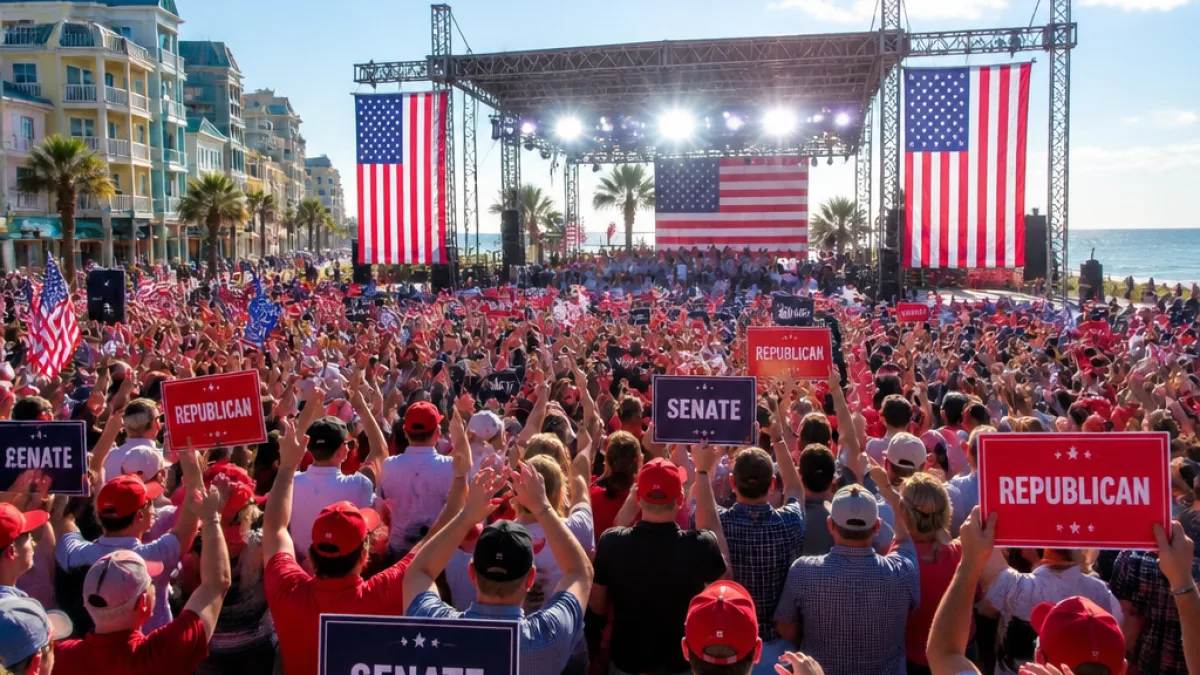
President Donald Trump visited Myrtle Beach on Aug. 21 to deliver an outspoken endorsement of Sen. Darline Graham, urging South Carolina Republicans to back the appointed incumbent in next week’s GOP runoff.
Campaign pitch in a deep-red state
Trump told a receptive crowd that electing Graham would be critical to preventing what he called a progressive Democratic agenda. The president framed the contest as part of a broader national fight, arguing a Graham victory would help Republicans hold ground against Democrats in Congress.
“With your help this November, we are going to stop the radical left, Democrats, communists here in South Carolina and all across the nation, and we are going to elect Senator Darline Graham to fight, fight, fight for South Carolina,”
His remarks came as Graham prepares for an Aug. 25 runoff against U.S. Rep. Ralph Norman, both Republicans, to determine the GOP nominee for the special general election this November. Graham was appointed to the Senate seat by Gov. Henry McMaster after the sudden death of her brother, Sen. Lindsey Graham.
Runoff dynamics and recent debate moment
Graham led the Aug. 11 special Republican primary but did not reach the majority needed to avoid a runoff. According to vote totals from the primary, she received 33% of the vote; Norman finished with 25%, and Rep. Russell Fry tallied 20%. Fry has since endorsed Graham for the runoff.
| Candidate | Primary share |
|---|---|
| Darline Graham | 33% |
| Ralph Norman | 25% |
| Russell Fry | 20% |
The campaign has included scrutiny of Graham’s debate performance, when she stumbled over a national security question — a moment that drew attention in the lead-up to the runoff. Trump defended her handling of the issue at the Myrtle Beach stop, telling reporters that national security has been “his thing” and that Graham was surrounded by capable advisers.
Why the endorsement matters
Trump’s appearance marked a notable on-the-ground effort in a race that will test the reach of his endorsements among Republican voters. While South Carolina is reliably Republican at the federal level — the state has not elected a Democratic U.S. senator in decades — the GOP primary contest has drawn national interest because it follows the unexpected vacancy created by Lindsey Graham’s death.
The president’s event was one of the few in-person campaign stops he has undertaken this year. While he has occasionally campaigned for allies in other states, he has generally limited travel to swing-state engagements and selective endorsements. Local Republican leaders, including Gov. McMaster, backed Graham’s appointment and have signaled support for her in the special election process.
Local context and what voters should know
South Carolina’s Aug. 25 runoff will determine the Republican nominee to appear on the November ballot for the remainder of the Senate term. The seat is widely considered safe for Republicans this fall, but the primary fight has underscored divisions within the state GOP over issues and political alignment.
- Runoff date: Aug. 25
- Key candidates: Darline Graham (appointed incumbent), Ralph Norman (U.S. representative)
- Primary result snapshot: Graham 33%, Norman 25%, Fry 20% (Aug. 11 primary)
Voters in the GOP runoff will decide which Republican advances to the general election in November to fill the vacancy. Both the national and state political implications of the race are receiving attention as campaigns mobilize in the final days before the runoff.
Trump’s stop in Myrtle Beach emphasized loyalty to a candidate he said Lindsey Graham respected. The president used the rally to cast the contest as a frontline in broader partisan battles ahead of the November midterms, while also pressing the local Republican electorate to coalesce behind the appointed senator.
As the runoff approaches, campaign officials for both candidates will continue outreach and mobilization efforts across the state. The outcome will determine who carries the Republican banner into a general election contest expected to maintain the GOP’s strong position in South Carolina’s federal delegation.