
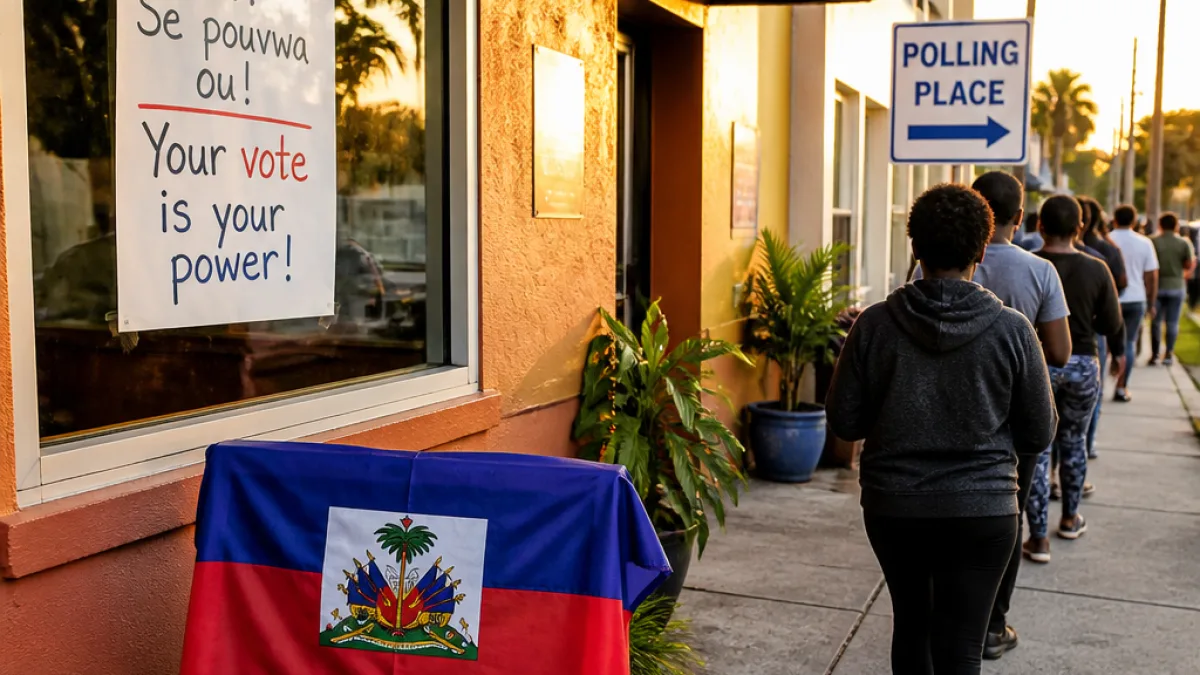
As primary voters head to the polls this week, members of Tampa’s Haitian American community say their choices are being shaped less by party affiliation than by concerns about immigration status, safety in Haiti and the welfare of relatives left there.
Local voters connecting ballots to family ties
For siblings who work at Kreyol Delight, a family restaurant in Tampa, voting represents a personal assessment of which candidates will protect vulnerable immigrants and preserve opportunities for newcomers. Alisa Oscar, 23, a first-time voter from Riverview studying to become a nurse, said she is looking for a candidate who will represent everyone’s interests.
"A person who I feel like is truly trying to represent everyone, trying to make everyone's future good in America,"
The comment captures a frequent refrain in conversations among Haitian Americans across Tampa: elected officials' positions on immigration protections and relief for family members abroad are decisive factors at the ballot box.
Federal policy and conditions in Haiti
Voter concern comes after the Trump administration’s cancellation of Temporary Protected Status for Haitian immigrants — a designation first granted to Haitians in 2010 after a magnitude 7.0 earthquake and extended several times since. That status has allowed many to remain and work in the United States but its cancellation has injected uncertainty into the lives of hundreds of thousands of people with Haitian ties.
Compounding worries are the deteriorating conditions in Haiti. President Jovenel Moïse was killed in July 2021, and the country has lacked a filled presidency since. Violence has surged, with gangs reported to control more than 70% of the capital, Port-au-Prince, and extend operations into other areas. According to the International Organization for Migration, more than 1.4 million people have been displaced. Haiti has been under a national state of emergency since March 2024, and the U.S. Department of State warns Americans not to travel there because of crime, terrorism, kidnapping, unrest and limited healthcare.
How those national and international developments shape local votes
In Tampa, where the U.S. Census Bureau estimates more than 500,000 people of Haitian descent live in Florida, the cancellation of protections and the humanitarian crisis in Haiti are not abstract issues. Voters here often have friends, relatives or neighbors who lack permanent legal status and who may be directly affected by federal policy decisions.
- Immigration status and pathways to residency for family members
- Responses to political instability and violence in Haiti
- Local economic security and access to services for immigrant communities
Those priorities are shaping candidate evaluations in the primary, and voters said they will carry through to the November midterms.
Local consequences and the coming election
For community businesses like Kreyol Delight, concerns about relatives abroad translate into support for candidates perceived as sympathetic to immigrants’ needs. Voters like Alisa said they want leaders who address inequalities here and abroad, and who offer concrete pathways to stability for people with ties to Haiti.
| Item | Figure |
|---|---|
| People displaced in Haiti (IOM) | 1.4 million |
| Port-au-Prince under gang control | >70% |
| Haitians in Florida (U.S. Census Bureau) | >500,000 |
| TPS first granted to Haitians | 2010 |
| Haiti national state of emergency | Since March 2024 |
As Tampa voters cast their primary ballots, many are weighing how candidates' stances on immigration and foreign policy might affect neighbors and relatives who remain vulnerable. The decisions made at the polls this week, community leaders say, will signal how seriously elected officials intend to take the needs of immigrant communities when national and international crises intersect with local lives.
Reporting for this story included interviews with Tampa-area Haitian American residents and references to public statements and data from the International Organization for Migration and the U.S. Department of State.

















