
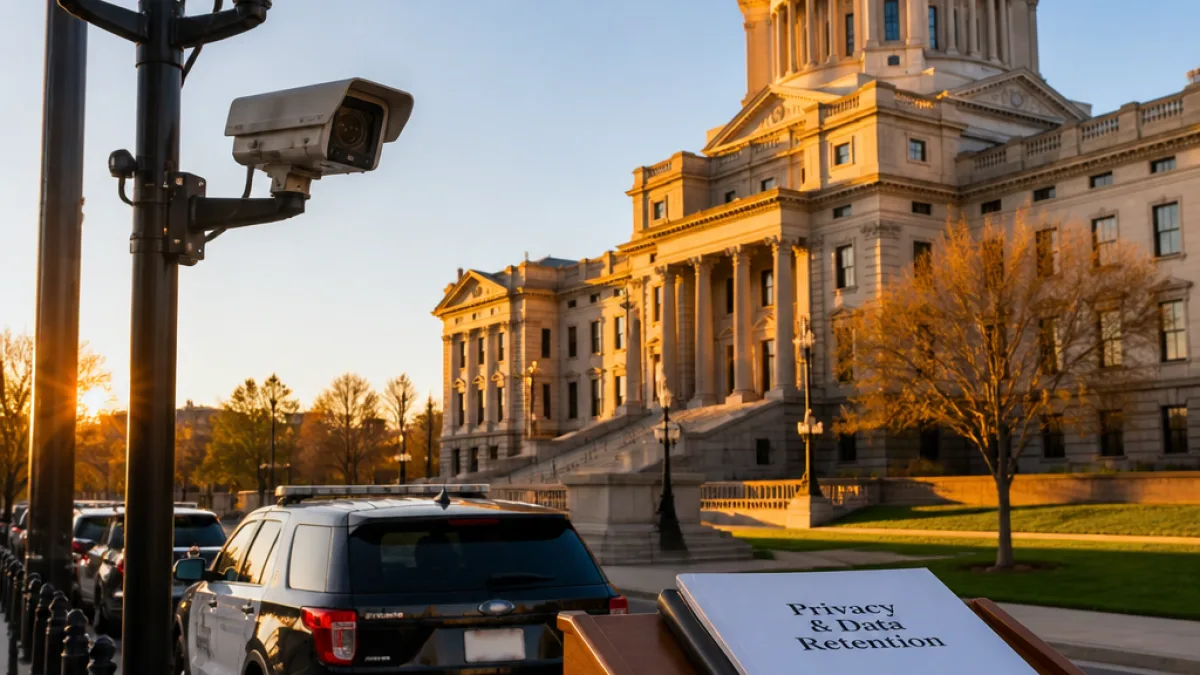
SIOUX FALLS — South Dakota Attorney General Marty Jackley on Wednesday said he will introduce legislation aimed at limiting the use of automatic license plate readers — commonly known as ALPRs or branded systems such as Flock cameras — to “legitimate law enforcement purposes” and instituting statewide safeguards to protect individual privacy.
State-level standards sought for growing technology
Jackley said the proposal is intended to balance the technology’s investigative value with safeguards against misuse. He pointed to cases in which plate-reading networks helped investigators, while acknowledging national concerns about potential abuses of the systems.
“I think this is, because of really what’s happened nationally, something that I think deserves legislative attention and proper legislation that allows law enforcement to use vital tools and has safeguards for private, individual privacy,”
In describing the problem, Jackley cited two high-profile cases in which ALPR data assisted investigations: the search that located a 9-year-old girl abducted in Clark County in 2023, and the inquiry related to the disappearance and death of 14-year-old McKenna Wendel of Sioux Falls, which remains linked to ongoing prosecution. He called the technology “instrumental” in those probes.
Privacy concerns and alleged abuses
National civil rights groups, including the American Civil Liberties Union, have warned that ALPR systems can be used for intrusive surveillance if left unchecked. The concern is that plate data can track individuals’ movements over time or be searched for reasons unrelated to serious criminal investigations — sometimes for personal motives in other jurisdictions, Jackley noted.
“But if you’re doing that, you need to safeguard our privacy, we take that very seriously in South Dakota,” Jackley said, urging lawmakers to build clear rules into law so both the public and law enforcement know the boundaries.
Local use, state oversight
Several South Dakota cities already operate or contract for ALPR systems, according to Jackley. He named Sioux Falls and Madison as municipalities that have employed the technology and said the details of where cameras are installed, how records are kept and who can access them currently rest with local authorities.
| City | Usage noted |
|---|---|
| Sioux Falls | Uses ALPRs in investigations (as noted by state AG) |
| Madison | Uses ALPRs in investigations (as noted by state AG) |
What the proposal aims to address
Jackley did not release specific language of the bill Wednesday, but outlined goals that include:
- Defining permissible, “legitimate law enforcement” uses of ALPR data;
- Establishing retention limits and access controls for plate-read records;
- Creating uniform rules so citizens and local agencies understand safeguards and oversight.
He said he expects the conversation to win bipartisan attention in the Legislature because the measure would preserve a law enforcement tool while protecting privacy.
Questions remain as lawmakers prepare to act
State lawmakers and municipal officials will face several policy choices if a bill is filed: whether to require warrants for certain historical searches, how long agencies may keep plate data, whether to allow private companies that operate camera networks to retain or share records, and what penalties should exist for unauthorized searches.
Jackley indicated decisions about camera placement and day-to-day operation would remain largely local, while calling for statewide rules on retention, access and transparency. He also noted the technology’s investigative value in missing-person and homicide inquiries, reinforcing his view that any restrictions should be narrowly tailored to avoid hampering serious criminal investigations.
Legislative staff and law enforcement leaders will likely begin drafting and vetting technical language in the coming weeks as the next legislative session approaches. The attorney general’s office did not provide draft bill text or a timetable for filing as of Wednesday evening.
As the debate unfolds, South Dakotans will be watching for how state lawmakers reconcile public safety priorities with privacy protections in the use of increasingly common surveillance technology.
















