
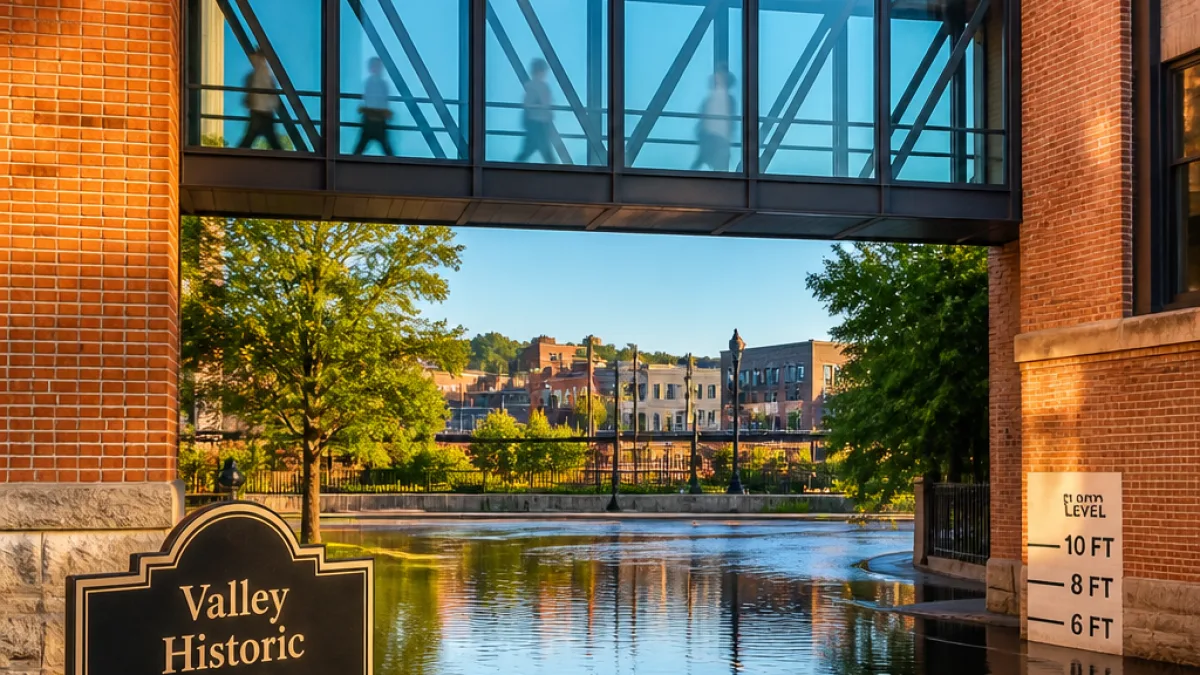
Across New Jersey, an old urban planning idea is making a comeback: the skybridge. Once associated with midcentury efforts to separate pedestrians from street life, the above-ground walkways are being reimagined by developers and engineers to address modern problems such as flood resilience, accessibility and constrained historic districts.
From floodplain workarounds to downtown connections
Proposals for new skybridges have appeared in places that until recently would not have been expected to consider them: the Valley Historic District in Orange, the downtowns of Somerville and New Brunswick, and existing complexes in Newark. The structures are intended less as statement pieces and more as functional infrastructure.
In the Orange project known as Nassau Commons, the building's ground floor can be inundated during heavy storms — sometimes seeing as much as three feet of water at the entrance. To ensure safe egress for residents and to meet regulatory requirements, the developer, Vida Capital, proposed a skybridge that allows pedestrians to traverse above the floodplain and exit into an adjacent building.
"Without this bridge, we would not be able to propose any sort of development due to the fact that this entire property and everything adjacent to it is in a flood zone," said Soufiane El Moussi, an associate at Inglese Architecture + Engineering, who worked on the Nassau Commons project.
The skybridge in Orange is one of at least two proposed in the Valley Historic District. Architects and engineers argue that, in constrained sites where raising total building height or regrading the site is not feasible, above-ground connections can allow projects to meet safety and code standards without sacrificing development potential.
How the current wave differs from midcentury precedents
Skybridges have a long architectural pedigree — the Vasari Corridor in Florence is a 16th-century example — and proliferated in the United States during the mid-20th century. Back then, planners often favored separating pedestrians from street-level commerce and life, reflecting a vision of downtowns as destinations for commuting workers rather than lived neighborhoods.
Today’s proposals emphasize adaptation and resilience. Rather than isolating people from the street, the new skybridges are being pitched as tools to ensure safety in flood-prone properties, maintain access in historic districts, and connect mixed-use buildings in growing downtowns.
- Flood mitigation: Elevates pedestrian passage above expected flood levels when ground-floor access is unsafe or restricted.
- Historic district constraints: Enables projects to comply with preservation rules while providing modern ingress and egress.
- Downtown circulation: Links residential, retail and transit hubs without requiring larger footprints or major grade changes.
Local examples and implications
Newark already has visible skybridge infrastructure, such as the connection between Newark Penn Station and the Gateway Complex. The new proposals extend that language into smaller and midsize communities where rising storm risk and denser development are driving creative solutions.
| Location | Primary purpose |
|---|---|
| Orange (Valley Historic District) | Allow safe exit above floodplain for Nassau Commons residents |
| Somerville | Proposed as part of downtown development (circulation) |
| New Brunswick | Proposed for growing downtown connectivity |
| Newark | Existing examples linking transit and commercial complexes |
The practical consequences extend beyond architecture. For developers, skybridges can unlock projects that regulators might otherwise block because of flood-zone restrictions. For residents, they offer a safer route out during storm events. For planners and preservationists, skybridges can be a compromise that preserves street-level character while solving access challenges.
Questions for planners and neighbors
While proponents highlight safety and feasibility, skybridges can still provoke debate. Critics historically have argued that above-ground walkways can reduce street vitality and create segmented urban experiences. Communities will need to weigh those social impacts against the safety and regulatory benefits.
As New Jersey communities confront higher sea-level rise and more powerful storms, developers and municipal planners are likely to keep experimenting with design approaches that balance resilience, access and historic preservation. Skybridges are emerging as one such tool — practical, visible and sometimes controversial — in the state’s evolving urban playbook.
Reporting on local proposals and planning board reviews will be important in the coming months as specific designs and permits move forward. For now, what once seemed an artifact of midcentury urbanism is being refitted for 21st-century needs, bridging not only buildings but regulatory and safety gaps.
Rohan Iyer is the state correspondent at WE NEWS covering urban development and planning across New Jersey.















