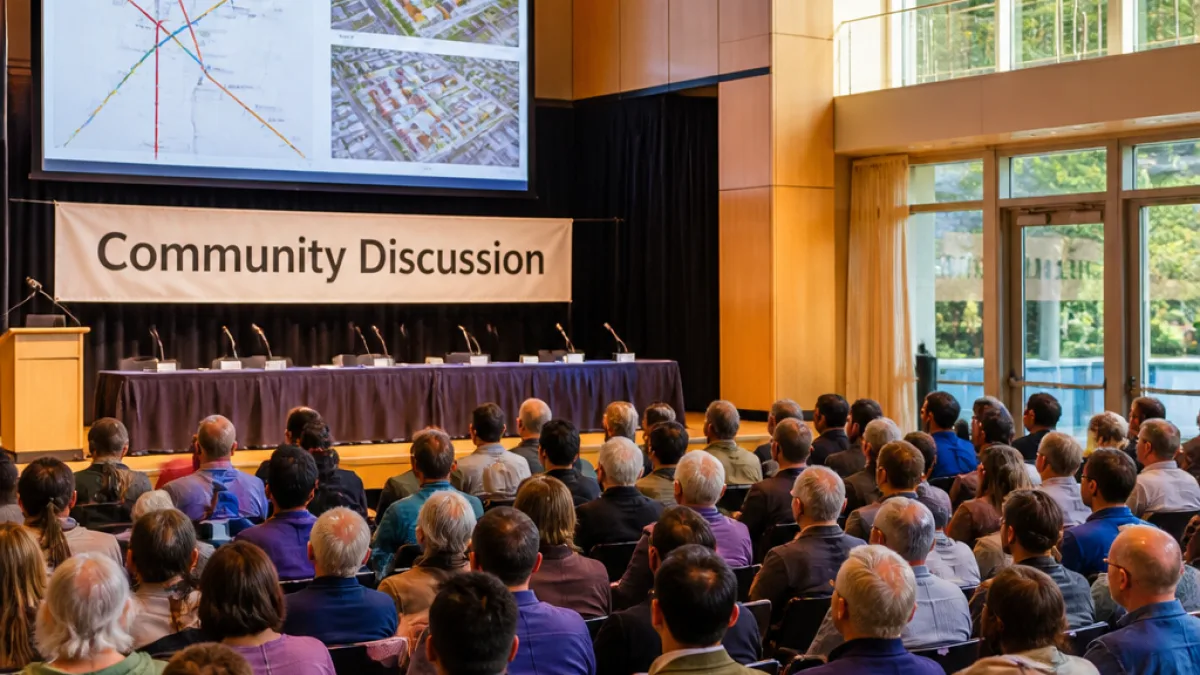
Princeton — State and local officials convened Aug. 5 at the Arts Council of Princeton in a panel discussion that sought to bridge the gap between statewide policy goals and municipal realities, placing emphasis on housing, transit-centric development and making government more transparent and accountable.
Panel stresses interconnected solutions across levels of government
Gov. Mikie Sherrill joined a diverse group of public officials and community leaders for the Jim Floyd Memorial Community Discussion, part of the Joint Effort Princeton Witherspoon-Jackson Community Safe Streets Summer Program. Participants included Mercer County Executive Dan Benson, Princeton Mayor Mark Freda, state Sen. Andrew Zwicker, Mercer County Commissioner Sam Frisby, former Trenton Mayor Douglas Palmer, African American Chamber of Commerce of New Jersey CEO John Harmon, and Mercer County Commissioner candidate Nakia White-Barr.
Panelists framed challenges such as affordable housing, economic opportunity and racial disparities not as isolated municipal problems but as linked issues that require layered solutions. That perspective guided much of the discussion, with officials urging collaboration rather than siloed approaches.
“Here’s my vision: In short, driving costs down, lifting every community up, and building a more transparent, accountable government that helps us do both,”
The governor highlighted several initiatives as examples of that coordinated approach. She pointed to the state-supported NJ Homes Affordable Building Club, which currently includes Princeton, Pennington and Trenton, and a proposal to work with New Jersey Transit to create housing near transit hubs on underused state land, a plan she said could produce 20,000 homes.
Local context and practical hurdles
Speakers at the Arts Council drew attention to the everyday mechanics of intergovernmental work: aligning permitting processes, addressing utility and infrastructure costs, supporting minority- and women-owned businesses, and ensuring municipal finances remain stable. They noted that while communities confront different immediate needs, policy choices in one locality can reverberate across neighboring jurisdictions.
Discussion participants emphasized that building trust and transparency in government operations was central to any effort to reduce costs and expand opportunity. That included simplifying permitting and coordinating services to avoid duplication and to leverage economies of scale.
- Affordable housing: NJ Homes Affordable Building Club membership cited as a model for shared planning.
- Transit-oriented development: a state-NJ Transit plan to develop housing on state property near transit could add thousands of units.
- Government efficiency: calls for streamlined permitting and shared services across municipalities.
Speakers also addressed broader equity concerns, including racial disparities and economic opportunity, underscoring the historical significance of the Witherspoon-Jackson community that the summer program celebrates.
Who spoke and their roles
The panel represented a range of elected and civic voices from across Mercer County and the state. A quick look at attendees and their positions:
| Person | Role |
|---|---|
| Mikie Sherrill | Governor |
| Dan Benson | Mercer County Executive |
| Mark Freda | Princeton Mayor |
| Andrew Zwicker | State Senator |
| Sam Frisby | Mercer County Commissioner |
| Douglas Palmer | Former Trenton Mayor |
| John Harmon | CEO, African American Chamber of Commerce of New Jersey |
| Nakia White-Barr | Mercer County Commissioner candidate |
The breadth of representation was intended to reflect the need for policymakers at every level to coordinate on long-term planning, especially when tackling housing supply and the costs of living that affect residents across municipal borders.
What this means for residents
For homeowners, renters and small-business owners in Mercer County and neighboring towns, the conversation signaled a push toward policy tools that could lower housing and utility costs and expand opportunities for minority- and women-owned enterprises. A state-led push to site housing near transit could also change local development patterns, bringing new residents and transit usage while raising questions about infrastructure and municipal capacity.
Panelists repeatedly returned to the idea that successful implementation will depend on clearer communication, more transparent processes and practical steps to coordinate services — from permitting to shared municipal programs.
The Jim Floyd Memorial Community Discussion, part of a nine-day local summer program, offered a public forum for those questions but stopped short of establishing a formal roadmap. Attendees left with a reinforced sense that policy wins will require both statewide ambition and local follow-through.
Coverage of these initiatives and any subsequent proposals or local actions will be key to tracking how — and whether — the ideas discussed in Princeton translate into concrete changes across Mercer County and beyond.