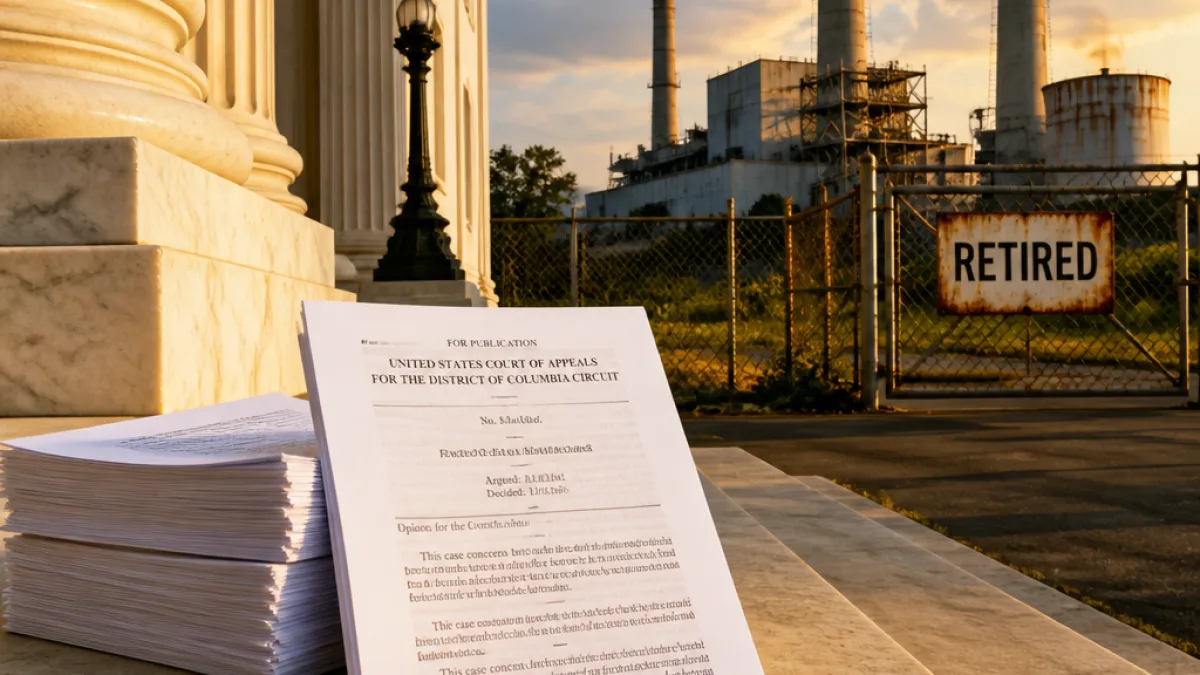
WASHINGTON — A federal appeals court on Friday unanimously ruled that the U.S. Department of Energy exceeded its authority when it ordered a Michigan coal-fired power plant to remain in operation beyond its scheduled retirement, finding no legal basis for invoking emergency powers.
Court finds no true emergency
The U.S. Court of Appeals for the District of Columbia Circuit sided with a coalition of environmental groups and three states that challenged the department’s order. The panel concluded the statute the department relied on is a narrow tool meant for immediate, last-resort action — circumstances that the court determined were not present in this case.
"[The statute] is essentially a narrow, last-resort backstop," Appeals Court Judge Cornelia Pillard wrote for the unanimous three-judge panel, adding that the emergency authority is "triggered only when there is a need for immediate, essentially last-resort action."
Judge Pillard also warned that reversing a plant’s "long and carefully planned retirement" is disruptive and that federal emergency authority should not displace the responsibilities of states in ensuring resource adequacy.
State officials and advocates welcome the ruling
Michigan Attorney General Dana Nessel, a plaintiff in the case, reacted strongly to the decision, saying the order lacked legal merit and public purpose. Her office characterized the department’s intervention as an improper use of power that overlooked state authorities and local planning.
The challenge to the department’s order was not limited to Michigan. Illinois and Minnesota joined the lawsuit, and environmental organizations that had pushed for the plant’s retirement argued the emergency invocation was a pretext to prop up coal generation despite long-planned closures and concerns about costs and health impacts.
Broader litigation over similar orders
The Michigan case is among several legal contests across the country in which the Energy Department used the same emergency provision to direct multiple coal-fired plants to keep operating. The administration’s orders affected facilities in several states as it argued they were necessary to maintain reliability in regional electrical grids.
Opponents said the moves could raise costs for ratepayers and undermine efforts to reduce pollution. The appeals court’s decision limits the department’s ability to unilaterally keep plants running where states and regional grid operators had planned for retirements and replacements.
- Ruling: D.C. Circuit unanimously reversed DOE order for Michigan plant.
- Legal basis: Emergency authority under the Federal Power Act deemed a narrow, last-resort power.
- Parties: Challengers included Michigan, Illinois and Minnesota, plus environmental groups; DOE acted through its secretary.
What the decision means locally
For Michigan residents, the ruling affirms that long-term planning by utilities and state regulators cannot be overturned lightly by a federal emergency order. The decision reinforces the role of states and regional grid authorities in managing resource adequacy and retirement schedules for generation assets.
Legal analysts say the opinion places limits on when the federal government can step into energy market decisions — a point likely to shape future disputes over plant retirements, reliability claims and grid planning. Utilities that have been ordered to keep older units online may now press to proceed with previously scheduled retirements, subject to regulatory approvals and grid operator determinations.
Key facts at a glance
| Issue | Detail |
|---|---|
| Court | U.S. Court of Appeals for the D.C. Circuit |
| Parties challenging DOE | States: Michigan, Illinois, Minnesota; environmental groups |
| Legal point | Emergency authority under the Federal Power Act is narrow and last-resort |
The decision comes amid wider national debate over the future of coal-fired generation, reliability standards and how to balance grid stability with environmental and public health concerns. Advocates for retirements say modernizing the grid and investing in lower-emission resources is essential; supporters of the department’s actions argued certain plants were needed to maintain electric reliability.
With the appeals court now setting limits on the department’s emergency powers, state officials and utilities will likely return to established regulatory and planning processes to address reliability questions. The ruling also leaves open potential appeals or further litigation on other orders issued under the same authority.
As the legal and policy ramifications unfold, Michigan officials said they will continue to press their case that federal emergency authority cannot be used to override state-led energy planning and the public interest.
Aaliyah Freeman is the state correspondent for WE NEWS.