
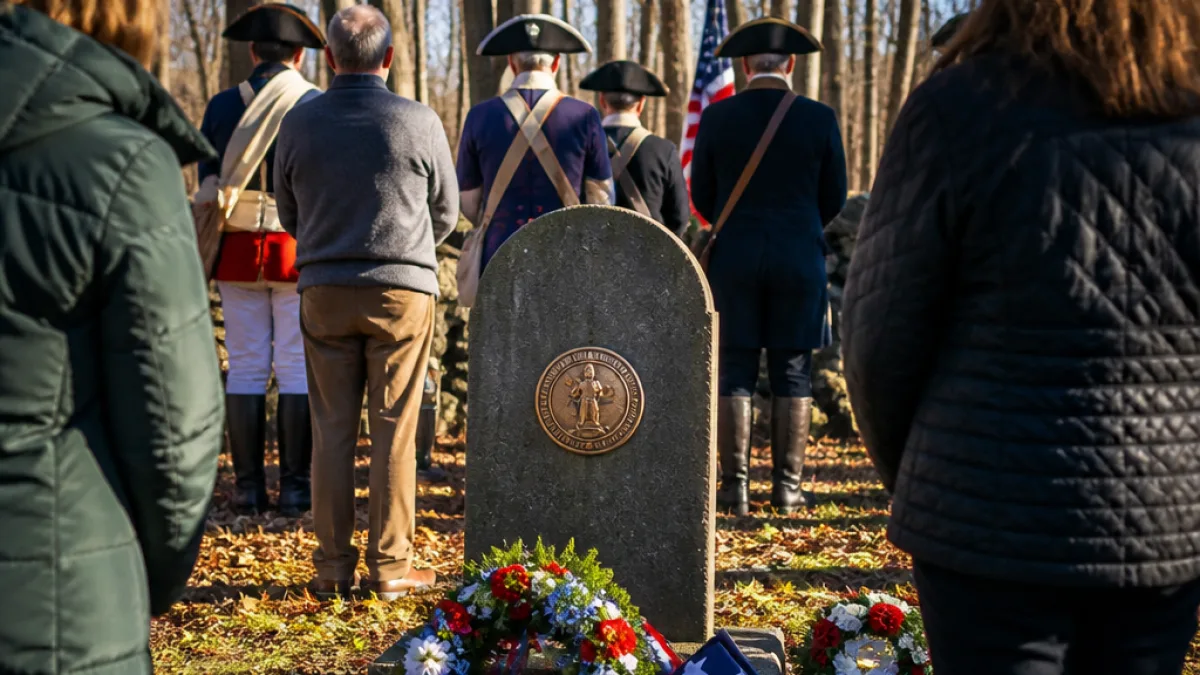
SHARON — A small cemetery in Windsor County became the site of a transatlantic piece of Revolutionary War remembrance Monday when historical reenactors and relatives gathered to honor Anthony Morse, identified as a participant in the Boston Tea Party.
The event was part of the Boston Tea Party Marker Project, an initiative that locates and marks the graves of people who took part in the 1773 protest. The project, launched in 2018, has placed commemorative medallions at the burial sites of participants across the United States and, organizers say, even overseas.
Local crowd and descendants at Pine Hill Cemetery
The ceremony at Pine Hill Cemetery in Sharon included historical reenactors who traveled from Boston and a turnout of family members, including Doris Backus, the cemetery’s president. Organizers said the meeting connected community members with their own place in Revolutionary history when Backus realized she is a direct descendant of the man being honored.
“It's about people being able to say, hey, we have somebody in our town who was at the Boston Tea Party. I mean, how cool is that?”
The quotation above came from Jonathan Lane, executive director of Revolution 250, an organization involved in promoting Revolutionary-era remembrance. Project officials described the experience of notifying families and hosting ceremonies as one of the most meaningful elements of their work.
Project reach and significance
Kristin Harris of the Boston Tea Party Ships & Museum, which operates the Marker Project, said teams have traveled widely to install markers. In addition to sites around the United States, organizers have placed markers in Ireland and Paris, the museum said. To date, about 120 Boston Tea Party participants have been recognized, with roughly 40 more graves remaining on the project’s list.
According to Harris, one of the most rewarding moments for the project is making families aware of their ancestors’ roles in the Revolution. That element of connecting living communities to the past was on display in Sharon, where Backus and several relatives attended the marker ceremony.
What happened at the Sharon ceremony
- Historical reenactors from Boston participated in Monday's observance in Sharon.
- Project leaders located Anthony Morse’s gravesite at Pine Hill Cemetery after researching records and family correspondence.
- Doris Backus discovered she is a fourth-great-granddaughter of Morse and attended with other relatives.
- A commemorative medallion from the Boston Tea Party Marker Project was placed to identify Morse’s role in the Revolution.
Organizers said Morse’s participation in the Boston Tea Party was documented in letters from his son. The project uses such documentary evidence to verify involvement before placing markers.
| Item | Figure |
|---|---|
| Project launch year | 2018 |
| Honored participants to date | 120 |
| Additional graves identified | ~40 |
For community members in Sharon, the ceremony offered a tangible link between their town and a seminal act of colonial protest. Backus said the connection felt personal and surprising when she learned of her family tie to Morse.
Project leaders noted they continue to research and locate final resting places for those known to have taken part in the Boston Tea Party, with the goal of providing recognition and historical context in the communities where these participants are buried.
The Sharon ceremony underscores how local cemeteries and family records can surface previously overlooked ties to national events, and how museum and nonprofit initiatives are working to make those connections visible to the public.


















