
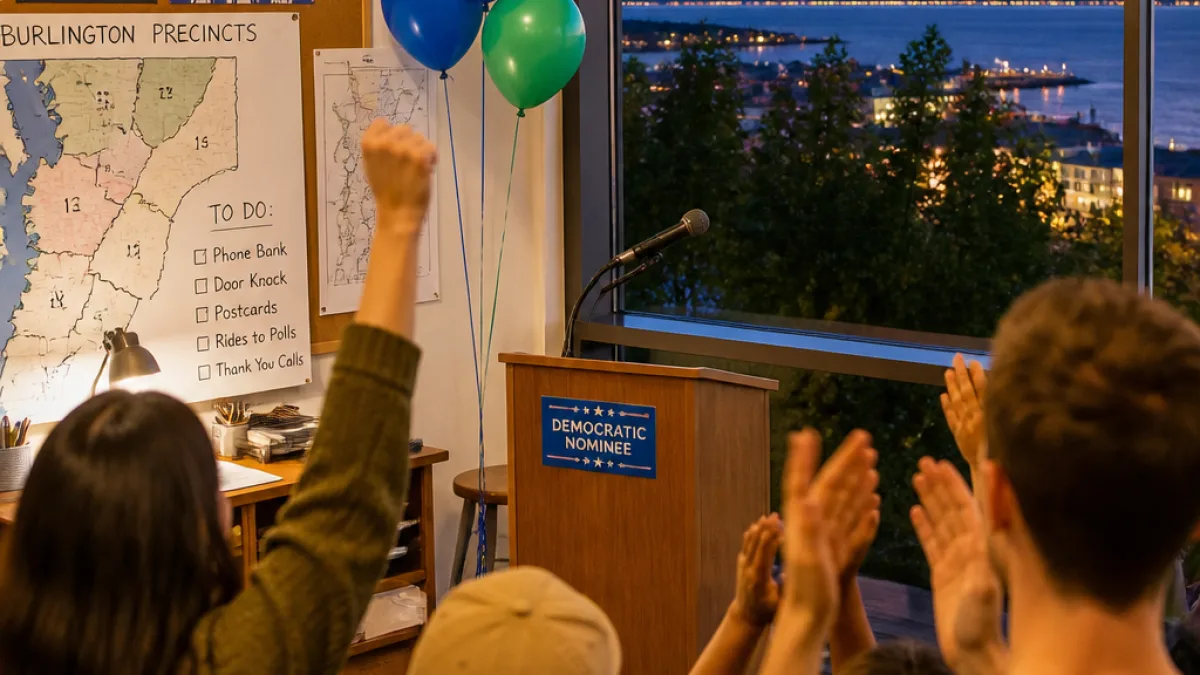
BURLINGTON — Amanda Janoo, a 38-year-old economist and political newcomer, secured the Democratic nomination for Vermont governor Tuesday, mounting a surprise victory that pits her progressive platform against five-term Republican Gov. Phil Scott in the November general election.
Grassroots surge tops better-known opponent
Janoo entered the race in March with little public profile but attracted a rapid and enthusiastic following by promising bold changes to state policy and financing. With about 97% of the vote reported Tuesday night, she led her lone primary opponent, Aly Richards, by roughly 2.7 percentage points, according to Vermont Public's initial tallies.
Her campaign emphasized a plan to expand health care access through higher taxes on top earners and spoke to broader ambitions to overhaul economic and political structures in the state. Supporters said that approach energized voters who wanted more systemic change.
"As an economist, I know that money is power, but as a Vermonter, I know that money is not the only kind of power. Knowledge is power, trust is power, democracy is power, and community is power," Janoo told supporters Tuesday night in Burlington.
Her remarks at a mixed-use arts space in Burlington reflected a message that blended technocratic credentials with community-focused rhetoric. The win capped a short but intense campaign that relied heavily on grassroots organizing and small-dollar donations.
What the result means for the general election
Janoo now faces Gov. Phil Scott, who is seeking a sixth term and crushed opponents in previous general elections — securing more than 70% of the vote as recently as 2024. Scott is widely viewed as a moderate Republican who has held broad appeal across party lines in Vermont.
Democrats must now rally behind a candidate who, while energetic among progressive voters, will need to expand her appeal to centrists and independents in a state where a popular incumbent has been electorally resilient. Her proposals to raise taxes on high earners to fund single-payer-style health benefits will be a focal point in the campaign — both as a potential mobilizer of liberal voters and as a line of attack for Republicans.
Reactions across the state
At a Montpelier polling site Tuesday morning, Capital City resident Eli Robinson described Janoo as "the most refreshing activist we’ve had run for political office since Bernie," saying he believed her ideas could propel innovation in Vermont's small communities. Aly Richards, who ran a more conventional Democratic campaign, left her watch party without addressing supporters but issued a written statement congratulating Janoo and offering support.
Party strategists and political observers noted that while Janoo’s victory shows the energy behind progressive ideas, it also raises organizational challenges for Democrats heading into November. The statewide party will need to coordinate messaging and fundraising quickly to position Janoo for a competitive race against an incumbent with deep name recognition.
- Candidate: Amanda Janoo, 38, economist with United Nations experience
- Primary result: Janoo led by approximately 2.7 points with 97% reporting
- Next milestone: General election in November against Gov. Phil Scott
Vote snapshot
| Item | Figure |
|---|---|
| Vote reporting (approx.) | 97% |
| Janoo's margin | ~2.7 percentage points |
Campaign watchers said the coming months will test whether Janoo’s message can translate into broader support across Vermont’s diverse electorate. Her background as an economist with international experience, including work with the United Nations, has been central to her appeal with voters who valued both policy knowledge and outsider credentials.
Democratic leaders in Vermont will now balance assisting their nominee while emphasizing the party’s broader priorities in a state where ticket-splitting is common and incumbency advantage is substantial. The general election will be a referendum not only on Janoo’s proposals but also on Gov. Scott’s record and Vermont’s political direction.
Vermonters can expect intensive campaigning over the coming weeks, with debates, policy rollouts and fundraising drives shaping how the two candidates position themselves ahead of November’s vote.
This race will be among the most closely watched statewide contests in New England this year, as both parties assess strategies in a state that has produced both progressive experiments and moderate Republican governance in recent cycles.
Reporting from Burlington. — Elliot Vance, State Correspondent

















