New affordable building replaces shelter site near Main and S. Winooski
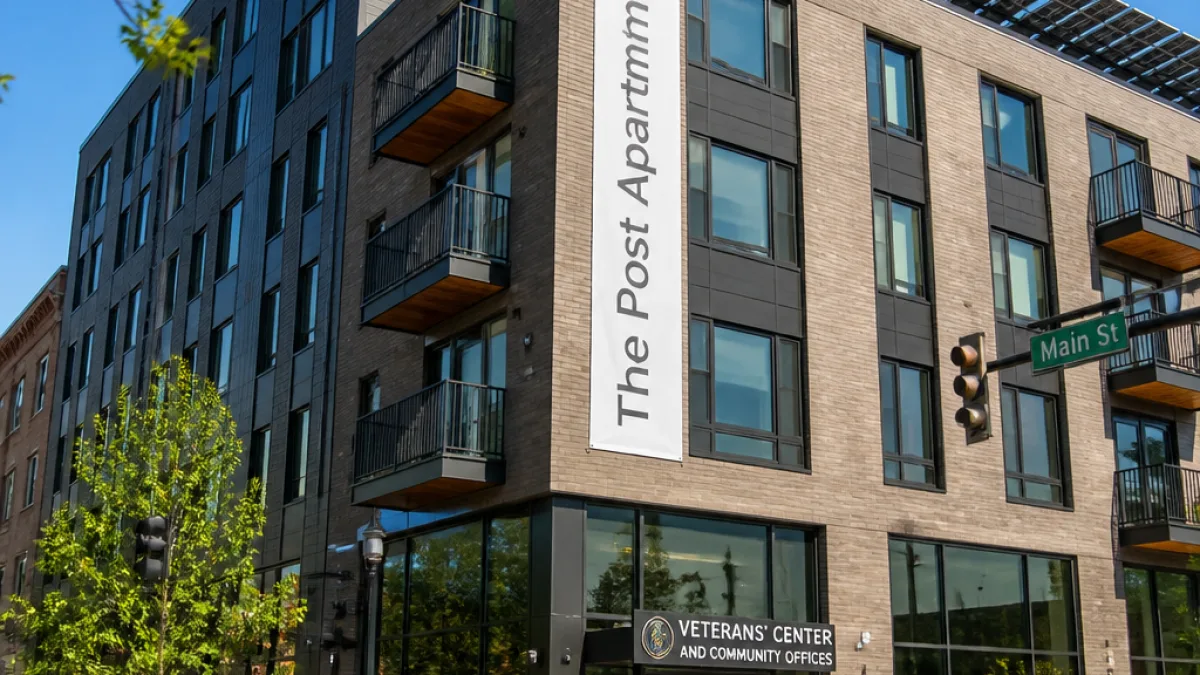
Downtown Burlington gained 38 units of permanently subsidized housing with the opening of The Post Apartments, a five-story development created by Champlain Housing Trust and Evernorth that stands on the former site of a veterans’ hall and a homeless shelter. Developers, city officials and federal lawmakers gathered Sept. 4 for a ribbon-cutting ceremony marking the completion of what supporters say is an infill project built to address long-standing housing needs in the city.
The $24 million project includes a mix of unit sizes: eight efficiency apartments, 26 one-bedroom units and four two-bedroom units. Of those, nine apartments are reserved for people transitioning out of homelessness and ten carry Section 8 vouchers, which generally limit tenant rent contributions to about one-third of income. Monthly rents at the building start at $1,160, and the structure is already fully occupied, officials said.
- Developed by: Champlain Housing Trust and Evernorth
- Cost: $24 million, including a $1 million federal earmark
- Units: 38 (8 efficiencies, 26 one-bedrooms, 4 two-bedrooms)
- Special allocations: 9 for those exiting homelessness; 10 with Section 8 vouchers
The project received $1 million in federal funding that U.S. Sen. Bernie Sanders helped secure. At the ceremony he framed the development as a model for local and national responses to what he described as an extensive housing crisis.
“In the city of Burlington, in the state of Vermont, in the United States of America, we have a massive, massive housing crisis,” Sanders said. “Maybe instead of spending hundreds of billions of dollars fighting a war that we never should have gotten in, we might want to be investing in low-income and affordable housing.”
Services, sustainability and site challenges
The ground floor of the five-story building is home to a new veterans’ center and office space for the Chittenden County Community Justice Center, integrating social services and community programs into the downtown footprint. The building was finished earlier this year and is fully occupied, according to project officials.
Designed as an all-electric building, The Post also features a roof-mounted solar array. Organizers emphasized the sustainability elements at the opening, saying they align with municipal and regional goals to reduce building emissions.
The site, near the intersection of Main Street and South Winooski Avenue, presented construction challenges common to downtown infill projects, including limited lot area and contaminated soils. The location sits next to a gas station and close to other legacy industrial parcels, complicating excavation and site preparation, developers said.
Local impact and next steps
City housing advocates hailed the project as an important addition to the affordable-stock pipeline at a time when Burlington and the broader region continue to struggle with rising rents and limited availability of subsidized units. Because the apartments are subsidized in perpetuity, organizers said the units will remain affordable long-term rather than reverting to market-rate housing.
Officials did not announce additional immediate projects at the ribbon cutting, but leaders noted that infill developments like The Post are one approach to increasing supply without expanding the city's footprint. The mix of supportive housing, accessible rents through vouchers and on-site service space is intended to reduce barriers for residents who have experienced housing instability.
| Feature | Detail |
|---|---|
| Developer | Champlain Housing Trust & Evernorth |
| Cost | $24 million |
| Federal contribution | $1 million (earmarked) |
| Unit types | 8 efficiencies, 26 one-bedrooms, 4 two-bedrooms |
| Special designations | 9 units for people exiting homelessness; 10 units with Section 8 vouchers |
As Burlington considers how to expand affordable housing supply while managing downtown development constraints, The Post offers a local example of converting underused or formerly service-oriented sites into permanent housing. For residents and service providers, the building’s mix of housing and on-site programs could shape how the city meets the needs of veterans and people transitioning from homelessness in the months and years ahead.