
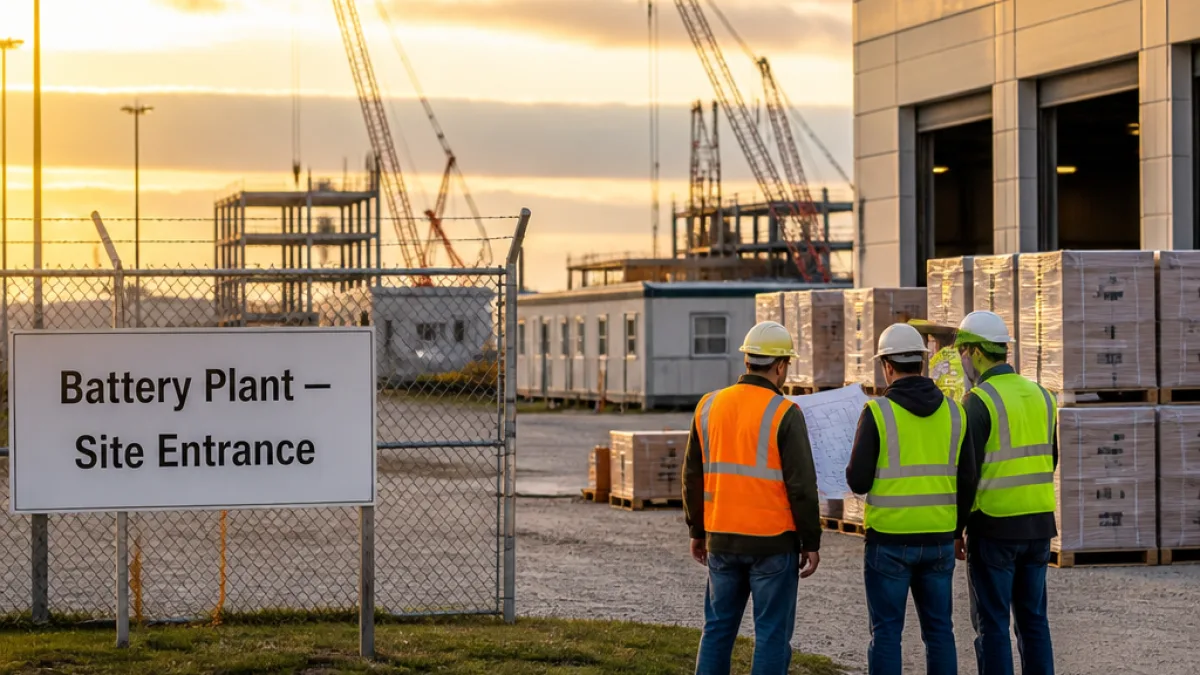
Samsung SDI announced Tuesday that it will end its joint venture agreement with General Motors Co. in Indiana by purchasing GM’s 49.99% stake, a move the South Korean battery maker said responds to softer-than-expected electric vehicle (EV) demand.
The company said in a regulatory filing that the joint venture, previously structured as a partnership, will become a wholly owned unit under the name SDI-GM Synergy Cells Holdings. Samsung SDI said it will reposition the unit to supply batteries for a wider array of markets, including energy storage systems and EVs, but did not provide a detailed revised investment plan.
Reason for shift and next steps
Samsung SDI cited market changes since the joint venture was announced two years ago, specifically pointing to a slower-than-expected ramp in EV demand. The company said it and GM had agreed to pursue other forms of cooperation rather than continuing the joint venture.
"The ownership change was made in consideration of market changes since the joint venture was announced – including the slower-than-expected growth of EV demand. The two partners have now decided to seek other forms of cooperation other than the joint venture,"
Samsung SDI added that it has signed a separate agreement with GM to jointly develop next-generation prismatic batteries for possible future EV use. The company said it will make further disclosures as required by regulators, but provided no timeline for when production might begin under the new ownership structure.
Local and regional context
The decision follows a string of adjustments across the automotive and battery industries as makers and suppliers recalibrate production to align with softer consumer demand and policy shifts. In May, GM announced it was pausing completion of a planned $3.5 billion plant tied to the joint venture, citing lower-than-expected EV market growth.
Industry moves elsewhere also reflect the same pressures: earlier this year, GM and LG Energy Solution transformed a Tennessee battery plant project to focus on energy storage systems rather than EV modules.
Samsung SDI’s announcement does not specify how the ownership change will affect construction timelines, workforce plans or local contracting tied to the Indiana project. The company said its existing investment plan will change but has not finalized details.
Why this matters for Indiana
The joint venture had been positioned as part of a broader national push to expand domestic battery production to support EV adoption and grid storage. Changes to the venture’s structure and timetable could ripple through local suppliers, construction firms and the workforce pipeline that state and regional economic development leaders have been cultivating.
- Ownership change: Samsung SDI will acquire GM’s 49.99% stake, converting the venture into a wholly owned subsidiary.
- Market drivers: The companies pointed to slower EV demand growth as a key reason for restructuring the partnership.
- Ongoing cooperation: Samsung SDI and GM agreed to jointly develop next-generation prismatic batteries.
Timeline of key public developments
| Date / Period | Development |
|---|---|
| About two years ago | Joint venture between Samsung SDI and GM announced (initial plan included ~27 GWh annual capacity). |
| May 2026 | GM paused completion of the planned $3.5 billion plant, citing lower EV demand. |
| Aug. 11, 2026 | Samsung SDI files to buy GM's 49.99% stake and convert the venture to a wholly owned unit. |
Broader industry shifts
Automakers and battery suppliers across the U.S. have been scaling back or redesigning EV projects since the loss of a $7,500 federal consumer tax credit last September, which affected buyer incentives and contributed to softer demand. While companies continue producing and selling EVs, many have lowered factory output to match current market levels.
Analysts and industry participants have noted that converting or pausing projects can preserve capital and allow companies to shift capacity toward stationary storage or other battery applications that are seeing more immediate demand.
What remains unclear
Samsung SDI has not disclosed the specific investment or production timeline changes it plans for the Indiana unit, nor has it detailed implications for site construction, hiring or supplier contracts. The company said further disclosures will follow regulatory requirements.
For Hoosiers tracking the future of battery manufacturing and EV supply chains in Indiana, Tuesday’s filing signals a meaningful reorientation of a high-profile project and underscores the volatility still shaping the industry.
















