
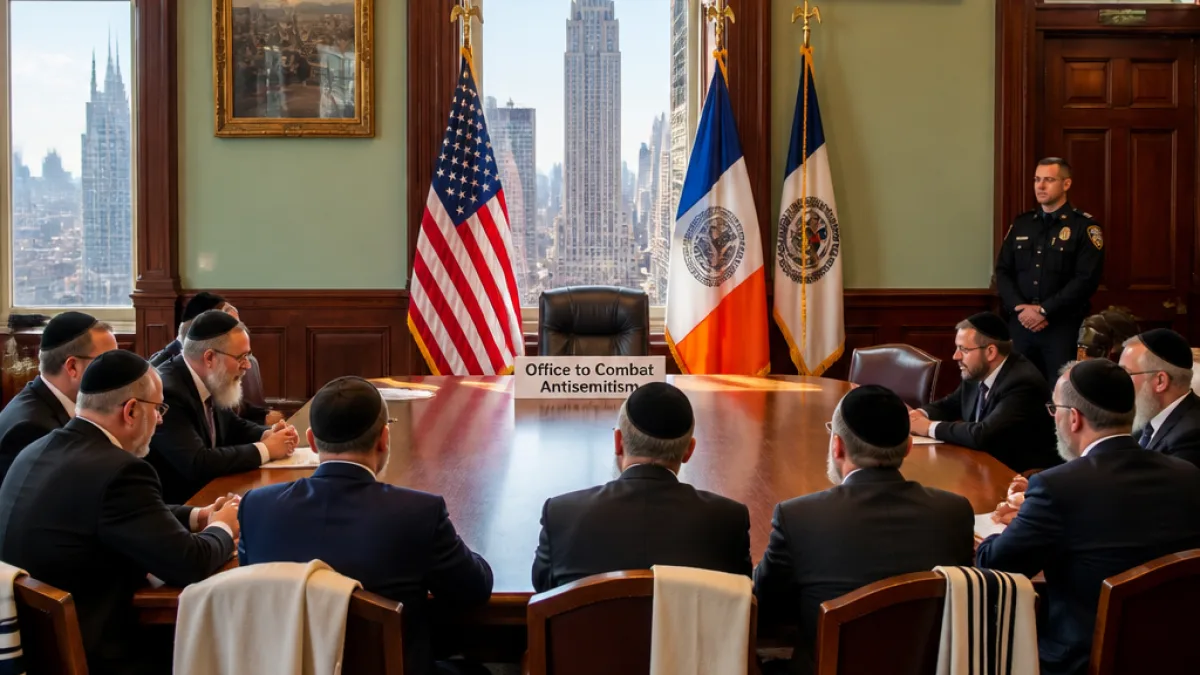
Ten leading New York rabbis representing Reform, Conservative and modern Orthodox communities urged Mayor Zohran Mamdani in a private City Hall meeting to change the tone of his public remarks about Israel and to step up work on antisemitism and synagogue security, participants said.
The hourlong session, convened by the Mayor’s Office to Combat Antisemitism, brought together clergy who described the exchange as candid but respectful. Attendees told reporters they did not present a unified political position on Israel; instead, they expressed a range of views about how the mayor should address the issue as the city's chief executive.
Calls for nuance and clearer condemnations
Some rabbis asked Mamdani to temper his public criticism of the Israeli government, while others suggested he avoid emphasizing Israel-related matters and concentrate on municipal responsibilities. Several participants urged the mayor to make more consistent public statements condemning Hamas and to avoid language that leaves Jewish New Yorkers feeling targeted or held responsible for the actions of a foreign government.
“If instead of vilifying Israel, you spoke constructively, in measured tones, that would move the needle more than anything else, and I’m hopeful you’ll use that power.”
The remark above was attributed to Rabbi Rick Jacobs, president of the Union for Reform Judaism, who said he told the mayor that his words carry significant weight and could alter the city's atmosphere.
Security and community relations at center stage
Participants also pressed the administration to devote greater attention to antisemitic incidents and the security needs of synagogues across the five boroughs. The meeting was organized through the mayor’s office that specifically focuses on combating antisemitism, an office created in recent years as New York has seen heightened concerns about hate crimes affecting the Jewish community.
One rabbi, speaking on the condition of anonymity because the session was private, told The New York Times that despite diverse perspectives, there was broad agreement that the relationship between the mayor and segments of the city's Jewish community requires repair.
What was said — and what was not
Meeting attendees did not coalesce around a single policy demand on Israel. Some advocated that Mamdani soften his criticism; others said the mayor should refrain from commenting on the matter and focus on issues within his direct authority. A number of participants expressed support for the mayor’s right to criticize Israeli leaders but asked for more balanced public language, including frequent, explicit condemnations of Hamas.
The discussion underscores the complex politics facing New York’s first Muslim mayor, who has been a longtime critic of Israel and whose remarks on the subject have at times strained relations with parts of the Jewish community.
Meeting details
| Item | Detail |
|---|---|
| Participants | 10 Reform, Conservative and modern Orthodox rabbis |
| Convening office | Mayor’s Office to Combat Antisemitism |
| Length | Approximately one hour |
What this means for New Yorkers
The meeting is likely to reverberate across congregations and community organizations that monitor antisemitic incidents and communal safety. Leaders emphasized that tone and public messaging from elected officials can affect daily life for minority communities, shaping whether residents feel secure in public and at houses of worship.
For municipal officials, the exchange highlights competing responsibilities: protecting free expression while addressing the security and safety concerns of vulnerable populations. How the administration responds could influence outreach and trust between City Hall and Jewish institutions.
- Who met: 10 rabbis from multiple denominations and the mayor’s antisemitism office.
- Primary asks: more nuanced comments on Israel, consistent condemnation of Hamas, and greater focus on synagogue security and antisemitism.
- Tone of meeting: described by participants as candid and respectful, with no single political demand agreed upon.
City Hall has not publicly released a transcript of the private session. Officials and community leaders will likely continue talks in the coming days and weeks as both sides seek common ground on security measures and how municipal leaders should address contested foreign-policy issues in local discourse.
— Camille Rousseau, State Correspondent, WE NEWS
















