
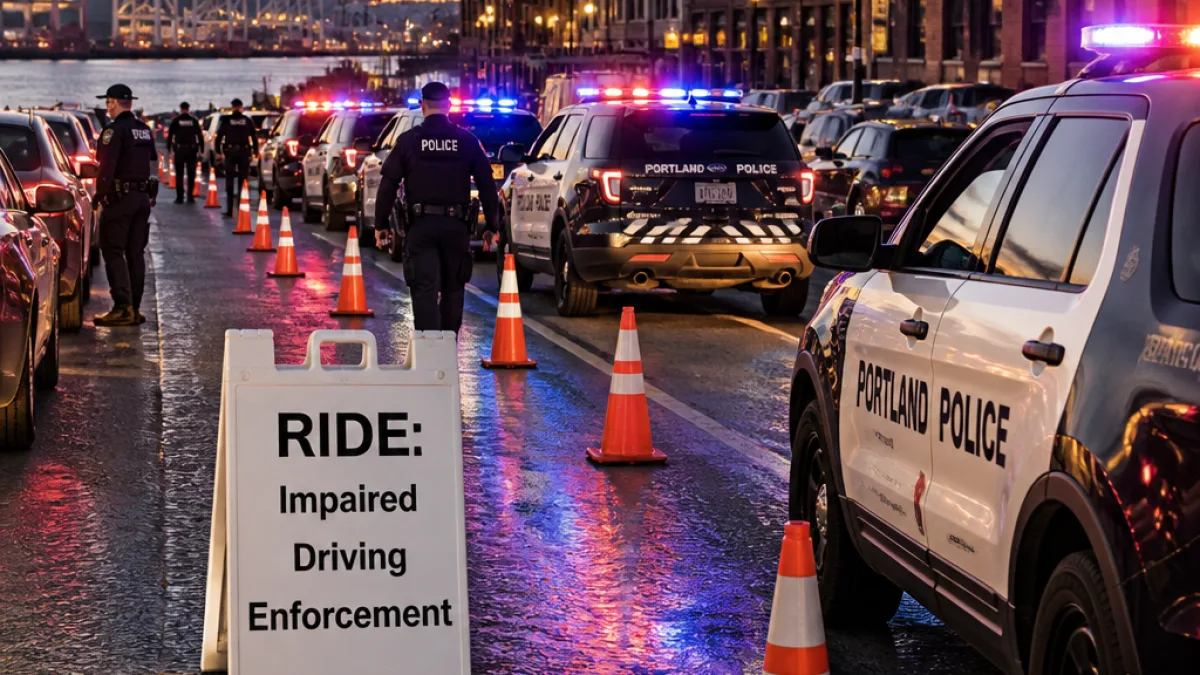
Portland police will join a coordinated statewide enforcement effort aimed at reducing impaired driving, city officials announced Thursday, as state data show Maine averages more than 1,200 impaired-driving crashes annually and that nearly 40 percent of drivers involved in fatal collisions tested positive for impairing substances.
Targeted enforcement under the RIDE program
About 10 Portland officers will take part in the Maine Bureau of Highway Safety’s Regional Impaired Driving Enforcement, or RIDE, initiative, officials said. The program pairs officers from multiple agencies and deploys them to locations selected using crash and enforcement data that indicate higher risks of impaired-driving incidents.
- Increase patrols and checkpoints in data-identified high-risk areas.
- Coordinate multiagency stops and enforcement to catch impaired drivers.
- Support Portland’s Vision Zero strategy to eliminate traffic deaths and serious injuries.
The Portland Police Department described the operation as one element in a broader push to make the city’s roadways safer for motorists, cyclists and pedestrians. Officials have not released specific dates, times or locations for the increased enforcement.
"These efforts are part of our continued commitment to improving roadway safety and addressing behaviors that put motorists, pedestrians, and other roadway users at risk," Portland Police Chief Mark Dubois said.
RIDE is run jointly by the Maine Bureau of Highway Safety and the Maine Chiefs of Police Association. John Roma, the RIDE team coordinator for Dirigo Safety, emphasized the need for multiagency action to change behavior.
"We know that impaired driving remains a leading cause of traffic fatalities, and that it takes a coordinated, multiagency approach to make a real impact," Roma said. "By working together, we can send a clear message: impaired driving will not be tolerated."
Local implications and context
Portland’s participation in the RIDE initiative ties directly to the city’s Vision Zero program, which seeks to eliminate traffic deaths and serious injuries through enforcement, engineering and education. City leaders have increasingly pointed to enforcement campaigns as one tool among several — alongside infrastructure changes and public awareness efforts — to meet that goal.
Traffic safety advocates say enforcement can have immediate effects on driver behavior, but stress that long-term reductions in crashes require coordinated investments. Portland has been implementing pedestrian safety improvements and traffic-calming measures in recent years; RIDE expands the city’s strategy by focusing resources on impaired-driving deterrence.
Officials provided two key statistics to explain why the campaign is necessary: Maine’s three-year average of impaired-driving crashes exceeds 1,200 per year, and nearly 40 percent of drivers involved in fatal crashes tested positive for an impairing substance. The numbers mirror national concerns about the role of drugs and alcohol in road deaths and underscore the emphasis on targeted enforcement.
| Metric | Reported figure |
|---|---|
| Annual impaired-driving crashes (3-year average) | >1,200 |
| Drivers in fatal crashes testing positive for impairing substances | Nearly 40% |
While the Portland Police Department said the effort is part of a statewide plan, it did not specify how long the increased enforcement would last or whether such deployments will be ongoing. The lack of announced dates or checkpoints is consistent with some enforcement strategies that avoid pre-publicizing exact locations to maximize deterrence.
Local residents can expect increased patrol activity in certain areas and are encouraged to report suspected impaired drivers to authorities. The police department reiterated that enforcement is only one element in reducing crashes and called for continued community cooperation and education to address the problem.
As the RIDE campaign proceeds, Portland officials said they will continue to coordinate with state and regional partners to align enforcement with broader safety projects, with the stated aim of reducing the number of serious and fatal crashes on city streets.
















