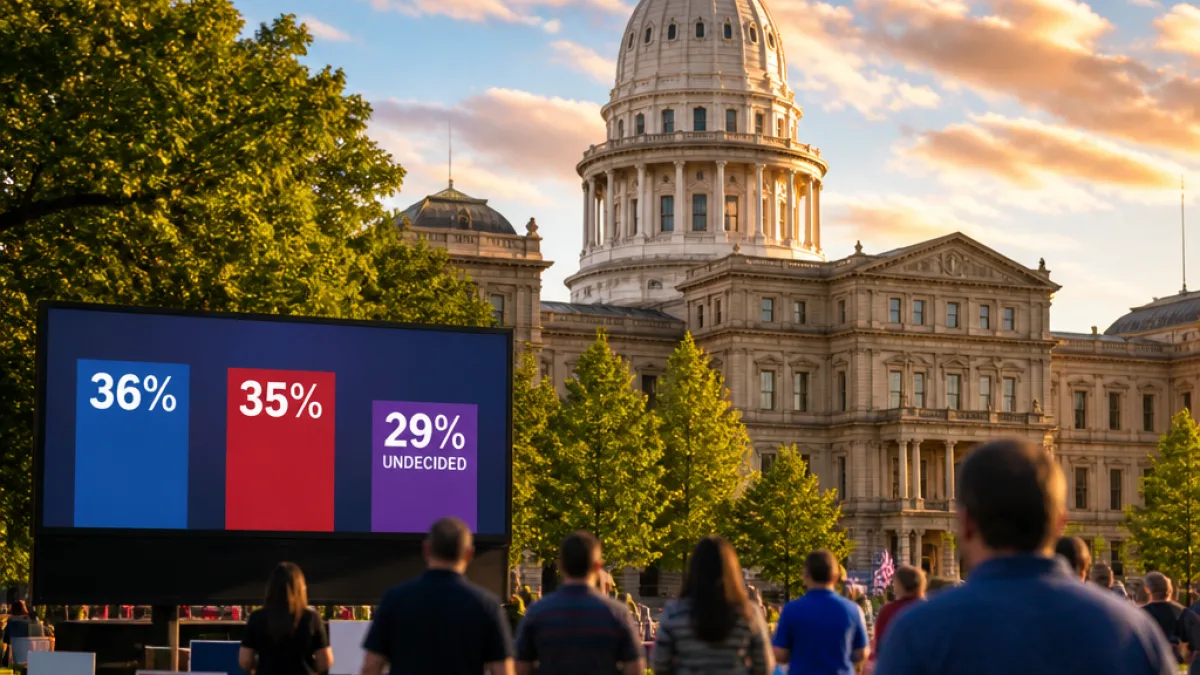
The latest Detroit News/WDIV poll released Sept. 13 shows the race for Michigan attorney general is effectively tied, with Democratic nominee Eli Savit at 36% and Republican Eaton County Prosecutor Doug Lloyd at 35%. The poll found that 29% of likely voters remain undecided.
What the numbers mean
The close margins and large undecided cohort present a potential trouble spot for Democrats, who hold the incumbent attorney general’s office. In recent years, state attorneys general have played an outsized role in national legal fights, and Michigan’s office has been a notable participant.
Michigan Attorney General Dana Nessel has joined other Democratic attorneys general in litigation against the federal government, and her office says those actions have helped recover billions of dollars in federal funding for the state. Those high-profile interventions have elevated the office beyond the traditional image of a lower-ticket, administrative role.
Campaign implications for Savit
With nearly three in 10 likely voters undecided, the poll suggests Savit cannot rely solely on party alignment or top-of-ticket performance to secure victory. He faces the task of articulating concrete priorities to a broad swath of voters across the state.
- Clarify what he would protect or challenge when federal policies affect Michigan residents.
- Explain how his record and plans address economic concerns such as wages and healthcare access.
- Lay out approaches to issues voters cite as priorities, including reproductive rights, ballot access and environmental protection.
Savit’s background as Washtenaw County prosecutor is likely to be part of his pitch, but the poll indicates he needs to translate prosecutorial experience into a statewide narrative that resonates with voters in Detroit, Grand Rapids, Flint, the suburbs and rural communities.
What the office of attorney general can do
Recent history has shown the Michigan attorney general can act as a legal check on federal actions and as a defender of state-level interests in court. That functional shift makes the race more consequential for voters weighing policy outcomes that are affected by litigation, from healthcare and environmental policy to voting rights and consumer protections.
| Candidate | Poll support |
|---|---|
| Eli Savit (D) | 36% |
| Doug Lloyd (R) | 35% |
| Undecided likely voters | 29% |
That numerical snapshot leaves room for multiple outcomes. If undecided voters break heavily for one candidate, the race could swing decisively. If they remain scattered, the contest could remain tight through Election Day.
Broader political context
In an era when state attorneys general often litigate against or defend federal actions, the office's occupant can influence policy outcomes beyond Michigan’s borders. For Democrats, keeping the post has been a way to assert state-level counterweights to federal policies they oppose. For Republicans, winning the office can limit those interventions and reshape the legal posture of the state.
That dynamic helps explain why a single-digit advantage—or no clear advantage at all—matters. The contest is not only about law enforcement and consumer protections; it can determine whether Michigan joins multistate legal coalitions or mounts its own challenges to federal policy.
What voters should watch
As the campaign proceeds, voters should look for:
- Specific plans from each candidate on how they would use the power of the attorney general’s office.
- Explanations of how candidates would prioritize cases and allocate resources across civil and criminal matters.
- How each candidate frames the role of the attorney general in defending or challenging federal policies.
The poll’s numbers indicate the race is far from decided. The coming weeks will test whether Savit can consolidate support and convert the sizable undecided bloc into a majority, or whether Lloyd can capitalize on voter uncertainty to gain ground.
Coverage of this race will continue as both campaigns respond to the poll and refine messages aimed at persuading the nearly 3 in 10 voters who have yet to make up their minds.