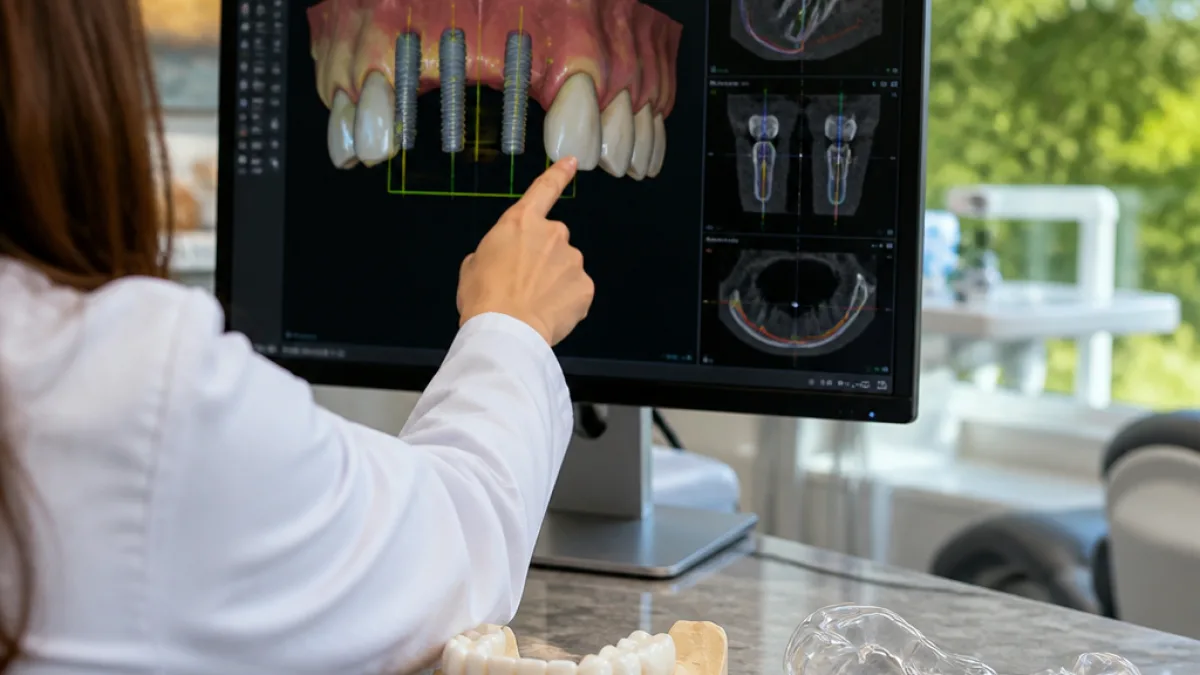
The Institute for Advanced Dentistry & Implants in Peoria is highlighting the importance of coordinated planning between surgery and restoration for dental implants, saying the position chosen at surgery can determine what is possible months or years later.
Why implant position matters long after surgery
Dental implant treatment is often discussed as a surgical procedure, but experts at the Peoria practice say the decision about where to place an implant must be made with the final tooth and bite in mind. Once an implant is integrated into the bone, its depth, angulation and position generally cannot be corrected by modifying the crown or bridge placed on top.
Those surgical choices affect how the tooth emerges from the gum, how chewing forces are distributed across the restoration and whether patients can clean around the implant. In complex situations — including full-arch replacements and revision cases — the practice plans treatment "from the final restoration backward," coordinating imaging, surgical placement, provisional restorations and the final prosthetic.
"An implant can integrate into bone and still create a restorative problem if it is positioned without enough attention to the final tooth and the bite," said Jonathan Bensoussan, DDS, the surgical prosthodontist who leads the practice.
Considerations Peoria patients should ask about
The institute recommends local patients ask potential implant providers about the following before starting treatment:
- Who is responsible for the surgical plan and who designs the final teeth.
- Whether surgical and restorative phases are coordinated as one plan.
- What imaging (for example, 3-D scans) is used before treatment.
- How provisional (temporary) teeth are handled during healing and adjustment.
Those questions are aimed at clarifying whether a practice uses a prosthodontic approach that keeps surgical and restorative phases aligned — an approach the Peoria practice says is particularly valuable in complex cases.
How anatomical and mechanical factors intersect
The Peoria team notes that multiple factors must be evaluated together before surgery: available bone, nearby nerves, sinus anatomy, the patient’s bite and restorative space. Missing consideration of any one of these can complicate function or hygiene after the implant is placed.
| Factor | Impact on outcome |
|---|---|
| Depth and angulation | Affects emergence profile and ability to restore properly |
| Available bone | Limits placement options and may require grafting |
| Bite (occlusion) | Determines load and long-term function of the restoration |
According to the practice, even a successfully integrated implant can present a restorative problem if its position does not allow a properly functioning, maintainable final tooth. The message for Peoria patients is that implant care is a multidisciplinary process that should be planned to the finish line.
Local patients weighing implant treatment are encouraged to ask prospective providers how they coordinate imaging, provisional restoration and final prosthetic design, and whether a prosthodontist plays a role in planning. Those steps, the institute says, can reduce the risk of long-term complications and improve the likelihood that the restoration will function and be maintainable.
For residents seeking further details, the Institute for Advanced Dentistry & Implants in Peoria is the practice cited for this approach. The practice emphasizes planning complex cases — including full-arch and revision treatments — with the end prosthetic result guiding surgical decisions.