Fire crews shift response to protect personnel amid extreme heat
Oklahoma City firefighters are changing how they respond to emergencies as sustained triple‑digit temperatures add a new layer of danger to an already hazardous job. Department leaders say the adjustments aim to reduce heat exposure for crews, protect public safety and keep operations effective during periods of extreme heat.
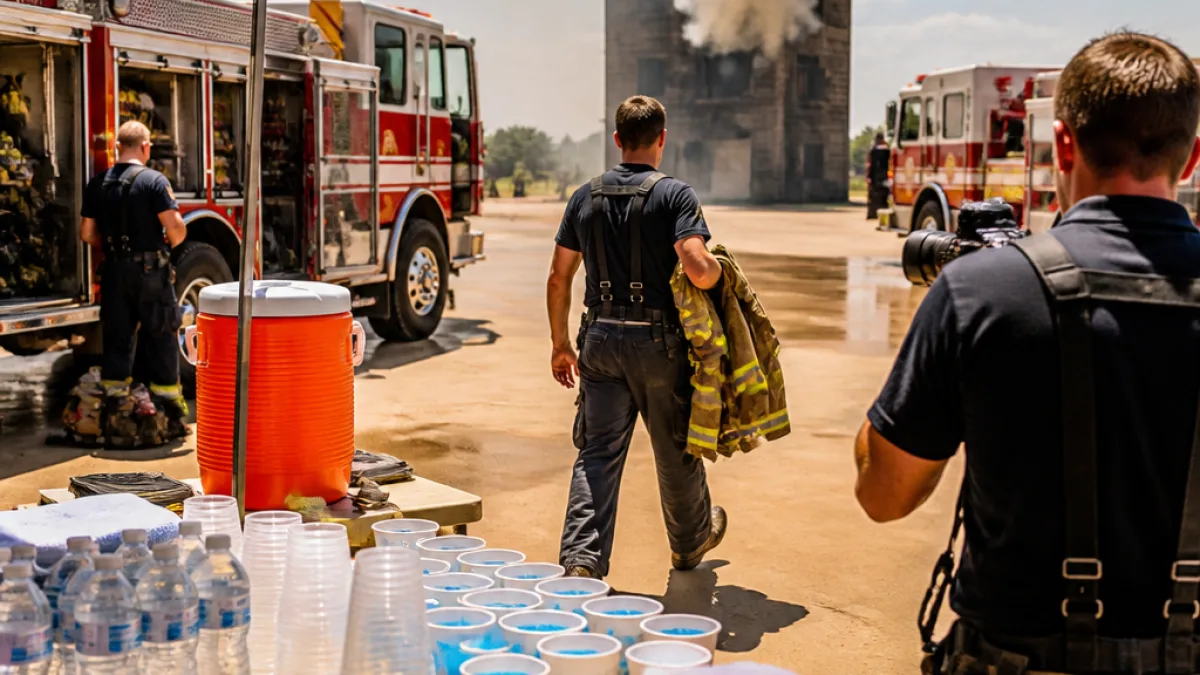
In a demonstration for reporters, the Oklahoma City Fire Department took crews through a search‑and‑rescue exercise in a smoke‑filled training structure. Firefighters carried more than 60 pounds of protective equipment while using thermal cameras to locate a staged victim — an activity that becomes significantly more taxing when ambient temperatures climb above 100 degrees.
“We’ll bring extra resources to a house fire, car wreck or grass fire, and we’ll rotate our crews in and out quicker than what we normally would just so that those firefighters don’t break down, just so that firefighters are hydrated,”
The department’s approach shifts the typical response pattern. On what used to be a standard residential structure fire — generally covered by two engines, a ladder truck and a chief — crews now arrive with additional units so personnel can take scheduled breaks and cool down without compromising fireground operations, said Maj. John Chenoweth of the Oklahoma City Fire Department.
Chenoweth said the moves are prompted by a sustained heat wave affecting the city. He described recent incidents in which heat complicated responses, including a wildfire near the airport and a structure fire the department handled in the past 48 hours. In one instance, a firefighter was taken to a hospital for dehydration, highlighting the immediate human cost of working long periods in heavy, insulating gear under extreme heat.
Operational changes and on‑scene practices
City firefighters and leaders outlined several operational changes meant to reduce heat stress for personnel while maintaining response capability. Measures include:
- Adding units to incident responses so crews can rotate out more frequently;
- Shortening work cycles inside hot, smoky environments to limit time in full protective ensembles;
- Emphasizing hydration and monitoring for signs of heat illness;
- Using thermal imaging and other tools to speed victim location and reduce time spent in high‑heat zones.
Those adjustments reflect broader firefighting challenges in hot weather. Protective gear that shields workers from flames also traps body heat and impedes cooling. That makes established practices such as scheduled rehab — the on‑scene process where firefighters rest, rehydrate and are medically evaluated — even more important during heat waves.
| Typical response | Adjusted response in extreme heat |
|---|---|
| Two engines, ladder, chief | Additional engines/units to allow faster rotation |
| Standard crew work cycles | Shortened cycles, more frequent rehab |
| Normal operational tempo | Heightened monitoring for heat illness and dehydration |
Department leaders said these changes are intended to be flexible, scaled to the size and type of incident. Chenoweth noted that the city will not compromise scene safety but wants to reduce the chance of heat‑related injuries among responders.
What this means for Oklahoma City residents
For residents, fewer visible signs may change little about how an incident appears from the street. Firefighters will still prioritize life safety and property protection. But the altered tactics could affect response dynamics: more apparatus arriving on scene initially, visible rehab areas for crews, and potentially faster crew rotations during prolonged incidents such as structure fires or large grass fires.
City officials also emphasized public cooperation to reduce fire risk during heat waves: avoid outdoor burning, be cautious with equipment that can spark fires, and stay aware of city advisories — including any temporary water or outdoor‑work restrictions that sometimes accompany extreme heat.
As Oklahoma City continues to face periods of extreme temperature, the fire department’s adjustments underscore the interconnected risks of heat, firefighting and emergency medical response. Officials say they will continue to monitor conditions and adapt tactics to protect both responders and the public.