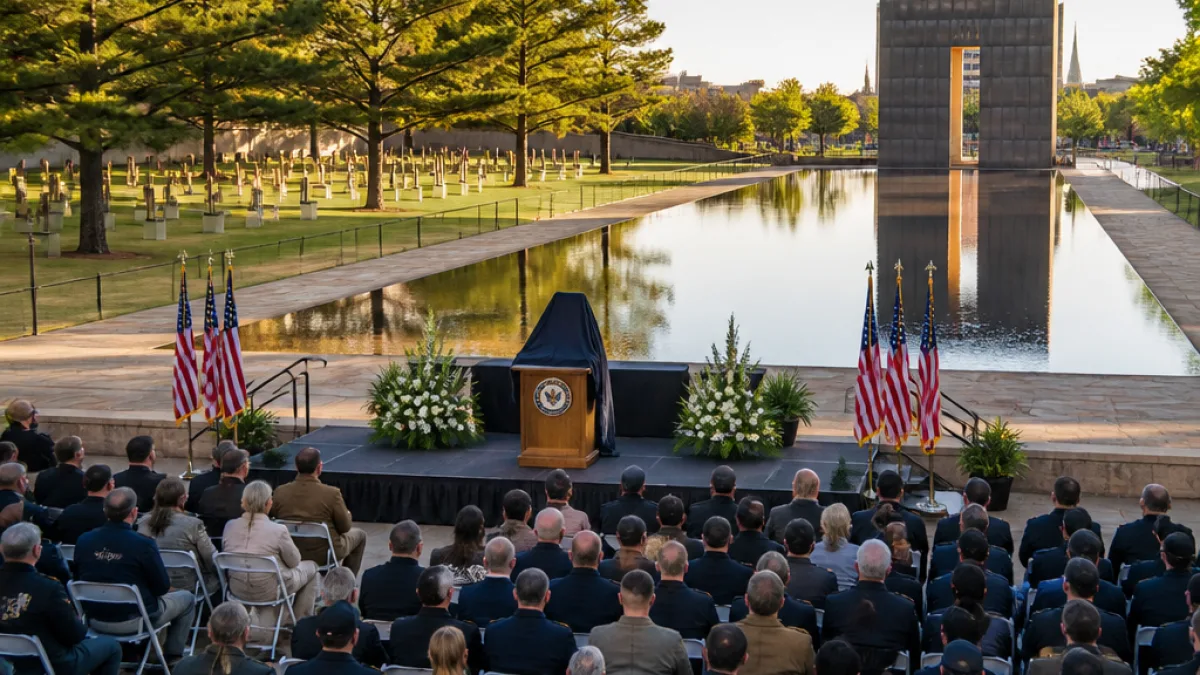
OKLAHOMA CITY — Days after the nation observed the 25th anniversary of the Sept. 11 attacks, the Oklahoma City National Memorial and Museum hosted a "Better Conversations" event where the FBI outlined how the agency altered its mission and methods in the years after 2001.
From criminal investigations to intelligence emphasis
Joe Skarda, assistant special agent in charge of the FBI's Oklahoma City office, told the audience the agency was more criminally focused before 9/11 and that the nature of the Sept. 11 attacks forced a rapid and fundamental shift.
"Federal agencies, FBI included, you know, we're here to keep America safe," Skarda said during the event. He said the complexities of an international attack such as Sept. 11 presented different challenges than the domestic terrorism seen in Oklahoma City in 1995.
- Mission shift: Skarda said the FBI moved from largely criminal investigations to a posture that places greater weight on counterterrorism and intelligence.
- Resource allocation: The agency committed additional manpower and resources to address international terrorism threats, he said.
- Operational approach: Skarda described the FBI as now using a more intelligence-driven product to guide responses and improve results.
"We're fighting a lot better and use a lot more of an intelligence-driven product in order to have better, better response and results," Skarda said.
Local context: Oklahoma City's memory and national security conversation
The museum and memorial have for years been a place where Oklahomans reckon with domestic terrorism and its aftermath. Skarda acknowledged that the Oklahoma City bombing was a domestic terror attack and contrasted that with the international dimensions of 9/11, which required different capabilities.
Speakers at the event connected those historical events to the FBI’s evolving responsibilities, arguing the agency adapted to meet a broader threat landscape while maintaining its foundational mission. "Our motto is protect the American people and uphold Constitution, United States. It's simple," Skarda said, underscoring continuity amid change.
| Before 9/11 | After 9/11 |
|---|---|
| More criminally based investigations, according to the FBI | Greater emphasis on intelligence, counterterrorism and international threats |
| Domestic terrorism incidents, including the Oklahoma City bombing, formed much of the experience | Enhanced resource and manpower commitments to detect and disrupt international terrorist plots |
By hosting the discussion at the National Memorial and Museum, organizers reinforced a local connection between a community that endured a high-profile domestic attack and a federal agency whose remit expanded in response to a different, international tragedy. The setting underlined shared concerns about both remembrance and preparedness.
Implications for residents and the region
Skarda’s comments highlighted how federal agencies adapt after major incidents and what that means for local communities: the ways investigations are conducted, how information is shared, and how priorities shift when facing transnational threats. While the FBI framed these changes as improvements that have helped keep Americans safe, the discussion also served as a reminder of the balance agencies say they seek between security measures and constitutional protections.
The event was part of broader efforts by museums, memorials and civic institutions to foster dialogue about safety, history and the trade-offs that come with evolving law-enforcement strategies. Attendees heard not only about tactical changes but also the enduring mission that federal agents describe as central to their work.
Officials at the memorial have periodically hosted conversations that place local history in national context. This session, coming immediately after the 25th anniversary of Sept. 11, brought that mission into sharp relief for Oklahoma City residents who continue to engage with the legacies of both domestic and international acts of terror.