
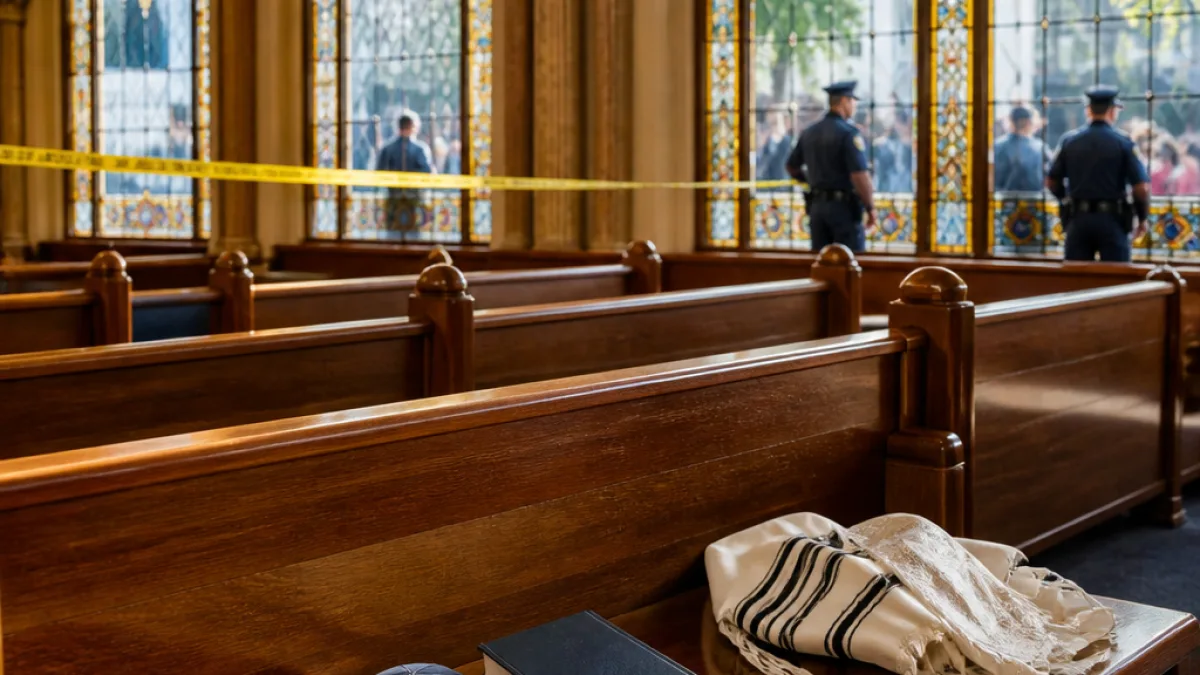
Eyewitness disputes reporting after attack during Shabbat service
A congregant who said he sat a few rows from the altercation inside Central Synagogue in Midtown Manhattan has publicly challenged The New York Times’ account of a Friday-night attack during Shabbat services, saying the newspaper downplayed what he called a “very violent and frightening incident.” The dispute underscores simmering tensions over how the city’s news organizations describe incidents of violence at houses of worship and how the broader community perceives their coverage.
The witness, identified in media reports as a 70-year-old man who sat in the sixth row of the packed synagogue at Lexington Avenue and East 55th Street, wrote on Facebook that his first-hand observations did not match the phrasing used by the Times. The suspect, 46-year-old Larry Montes, was taken into custody following the incident and has been charged with a hate crime, according to reporting from local outlets. One worshipper, identified in those accounts as 63-year-old Michele Anenbeg-Poma, was seen with a busted lip and a bloody gash on her right forearm.
“I cannot emotionally consolidate … the difference between what I witnessed from a few feet away and how The New York Times decided to describe the event,” the witness wrote, according to published reports.
Officials, community leaders weigh response
Central Synagogue, a prominent Midtown house of worship, drew hundreds of people for the service when the disruption occurred. Media coverage described the suspect’s actions using terms such as “agitated” and noted that he “struggled” and “hit” a congregant. The eyewitness called those descriptions insufficient to convey the force and apparent intent of the attacker.
The incident has already prompted legal action and community concern. Hate-crime charges in New York carry enhanced penalties and are investigated by law enforcement agencies that track crimes motivated by bias. The reporting and the witness’s reaction are likely to deepen conversation about how outlets characterize violent episodes, particularly when they occur in sacred spaces.
- Where: Central Synagogue, Lexington Avenue and East 55th Street, Manhattan.
- When: Friday night Shabbat service (evening reported in local coverage).
- Suspect: Larry Montes, 46, taken into custody and charged with a hate crime.
- Injured: One congregant, reported as 63-year-old Michele Anenbeg-Poma, shown with a busted lip and a bloody gash.
Questions about description and community impact
The eyewitness’s critique highlights a common fault line after traumatic events: the divergence between what participants experience and how events are summarized in subsequent reportage. He told readers he did not need an interpretation from others because he “was there” and saw the actions firsthand. That assessment compounds the emotional aftermath for congregants and raises expectations among readers and community leaders for precise language in reporting, particularly about incidents labeled as bias-motivated.
For Midtown residents and worshippers citywide, the case may also prompt renewed attention to security at houses of worship and to how municipal authorities, faith leaders and media outlets coordinate information after an incident. Authorities typically release further details as charges progress, and court dates or filings will provide an official record of the allegations.
| Detail | Known information |
|---|---|
| Location | Central Synagogue, Lexington Ave & E. 55th St., Manhattan |
| Alleged assailant | Larry Montes, 46 |
| Injured | Michele Anenbeg-Poma, 63 (reported injuries: busted lip, gash on forearm) |
| Charge | Hate crime (reported in coverage) |
The synagogue and law enforcement officials have not provided additional public comment in the accounts cited. As the legal process unfolds, residents and congregants will be watching for confirmation of facts in court filings and for any statements from community leaders addressing safety and support for those affected.
Coverage disputes such as this one often prompt both media self-reflection and community discussion about terminology, context and the responsibilities of reporters to convey the severity of events without exaggeration. For Manhattan’s Jewish community, the exchange between an eyewitness and a major newspaper has already become part of the story surrounding an unsettling night at a longstanding Midtown house of worship.
















