
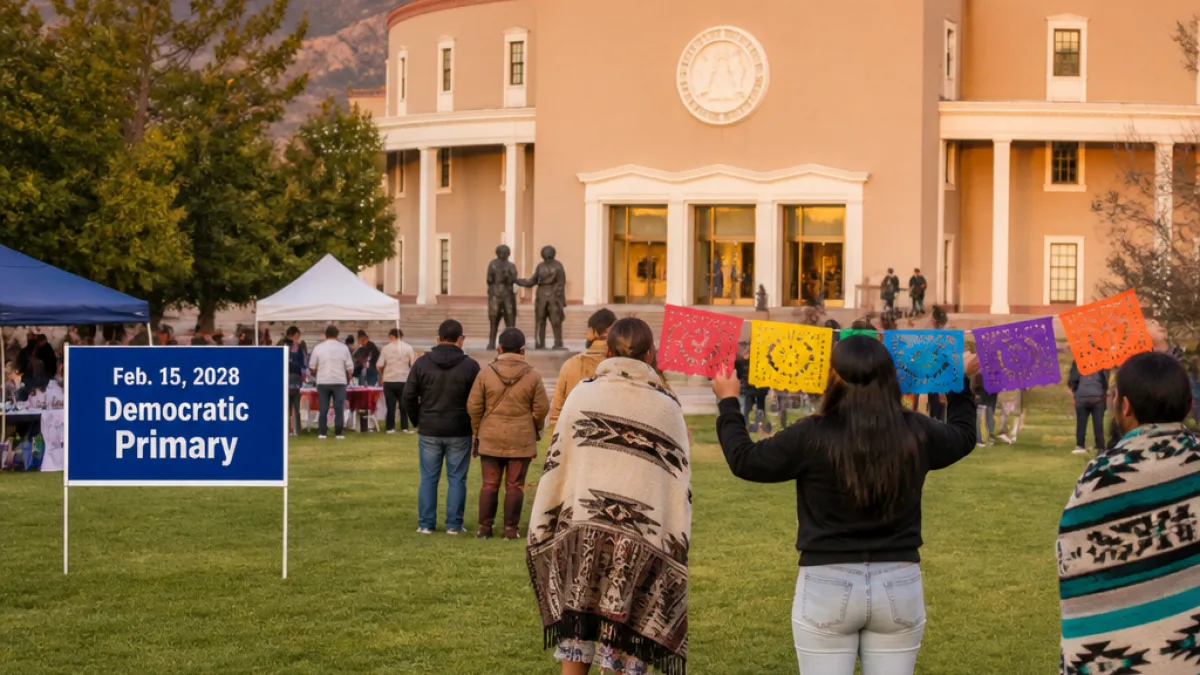
ALBUQUERQUE — New Mexico will be one of the earliest states to hold a Democratic presidential primary in 2028, a designation party leaders say will bring candidates, media and campaign investment to the state at a critical moment in the nominating process.
When New Mexico votes
The Democratic National Committee announced its 2028 nominating calendar in Austin, Texas, approving a slate of early contests that places New Mexico’s Democratic primary on Feb. 15, 2028. Under the plan, New Mexico will follow the contests in South Carolina (Jan. 22) and Nevada (Feb. 1), and will come after the New Hampshire primary and before other early ballots such as Michigan and Virginia scheduled throughout February.
State leaders welcome the spotlight
Officials in New Mexico framed the decision as recognition of the state’s demographic and political significance. At the DNC meeting, U.S. Rep. Teresa Leger Fernandez said New Mexico offers a compelling narrative for candidates who want to connect with a broad coalition of voters.
"If elections are about sharing with the American people the story in which they can see themselves, then we're going to have New Mexico be the backdrop for our Democratic nominee," Leger Fernandez said.
Gov. Michelle Lujan Grisham said the new placement means presidential contenders will need to engage with New Mexico’s electorate — including Hispanic, Native American and border-state voters — early in the nominating contest. She emphasized that the timing gives the state an opportunity to showcase policy gains made under her administration, pointing to expanded health care access, free childcare and free college programs.
What the change means for campaigns and voters
Party leaders who backed the calendar argued the sequence better reflects the nation’s demographic makeup than traditional early states. DNC officials and strategists say candidates will have to be "battle-tested" in diverse regions — the South, the West and border states — to demonstrate appeal to a broad coalition.
- New Mexico’s primary date: Feb. 15, 2028
- Early-state order (selected): South Carolina (Jan. 22), Nevada (Feb. 1), New Hampshire, New Mexico (Feb. 15)
- Approval location: Austin, Texas, at a DNC meeting
The committee’s move to shift New Mexico into an earlier slot could change how candidates allocate time and resources. Campaigns traditionally prioritize early states to build momentum and fundraising support. With New Mexico among the first handful, presidential hopefuls may increase travel to the state, recruit local organizing staff, and tailor messages to issues of particular importance to New Mexicans, including tribal relations, border policy, health care and rural economic development.
Party process and context
The idea to elevate New Mexico in the early calendar followed a proposal from the DNC Rules and Bylaws Committee on July 24 that recommended an expanded set of early states beyond the long-standing Iowa and New Hampshire tests. The final calendar endorsed in Austin places South Carolina as the opening Southern primary, followed by Nevada and then New Hampshire before New Mexico’s mid-February date.
Supporters of the change have argued the new lineup better represents racial and geographic diversity and will test candidates’ ability to compete in varied electorates. Critics of removing traditional early status for some states have warned that longstanding local constituencies could be sidelined.
Local implications and next steps
Practical consequences for New Mexico include increased logistical planning by the state Democratic Party and local election offices. Campaigns will likely coordinate visits to urban centers such as Albuquerque and Santa Fe as well as to rural and tribal communities, raising questions about access to candidate events and media coverage across the state’s large geography.
Officials did not lay out a detailed, statewide schedule for candidate forums or debates following the DNC announcement. But by making New Mexico an early contest, the committee effectively guarantees that presidential contenders will have to engage directly with the state’s electorate earlier than in past cycles.
The DNC’s calendar approval marks a notable shift in the party’s approach to the nominating sequence. For New Mexico, it represents a chance to shape the conversation on issues important to the state and to increase its influence in selecting the party’s standard-bearer.
Diego Salazar is the state correspondent for WE NEWS.

















