
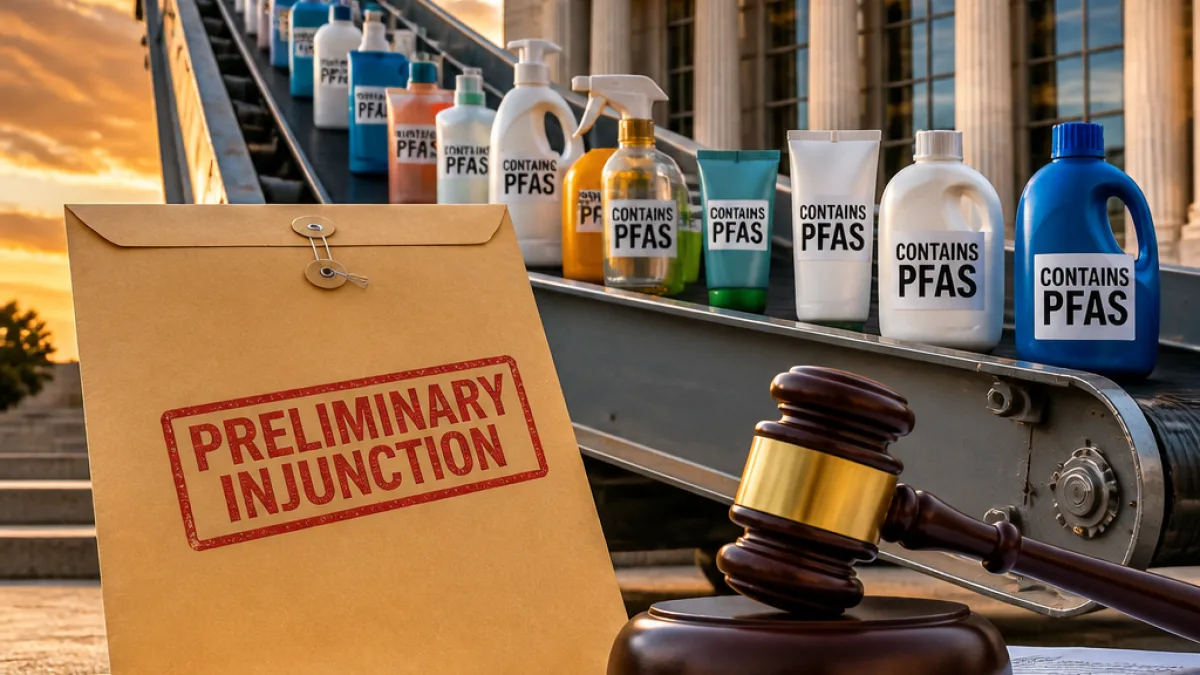
A federal judge has temporarily blocked New Mexico from implementing a rule that would have required manufacturers to place labels on consumer products containing per- and polyfluoroalkyl substances (PFAS), a group of persistent chemicals often called "forever chemicals." The preliminary injunction, issued Sept. 16, halts the rule that state regulators approved earlier this year and that was due to take effect as part of a broader law passed in 2025.
Court action based on industry challenge
The injunction follows a lawsuit filed by the American Chemistry Council, the National Association of Manufacturers and six other trade groups. The plaintiffs argued the labeling requirement violated companies' constitutional rights by compelling speech—that is, forcing them to convey a government-mandated message on their products.
"The state proclaims the regulation exists to raise consumer awareness, but underneath intends the label to operate as a warning in disguise," U.S. District Judge Margaret Strickland wrote in her order.
In her ruling, Judge Strickland said New Mexico had not demonstrated the labeling mandate was a rational means to achieve the state's stated goals of protecting consumer and environmental health. She also rejected some—but not all—of the manufacturers' legal claims, leaving the broader case to proceed in court.
Where the rule came from
The labeling requirement was developed under the umbrella of the PFAS Protection Act, legislation the New Mexico Legislature approved and that Gov. Michelle Lujan Grisham signed into law in 2025. The New Mexico Environment Department then implemented a rule, which the New Mexico Environmental Improvement Board approved in March. Under that rule, manufacturers would have been required to disclose PFAS presence in covered consumer products beginning in 2027.
State officials have argued the labels would give shoppers clearer information about chemicals in everyday items. Supporters of the law say PFAS are widely used because they repel water, stains and heat, but are also persistent in the environment and linked to various health concerns.
Health concerns and regulatory context
PFAS are synthetic chemicals used in cookware, stain-resistant fabrics, firefighting foams and other products. Because many PFAS do not break down easily, they can accumulate in the environment and in human bodies. Studies have associated exposure to certain PFAS with reproductive and developmental issues, immune system effects and increased cancer risk, concerns that helped drive the state’s legislative and regulatory response.
Judge Strickland noted New Mexico’s definition of PFAS in the rule mirrors definitions used by other states, including Colorado and California, though her order questioned whether labeling is the proper regulatory instrument to address the public-health objectives the state cited.
What happens next
The preliminary injunction prevents New Mexico from enforcing the labeling requirement while the litigation continues. The plaintiffs will press forward with their constitutional challenge, and state regulators may consider whether to revise the rule or defend it through further litigation. The court’s decision that rejected certain claims suggests portions of the case will move beyond preliminary motions.
For consumers and manufacturers, the injunction leaves the status quo intact for now: companies will not be required to add PFAS labels to products under the halted rule, and shoppers will not immediately see the additional disclosures the state had planned.
Timeline
| Action | Date |
|---|---|
| PFAS Protection Act enacted | 2025 |
| Environmental Improvement Board approves labeling rule | March 2026 |
| Manufacturers and trade groups sue New Mexico | July 2026 |
| Judge issues preliminary injunction | Sept. 16, 2026 |
Implications for New Mexico
The ruling is a setback for state officials and advocates who viewed labeling as a tool to alert consumers and reduce exposure. It also demonstrates the legal hurdles states face when attempting to regulate chemical disclosures and product messaging. The lawsuit underscores tensions between state public-health initiatives and national trade groups that represent manufacturers doing business across multiple jurisdictions.
- Regulatory pause: The injunction stops enforcement of the labeling rule pending further court action.
- Legal question: Central to the dispute is whether the state can compel speech through product labels without violating the First Amendment.
- Health debate: The case highlights ongoing concerns about PFAS exposure and how best to inform and protect consumers.
The case will inform not only New Mexico policy but could influence how other states craft and defend PFAS-related measures. For now, consumers and manufacturers in the state await the next legal moves and any potential revisions to the rule that might respond to the court’s concerns.
Diego Salazar, State Correspondent, WE NEWS.

















