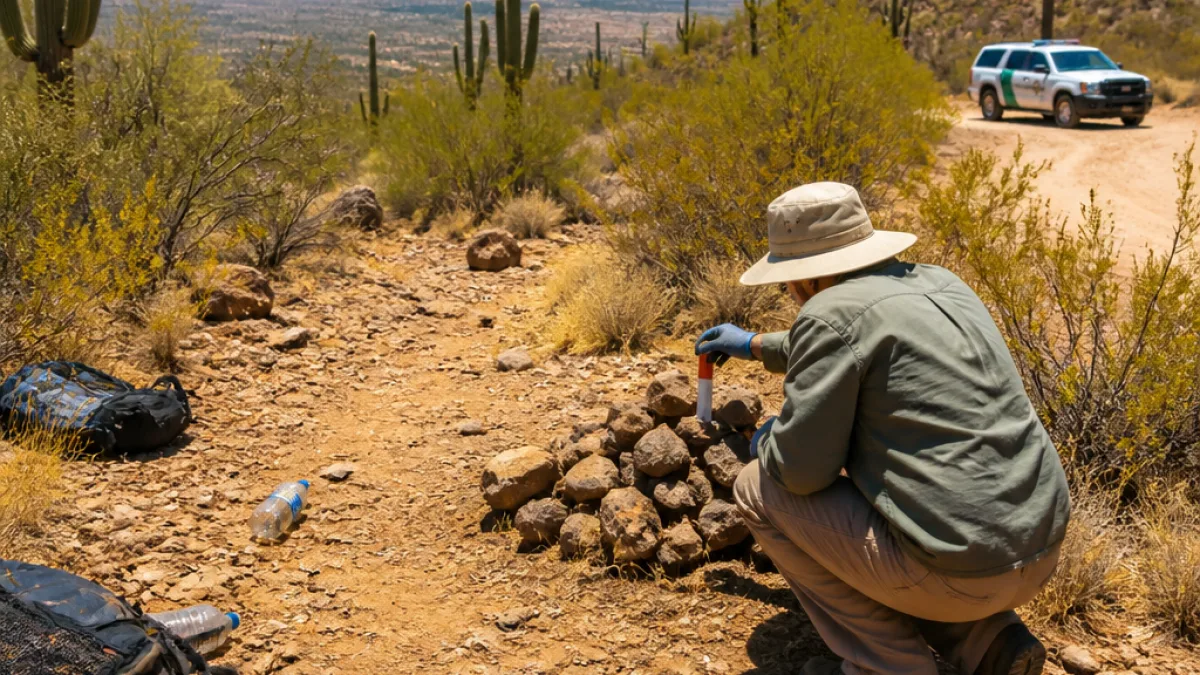
Southern Arizona is seeing a troubling rise in migrant fatalities this summer despite overall declines in border crossings nationally, according to data compiled by the humanitarian organization Humane Borders with the Pima County Office of the Medical Examiner.
Monthly spike amid seasonal heat
The group reported 19 deaths in July, the highest single-month total in two years, and 13 deaths in June. So far this year, the remains of 73 people have been recovered in Arizona — up from 59 during the same period last year. For context, there were 103 migrant deaths recorded in the state in 2025.
Humane Borders emphasized that summers are historically the deadliest months in Arizona, when migrants traveling through remote desert areas are particularly vulnerable to extreme temperatures. The organization cautioned that reported numbers likely undercount the true toll because remains in remote locations are often never recovered.
“In the desert, if they come the probability of death is high,”
said Brad Jones, a member of Humane Borders’ board. Octavio Fuentes, the group's executive director, said summers are typically the deadliest season and that deaths are often avoidable if migrants do not face extreme environmental exposure.
How and where remains are found
Most of the recovered remains have been found shortly after death. Humane Borders reported that of the July recoveries, five people had been deceased for less than a day, two for less than a week and four for less than three months. Volunteers, U.S. Border Patrol agents, landowners and hikers frequently discover bodies in the desert.
Humane Borders said the predominant causes of death in southern Arizona are dehydration and exposure. Other documented causes include hypothermia, drowning and blunt-force trauma. In some cases, investigators are unable to determine a precise cause of death.
Long-term toll
The newly reported cases bring the number of migrant deaths documented in southern Arizona over the past 25 years to 4,505. Humane Borders warned that the combination of remote terrain, extreme summer heat and limited water sources makes migration through these areas especially deadly.
| Period | Reported deaths |
|---|---|
| June 2026 | 13 |
| July 2026 | 19 |
| Jan–Jul 2026 (year to date) | 73 |
| Jan–Jul 2025 (year to date) | 59 |
| Total over 25 years (southern Arizona) | 4,505 |
Local impact and response
Humanitarian organizations that operate in Tucson and other parts of Pima County have long warned about the risks posed by summer temperatures that routinely top 100 degrees. Volunteers with search-and-rescue teams and water-drop programs try to reduce fatalities by placing water stations along common routes, but groups say resources and access are limited and efforts cannot reach every remote area.
- Primary causes: dehydration and exposure.
- Other causes noted: hypothermia, drowning, blunt-force trauma, undetermined causes.
- Discovery sources: Border Patrol agents, volunteers, landowners, hikers.
Advocates noted that when people leave dangerous or threatening situations in their home countries, they will continue to travel despite official border restrictions or public discussions of a “closed” border. The data underscore the dangers of movement through hostile landscape during Arizona’s hottest months.
Officials at the Pima County Office of the Medical Examiner and local law enforcement agencies continue to process recoveries and notify next of kin when possible. Humane Borders and other nonprofits said their priority remains preventing deaths through humanitarian assistance and raising awareness of how deadly desert crossings can be.
The organization urged policymakers and the public to acknowledge the human cost reflected in the numbers and the limits of deterrence-only approaches when people are compelled to migrate by violence, instability or other threats in their home countries.
Reporting for this story relied on data released by Humane Borders and information compiled with the Pima County Office of the Medical Examiner.