
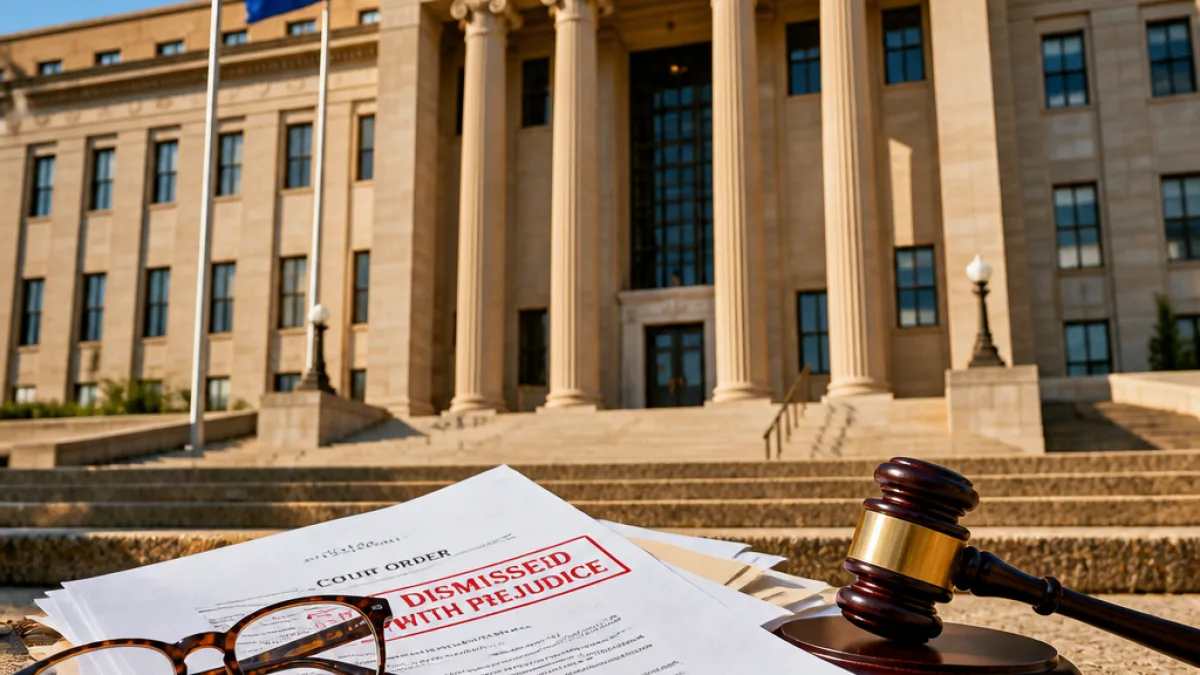
LINCOLN — A Lancaster County judge on Wednesday dismissed a Republican National Committee lawsuit challenging a Nebraska law that allows certain U.S. citizens who have never lived in the state to register to vote in a county where one of their parents is registered.
Ruling centers on constitutionality and hypothetical applications
In a 13-page order, Judge Ryan Post concluded the RNC and two Lancaster County voters seeking to block the statute failed to show that the law could never be applied constitutionally. Because a court presumes a statute is valid unless proven otherwise, Post dismissed the challenge with prejudice, which prevents the same plaintiffs from filing the same claim again.
"A statute is presumed to be constitutional, and all reasonable doubts are resolved in favor of its constitutionality," Post wrote.
The law at issue permits a U.S. citizen who has never resided in Nebraska to register in one Nebraska county if that person has a parent who is registered to vote in that county. Prosecutors and election officials have warned it would be a felony for a person to register or vote multiple times in different states or counties.
What plaintiffs argued
The RNC and plaintiffs Jack Riggins and Pam Dingman, the elected Lancaster County engineer, contended the statute unfairly dilutes Republican votes and conflicts with Article VI, Section 1 of the Nebraska Constitution, which defines a qualified voter as a U.S. citizen who "has resided within the state and the county and voting precinct for the terms provided by law." They argued the state constitutional requirement of residence means someone must have lived in Nebraska to be eligible.
Defense and hypothetical example influenced judge
Attorneys for Nebraska Secretary of State Bob Evnen — represented in the case by the Nebraska Attorney General's Office — countered that there are scenarios in which the statute is constitutional. Post cited an 1895 Nebraska Supreme Court decision referenced by both sides about the relationship between "residence" and "domicile," and described at least one hypothetical fact pattern where the statute could be applied without running afoul of the state constitution.
In the judge's written discussion, he described a hypothetical instance in which a person born and raised abroad to Nebraska parents might reasonably have a sufficient connection for registration under the law.
Who’s involved and next steps
The lawsuit was filed by the RNC along with Riggins and Dingman. Attorneys for the RNC and for the plaintiffs did not immediately comment Wednesday. The secretary of state's office, represented by the attorney general, defended the law in court.
| Party | Role | Position in case |
|---|---|---|
| Republican National Committee | Plaintiff | Challenged statute |
| Jack Riggins | Plaintiff | Local voter challenging law |
| Pam Dingman | Plaintiff | Lancaster County engineer; co-plaintiff |
| Bob Evnen | Defendant (official) | Nebraska Secretary of State |
| Ryan Post | Judge | Dismissed case with prejudice |
Implications for voting and future litigation
By dismissing the suit with prejudice, Post's decision leaves the statute intact for the time being. The ruling signals that, under Nebraska law, plaintiffs must show a statute cannot be constitutionally applied in any circumstance to prevail. That is a high legal bar, and one the judge found unmet.
Legal experts often note that a dismissal with prejudice significantly narrows the path for future legal challenges by the same parties. While the decision does not resolve broader political debates over residency rules and absentee or overseas voting, it does preserve the existing registration pathway for the specific group covered by the statute.
What the law allows and safeguards
Election officials emphasize that the statute is limited in scope: it applies only to citizens who never resided in Nebraska and who have a parent registered in a Nebraska county. State law criminalizes registering or voting in more than one place, and the secretary of state's office enforces those prohibitions.
- Statute: Permits non-resident citizens with a registered parent to register in one Nebraska county.
- Constitutional question: Whether "resided" in Article VI, Section 1 precludes such registration.
- Court outcome: Dismissal with prejudice due to at least one constitutional application.
The decision represents the latest chapter in disputes over voter eligibility and residency standards. For now, Nebraska's registration option for certain overseas citizens remains in place following Judge Post's order.
Nathan Ackerman is the state correspondent covering legal and political developments for WE NEWS.

















