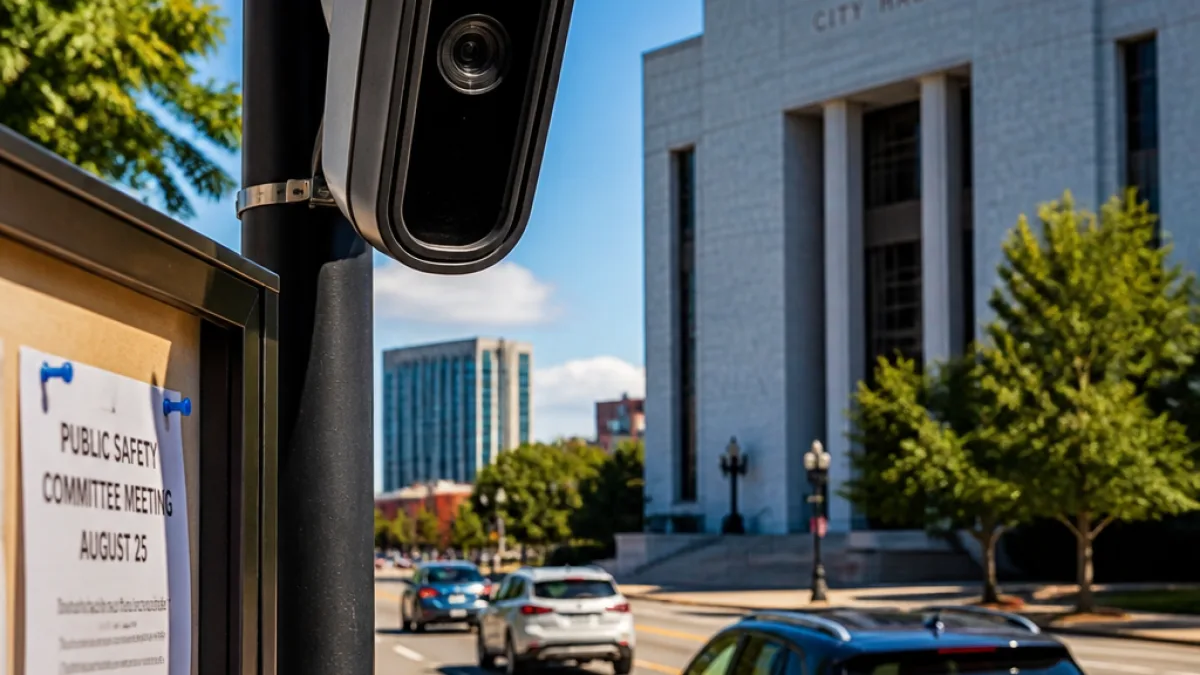
Grand Rapids city officials said they will provide a public briefing and invite representatives from Flock Safety to discuss the city’s use of automated license plate readers after residents raised concerns about privacy, government surveillance and potential Fourth Amendment violations.
City to explain use of ALPR technology
At a City Commission meeting on Aug. 11, more than a dozen residents urged the city to re-examine its contract with Flock Safety, the private company whose cameras capture and store images of license plates as vehicles pass. City Manager Mark Washington said officials will present information on how the Grand Rapids Police Department uses the technology at the next public safety committee meeting on Aug. 25. He also said Flock representatives will be invited to speak directly about the system.
Residents urged a range of responses, including canceling the contract, commissioning a third-party audit and adopting stronger safeguards for data sharing. Critics say the systems track the movements of private citizens without warrants or meaningful oversight and can share data with outside agencies.
- Contract timeline: The department has used automated license plate readers since 2012 and began contracting with Flock Safety in 2024.
- Contract cost: The City Commission approved a 24-month Flock contract in January 2024 with a cap of $165,700.
- Next step: Public safety committee briefing on Aug. 25 with Flock representatives expected to attend.
“They track and store the movements of private citizens without warrant or consent and share that data with outside agencies without permission,” resident Jennifer Townsend wrote to the commission. “I do not want my tax dollars paying for violations of my privacy and that of my neighbors.”
Questions over effectiveness and oversight
Speakers at the commission meeting argued there is little evidence that automated license plate readers reduce crime while posing risks to civil liberties. Some residents called for an immediate halt to the contract, while others asked the city to allow independent reviewers to audit how long data is retained, who has access and whether the information is being shared with outside law enforcement partners.
The police department’s use of automated license plate readers predates the Flock contract; however, switching to Flock in 2024 placed the operation under a private vendor that maintains searchable vehicle databases. The exact terms for data retention and third-party access under the current contract were not detailed during the commission meeting.
| Item | Detail |
|---|---|
| ALPR use begins | 2012 |
| Flock contract approved | January 2024 (24 months) |
| Contract cap | $165,700 |
| Next public briefing | Aug. 25, Public Safety Committee |
What residents can expect next
During the Aug. 25 meeting, city staff are expected to outline how the Grand Rapids Police Department deploys the cameras, the policies that govern access to the data and any agreements that allow sharing with other agencies. Inviting Flock representatives may allow commissioners and the public to question the company directly about data security, retention policies and claimed impacts on public safety.
Community members and civil liberties advocates will likely continue to press for transparency and formal oversight. The outcome of the committee meeting could lead to policy changes, a new public reporting schedule, or a request for an independent audit depending on what officials and citizens learn about how the system is used and who has access to the data.
The city manager’s assurance of a forthcoming briefing signals an effort to answer resident concerns in a public forum, but the debate over automated surveillance will continue as officials and the public weigh privacy risks against law enforcement tools.