GILBERT, Ariz. — Students at Gilbert Accelerated Middle School commemorated the 25th anniversary of the Sept. 11 attacks by collecting and sharing personal stories from people who lived through the day. The project aimed to deepen understanding of the events beyond dates and statistics by centering the emotional recollections of relatives and community members.
Learning history through personal testimony
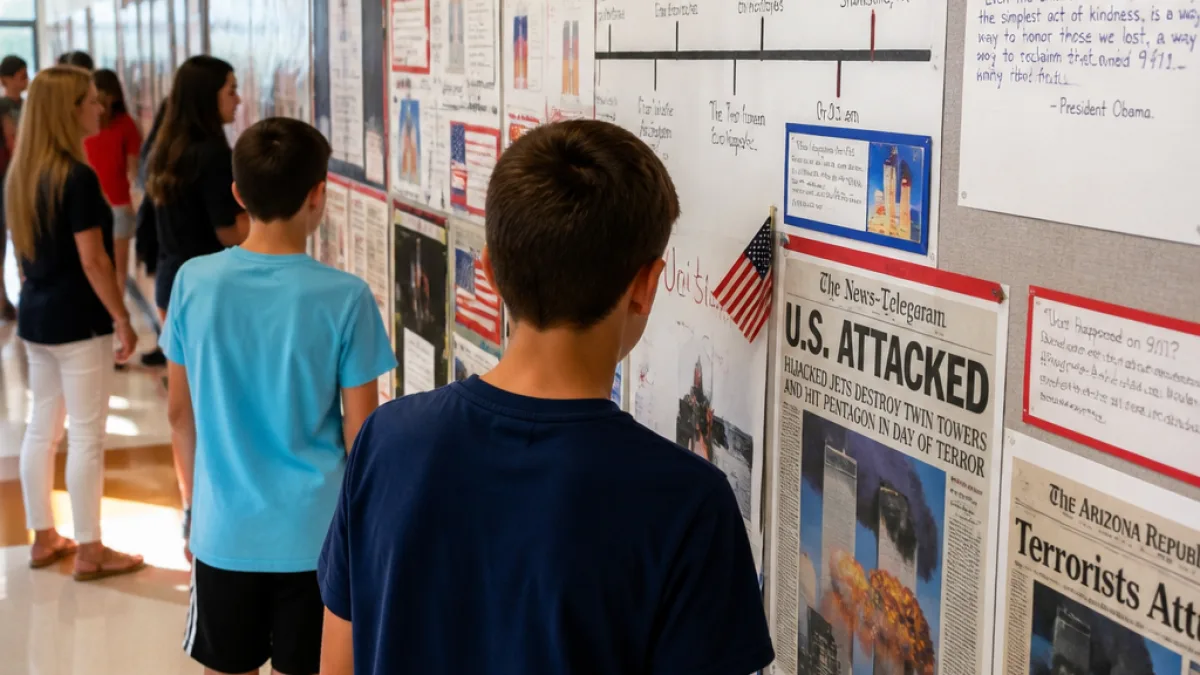
Staff assigned students to interview family members or others who remember Sept. 11, 2001. After gathering oral accounts, students produced posters that summarized what they heard and displayed those projects in the classroom to give peers a view of the event from varied personal perspectives.
For many students, the exercise made the historical event more tangible. Seventh grader Willo Shepard‑Beran said hearing the emotion in those interviews helped him grasp the subject in ways that textbook facts alone did not.
“History means a lot to me, and just knowing the stories from emotions, not just from facts and textbook, help people understand it better than just listing facts like you do in math, you know,”
Classmate Sofia Niebla described the experience as eye‑opening. She said reading and listening to classmates’ collected memories broadened her sense of what Sept. 11 represented to people at the time.
Teacher: personal objects and narratives add context
Teacher Jennifer Welcome said the collection of interviews and artifacts created a display that provided learning material not typically found in traditional textbooks. She noted the value of students seeing tangible items and family recollections mounted around the classroom.
“These are very personal objects up around the room now that you would never be able to get necessarily, like, out of a textbook,”
The assignment also required students to engage in conversations across generations. Student Jenna Schaff reported talking with her mother, who recalled that prior to the attacks she did not fully understand what the World Trade Center was and was later shocked by the magnitude of the events.
Local context and implications
The activity at Gilbert Accelerated Middle School reflects a broader educational trend of using oral history and primary sources to teach complex historical events. For a generation born after 2001, direct testimony from family and community members can provide emotional context and help preserve firsthand memories as living history.
- Students involved: Collected interviews and created posters to display peer‑gathered stories.
- Teachers: Facilitated cross‑generational conversations and classroom exhibits.
- Community impact: The project keeps personal memories accessible to younger residents who did not experience the attacks.
As time distances the public from Sept. 11 chronologically, local initiatives like this aim to maintain the human side of the historical record. By documenting how individuals remember the day — through both narrative and objects — the classroom project helps ensure those remembrances remain part of community understanding.
| School | Gilbert Accelerated Middle School |
|---|---|
| Anniversary | 25th anniversary of Sept. 11, 2001 |
| Student activities | Interviews, poster creation, classroom exhibits |
Students said the assignment not only taught history but also encouraged empathy and listening skills. For the generation of Gilbert youth who did not live through the attacks, those outcomes change historical study from abstract facts to a more nuanced understanding shaped by relationships and remembrance.
The project concludes with classroom displays that allow peers, teachers and visitors to read and reflect on the personal experiences collected by the students, preserving a local record of how Sept. 11 is remembered within Gilbert families and the school community.