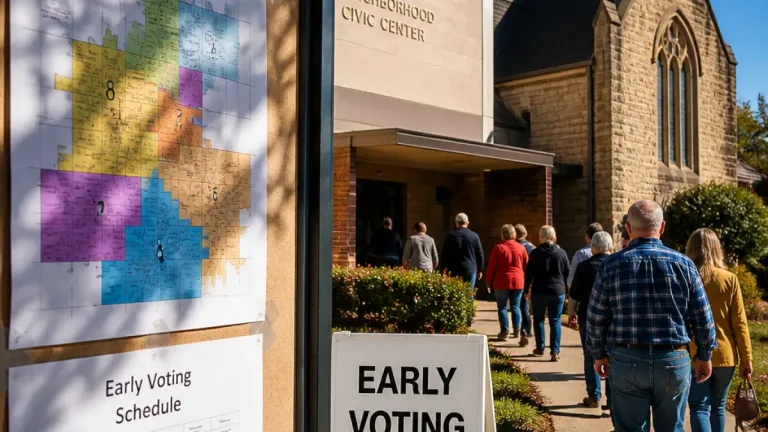
Florida voters on Tuesday will cast ballots in a primary that could determine the state’s political direction for years, selecting nominees to replace term-limited Republican Gov. Ron DeSantis and to complete the remainder of an unexpired U.S. Senate term tied to Marco Rubio. The contest also marks the first congressional primaries under a recently redrawn map that election analysts say is intended to benefit Republican candidates this fall.
High stakes for both parties
The gubernatorial primary has drawn crowded fields on both sides of the aisle and offers Floridians a choice between competing visions for the state. On the Republican side, 11 contenders are vying for the nomination, including Lt. Gov. Jay Collins, U.S. Rep. Byron Donalds, former investment firm CEO James Fishback and former state House Speaker Paul Renner. Donalds has the formal endorsement of former President Donald Trump and holds a substantial fundraising edge over his rivals.
Collins, a DeSantis ally and an Army Special Forces veteran who lost a leg in combat, was selected by DeSantis to serve as lieutenant governor in August 2025. His campaign message centers on preserving what he calls the outgoing governor’s legacy.
"He was the Chuck Norris of Florida politics,"
The remark, spoken by DeSantis when announcing Collins’ appointment, has been used by Collins’ campaign to underscore his close ties to the outgoing governor. Despite that alignment, DeSantis has withheld an endorsement in the primary.
Democrats seek a path forward
On the Democratic side, six candidates are competing for the nomination. The most prominent is former Republican U.S. Rep. David Jolly, who rejoined the Democratic fold in 2025 after leaving the GOP in 2018. Jolly has assembled a fundraising advantage within his party and has selected former Democratic U.S. Rep. Gwen Graham as his running mate; her name will appear on the ballot alongside his.
Also running are state Rep. Dotie Joseph and former high school math teacher Dayna Marie Foster, who is backed by the state’s Democratic Progressive Caucus. Democrats view the contest as an opportunity to reset after recent statewide losses and to present a ticket that can be competitive in November.
Congressional contests under a new map
Beyond the governor’s race, primary voters will be choosing nominees in the first congressional primaries conducted under a newly enacted district map. Lawmakers and map-drawers say the redistricting was intended to bolster Republican prospects in November, setting up competitive general-election battlegrounds in several parts of the state.
That redrawn terrain could change campaign strategies, fundraising priorities and turnout efforts over the next three months, making Tuesday’s primary outcomes an early indicator of which parties and candidates are best positioned for the fall.
What to watch on primary night
Several specific items are likely to draw attention as returns come in:
- Whether Byron Donalds’ lead holds: The congressman’s Trump endorsement and financial advantage make him the Republican front-runner to watch.
- Democratic consolidation: Whether David Jolly’s fundraising edge translates into a strong primary performance for Democrats seeking momentum.
- Impact of new congressional map: Early primary winners in reconfigured districts will shape general-election matchups.
| Race | Notable names | Key factor |
|---|---|---|
| Republican gubernatorial field | Jay Collins, Byron Donalds, James Fishback, Paul Renner | Trump endorsement, fundraising gaps |
| Democratic gubernatorial field | David Jolly, Dotie Joseph, Dayna Marie Foster | Jolly’s fundraising and running mate Gwen Graham |
Voters should be prepared for extended counting in some counties, particularly where mail ballots and provisional ballots are numerous. County election supervisors across Florida have worked to publicize polling locations, hours and acceptable forms of identification; Floridians who haven’t already checked their polling places would be advised to confirm times and locations with their local supervisor of elections before heading to the polls.
As returns begin to arrive Tuesday night, the outcomes will not only decide who appears on the November ballot but will signal the parties’ organizational strengths and the electorate’s mood heading into a consequential midterm cycle.
Reports from early precincts and fundraising tallies will shape the initial narrative, but close contests could drag into the days after the election as absentee and provisional ballots are resolved. For Florida, where statewide races often have national attention, the primary stage will offer the first clear view of who may lead each party into the fall campaign.