
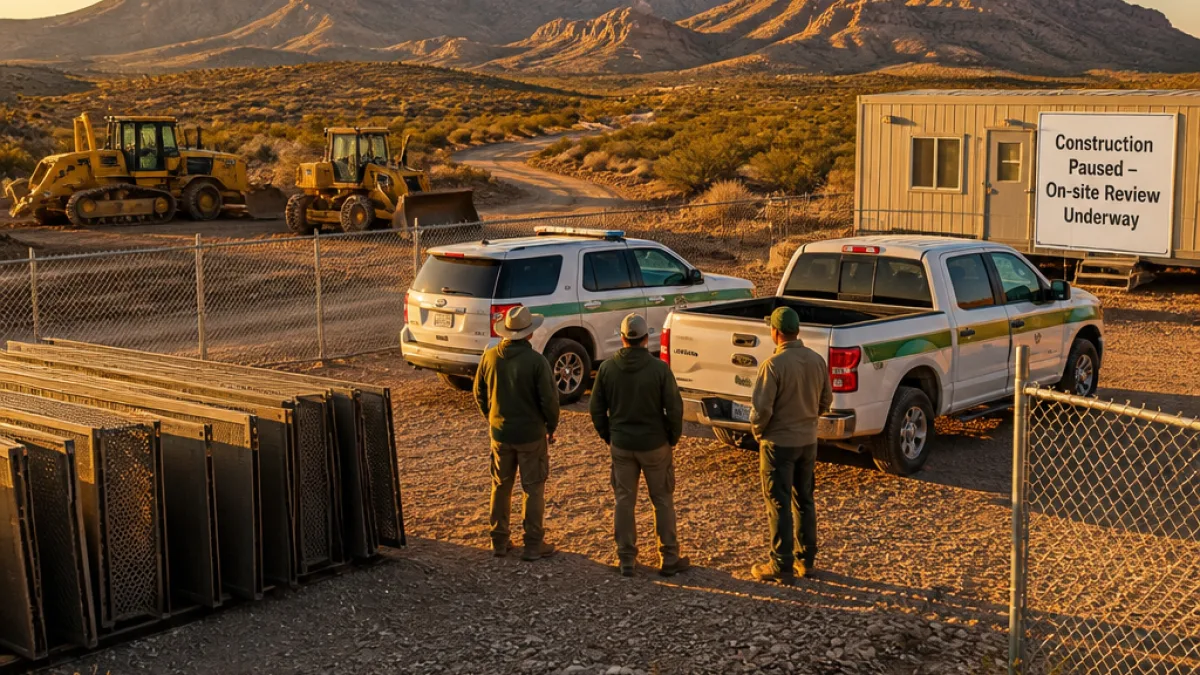
Federal authorities temporarily halted construction related to the border project running through Big Bend National Park, officials said Monday, as the head of Customs and Border Protection conducts an on-site review amid mounting bipartisan pushback.
Short suspension comes as CBP chief visits the park
CBP Commissioner Rodney Scott said he will visit the remote West Texas park to assess operations and talk with community members and local officials. The pause affects construction activity tied to a broader effort to install barriers and infrastructure along the U.S.-Mexico border.
“CBP is pausing all construction activity in Big Bend National Park while I visit and conduct a personal, on-the-ground evaluation,” Rodney Scott said on X.
Scott added that over the next several days he planned to “listen to local leadership, community members and stakeholders” in order to balance national security concerns with protection of the park.
What is being built and why it matters
The work through Big Bend is part of a larger border construction program that received significant federal funding last year. Congress provided $46 billion to support building barriers stretching from the Pacific Ocean to the Gulf of Mexico, and the administration has moved aggressively to complete those projects.
While CBP earlier stepped back from plans for a 30-foot bollard wall through protected lands, the agency has continued other measures in the area, including new roads, lighting, vehicle barriers and technological installations such as fiber-optic cable to support surveillance systems.
Bipartisan resistance and environmental concerns
The Big Bend work has provoked rare cross-party opposition in Texas and beyond. Environmental advocates and local officials argue that the national park’s rugged terrain already deters unlawful crossings and that construction would damage sensitive ecosystems and the park’s scenic character. Supporters of the wall argue the broader suite of infrastructure is necessary to address security threats.
Observers noted the pause — whether temporary or a prelude to a longer halt — signals the depth of controversy surrounding projects that traverse federally protected lands.
Timeline and federal posture
Federal officials have indicated an urgent timeline for completing initial segments of border infrastructure. CBP leaders have stated expectations that the first layer of barriers would be in place by the end of next year; the agency has also used regulatory waivers to accelerate work.
| Item | Detail |
|---|---|
| Congressional funding | $46 billion authorized for wall construction |
| Planned barrier height (earlier proposal) | 30-foot bollard wall (attributed to earlier plans) |
| CBP timeline (stated) | First layer expected by end of next year |
Local context and border activity
Big Bend is a remote stretch of southwest Texas where cross-border movement has historically been lower than in other parts of the border. Officials cited by critics point to the region’s rugged, often inaccessible terrain as a natural deterrent to migrants and smuggling operations. Those crossings have, according to federal data referenced by advocates and officials, fallen further over the past two years.
Still, the administration has continued to prioritize comprehensive border measures nationwide — and the decision to suspend work in Big Bend represents a rare concession prompted by political and public pressure.
What comes next
During his visit, Scott said he would meet with local leaders and stakeholders and evaluate security needs alongside conservation concerns. It is not yet clear whether the temporary suspension will evolve into a longer pause or a permanent change in plans for the park.
For communities around Big Bend and conservation groups watching closely, the visit will be a key test of how the administration reconciles an aggressive national infrastructure push with protections for federally managed lands.
- Pause announced: CBP halted construction activity in Big Bend National Park.
- On-site review: Commissioner Rodney Scott plans meetings with local leaders and stakeholders.
- Funding context: Congress approved $46 billion for border construction projects last year.
As federal officials carry out the review in Big Bend, the outcome may influence how similar projects proceed in other protected or sensitive areas along the border.

















