
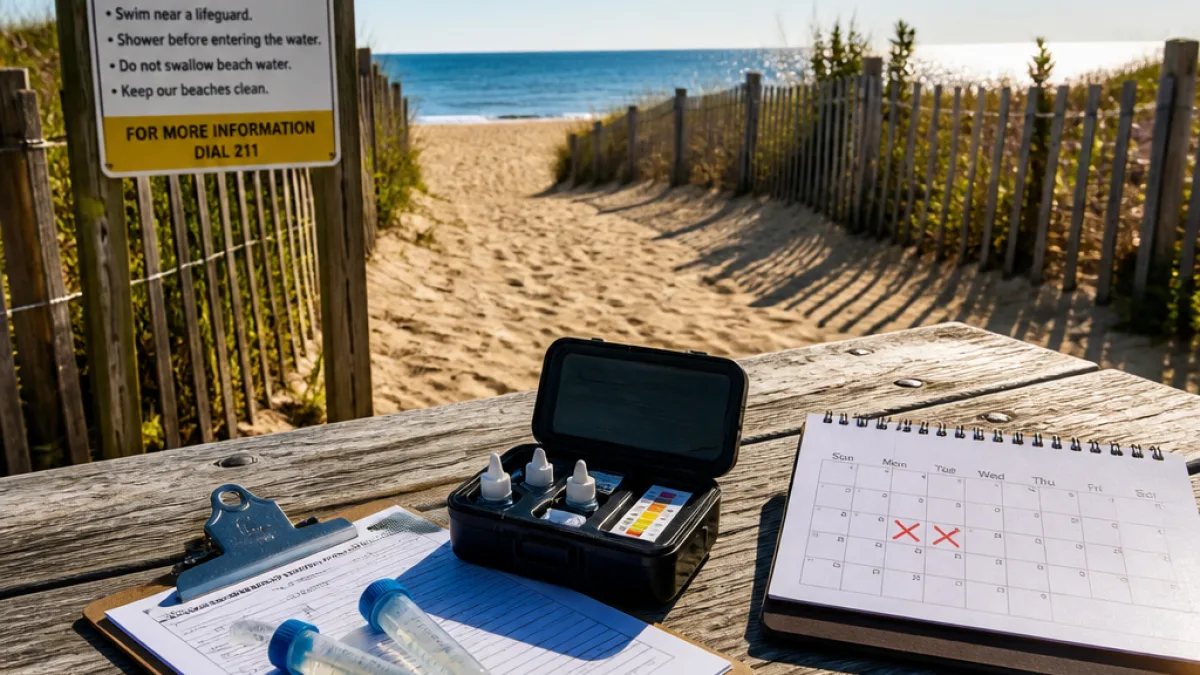
Delaware this summer stopped issuing public swimming advisories after a single test showing elevated bacteria levels, a change that alters how and when beachgoers are warned about water quality risks. State officials now require two consecutive days of high Enterococcus counts before posting an advisory, and they also use a 30‑day geometric mean to assess longer‑term conditions.
What changed and why it matters
Under the revised practice, a solitary sample that exceeds the advisory threshold no longer triggers an immediate public alert. Instead, the state re‑tests the affected site the next day; an advisory is issued only if the follow‑up sample is also high. Delaware continues to track a rolling 30‑day average—the geometric mean—which the Department of Natural Resources and Environmental Control views as a better indicator of overall water quality trends.
Swimmers should still be aware of the risks that elevated bacteria levels signal. High Enterococcus counts can indicate the possible presence of other harmful organisms, increasing the chance of illness after swallowing contaminated water. Those most vulnerable include people with weakened immune systems, young children and older adults.
How beach testing works
The state conducts weekly summertime testing at ocean beaches for Enterococcus, a bacteria commonly used to indicate fecal contamination and related health risk. It takes about 24 hours for lab results to be returned, meaning any advisory based on a daily sample reflects the previous day’s conditions. When a test exceeds the single‑sample threshold, technicians take a second sample the following day to determine if an advisory is warranted.
| Measure | Threshold (Enterococcus colonies per 100 mL) |
|---|---|
| Single daily sample | 104 |
| 30‑day geometric mean | 35 |
Recent testing this summer
State testing records show that there were multiple instances this summer when a daily ocean beach sample exceeded the single‑sample advisory threshold. However, those solitary elevated results did not immediately prompt public warnings because subsequent testing did not produce two consecutive high readings, and the 30‑day geometric mean had not crossed the advisory level.
- Testing is performed weekly during the bathing season.
- Results require approximately 24 hours to be processed.
- An advisory now requires either two consecutive high daily samples or a high 30‑day geometric mean.
Public health implications
Health officials emphasize that the advisory policy change is intended to reduce alerts based on transient spikes while still protecting beachgoers from sustained water‑quality problems. The 30‑day geometric mean smooths out short‑term fluctuations and is meant to reflect longer‑term trends rather than single‑day anomalies.
Even without a posted advisory, swimmers should use judgment: avoid swallowing seawater, stay out of the surf after heavy rains when runoff can elevate bacteria levels, and steer children away from areas where birds congregate or where visible pollution is present. People with chronic illnesses or weakened immune systems should consult their health care providers about swimming in open water when bacterial counts are uncertain.
How to find current testing and advisories
The state maintains a Recreational Water Monitoring website where recent test results and any posted advisories are published. Because results reflect samples taken the previous day, the site shows a rolling picture of conditions rather than real‑time water quality.
Last year, the Department of Natural Resources and Environmental Control worked with the U.S. Environmental Protection Agency on related monitoring questions as the state refined how it evaluates recreational water risks.
This adjustment in practice represents a significant change to how Delaware communicates beach safety. For many residents and visitors, the shift means fewer short‑term advisories but underscores the importance of checking the state’s monitoring site and exercising personal caution at the shore.

















