
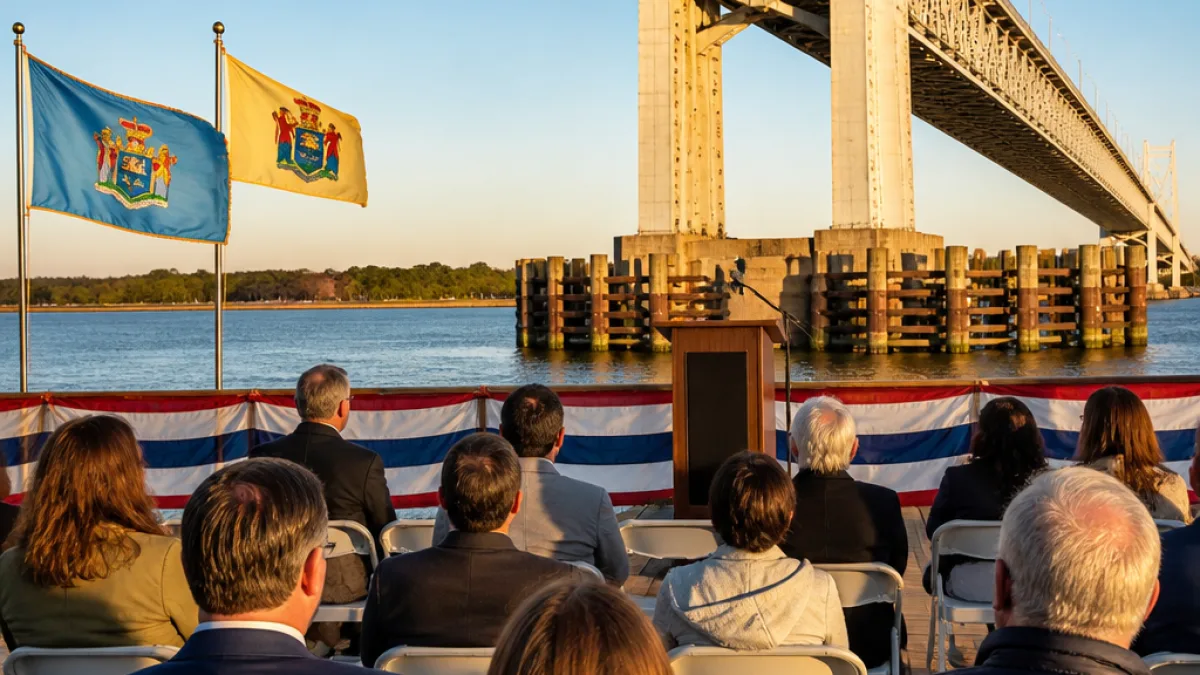
NEW CASTLE, Del. — Officials from Delaware and New Jersey joined leaders of the Delaware River and Bay Authority on Wednesday to mark the 75th anniversary of the First Span of the Delaware Memorial Bridge and to celebrate the completion of a major safety upgrade: an $89 million Ship Collision Protection System.
Historic span, modern protections
The First Span opened to traffic in 1951 and, at the time, ranked among the world’s largest suspension bridges. The anniversary observance recognized that history while highlighting new investments intended to protect the bridge and the commerce that moves across it every day.
The $89 million project is the largest single infrastructure undertaking in DRBA history, according to the agency. The work installs protective measures designed to reduce the risk and consequence of a vessel strike on the bridge piers — a concern for a facility that carries thousands of vehicles and links major highway networks in two states.
Why the protection system matters
Bridge collisions by large commercial or towing vessels can cause catastrophic structural damage and prolonged closures that ripple through regional supply chains. The new Ship Collision Protection System is intended to mitigate those risks and speed recovery if an incident occurs.
- Primary benefit: added physical protection for bridge piers against vessel impact.
- Operational goal: reduce likelihood of prolonged closures to traffic and commerce.
- Scale: the project is the DRBA’s largest single infrastructure investment to date.
Economic and transportation implications
The Delaware Memorial Bridge system is a critical artery for regional traffic and freight movement. Disruption along the crossing would affect daily commuters, commercial trucking and interstate travel between Delaware and New Jersey. Officials framed the investment as one that preserves continuity of travel and commerce for the Mid-Atlantic region.
While the anniversary emphasized the bridge’s legacy, the protection project underlines a forward-looking focus on resilience. Maintaining uninterrupted use of the spans supports local businesses, logistics operations and broader economic activity that depends on reliable river crossings.
Agency and interstate collaboration
The event brought together representatives from both sides of the Delaware River and the Delaware River and Bay Authority. Their participation underscored the interstate nature of the bridge’s management and the shared responsibility for safety and infrastructure investment.
| Milestone | Date / Figure |
|---|---|
| First Span opening | 1951 |
| Historic ranking at opening | Sixth-largest suspension bridge in the world |
| Ship Collision Protection System cost | $89 million |
What comes next
The DRBA will transition from construction to ongoing maintenance and monitoring of the new protections. Officials say the system is intended to meet contemporary standards for maritime safety and to complement routine inspections and bridge maintenance activities that keep the spans safe for motorists.
For the public, the improvements should be largely invisible in day-to-day travel but significant in their potential to prevent major incidents and to shorten recovery time should one occur. Travelers and freight operators benefit from the increased margin of safety without changes to usual crossing patterns.
The commemoration tied the bridge’s mid-20th century engineering achievement to 21st century priorities: preserving a vital crossing while investing in infrastructure resilience. As the DRBA looks toward future needs, this project represents a high-water mark in the agency’s capacity to carry out large-scale protective work on a structure that remains central to regional mobility.
Local residents and regular bridge users marked the anniversary with attention to both the bridge’s past accomplishments and the immediate value of protections intended to keep it operating for years to come.

















