
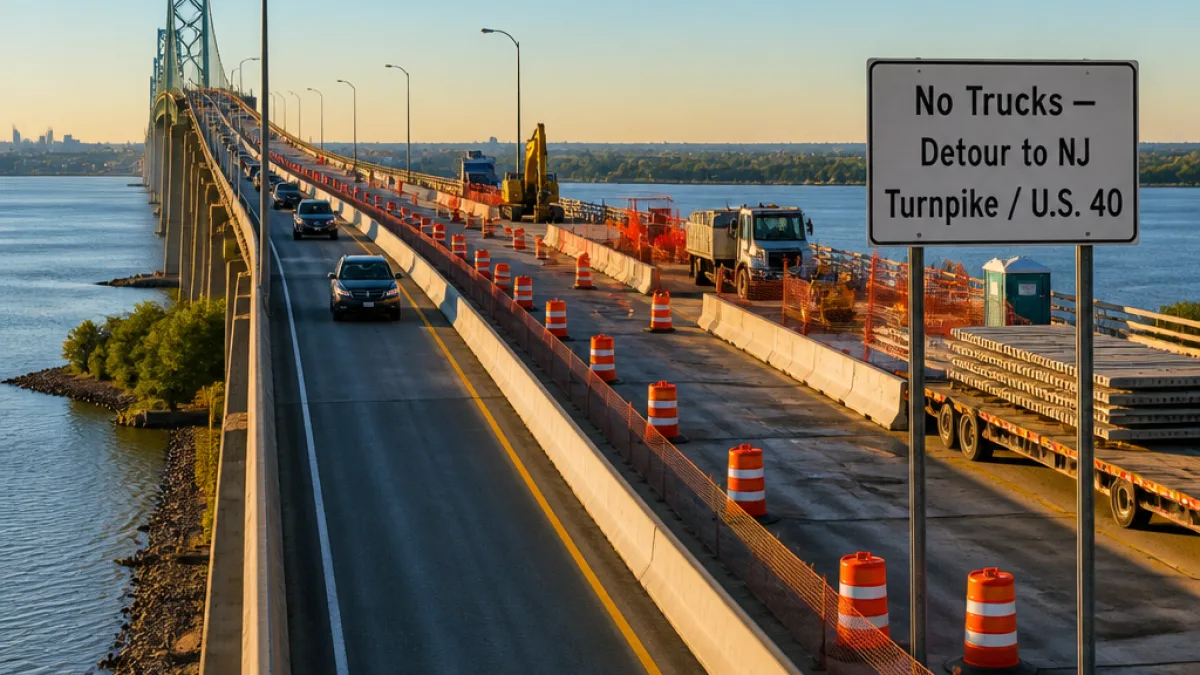
NEW CASTLE — Long-planned bridge preservation work will alter traffic across the Delaware River this fall as crews remove and replace dozens of joints on the northbound span of the Delaware Memorial Bridge.
The Delaware River and Bay Authority announced the project Monday, saying the contractor will begin construction on Sept. 7 and continue through Nov. 24. The schedule places the major portion of the work ahead of the Thanksgiving holiday travel period.
Scope of the work
Crews will take out and replace a total of 46 bridge joints on the New Jersey-bound structure. That includes 24 expansion joints and 22 relief joints. In addition to joint replacement, specialized Ultra High-Performance Concrete (UHPC) reconstruction will be performed adjacent to each joint location to restore the surrounding deck.
“Bridge joints are critical structural components that absorb the natural movement of the bridge caused by temperature changes and continuous heavy traffic,” DRBA Chief Engineer David Hoppenjans said. “Replacing these original joint systems in conjunction with our recent deck preservation work ensures the overall long-term structural integrity, safety, and performance of the bridge for decades to come.”
The DRBA named UHPC Solutions North America LLC as the contractor for the job, which officials characterize as an essential preservation project rather than a full-scale reconstruction.
What drivers can expect
To complete the work, the two right lanes on the New Jersey-bound span will be closed continuously for the duration of the project. The two left lanes on that span will remain open to all traffic.
To preserve overall crossing capacity, authorities will establish a barrier-separated bypass lane on the exterior lane of the Delaware-bound span. That temporary lane will allow passenger cars to travel northbound toward the New Jersey Turnpike or U.S. Route 40 without using the main New Jersey-bound span.
- Passenger cars will be permitted to use the bypass lane to reach the New Jersey Turnpike and U.S. 40.
- Trucks, tractor-trailers, buses and other commercial vehicles will be prohibited from the bypass lane and must use the New Jersey-bound span.
- Drivers headed to local New Jersey exits such as U.S. 130 or Route 49 must remain in the two open lanes on the main New Jersey-bound span because those exits will not be accessible from the bypass lane.
Officials emphasized that while the bypass lane will provide a dedicated route for passenger vehicles bound for specific highways, it will not serve all northbound destinations. Commercial traffic and those needing certain local exits should plan to remain on the main New Jersey-bound lanes.
Practical travel tips and schedule
Commuters and long-distance travelers should expect continuous lane closures on the northbound span from early September through late November. The DRBA has framed the restrictions as necessary to keep the bridge functioning safely for decades by addressing components that accommodate movement from temperature variations and heavy use.
| Item | Details |
|---|---|
| Start date | Sept. 7 |
| End date (estimated) | Nov. 24 |
| Joints replaced | 46 (24 expansion, 22 relief) |
| Contractor | UHPC Solutions North America LLC |
| Traffic change | Two right lanes closed on NJ-bound span; bypass lane on Delaware-bound exterior lane |
Travelers should allow extra time, especially during peak commuting hours and on weekends when holiday travel ramps up. Motorists using GPS navigation may see rerouting suggestions; check with official traffic resources before trips involving the bridge.
Local and regional impact
The Delaware Memorial Bridge is a major corridor for passenger and commercial traffic linking Delaware and New Jersey and serving travelers bound for the New Jersey Turnpike and points north. The lane restrictions and the ban on commercial vehicles in the bypass lane mean freight and bus traffic will concentrate on the main northbound lanes, which could produce congestion or slower speeds at certain times.
DRBA officials say the joint and UHPC repairs are preventive and intended to extend the structure's service life, protecting both daily commuters and long-haul traffic for years to come. While the short-term inconvenience is expected, the agency framed the work as necessary maintenance to prevent more disruptive repairs later.
People planning trips over the bridge in the coming months should monitor local traffic reports, follow posted signage near the bridge approaches and consider alternate crossings if heavy congestion is expected during their travel window.