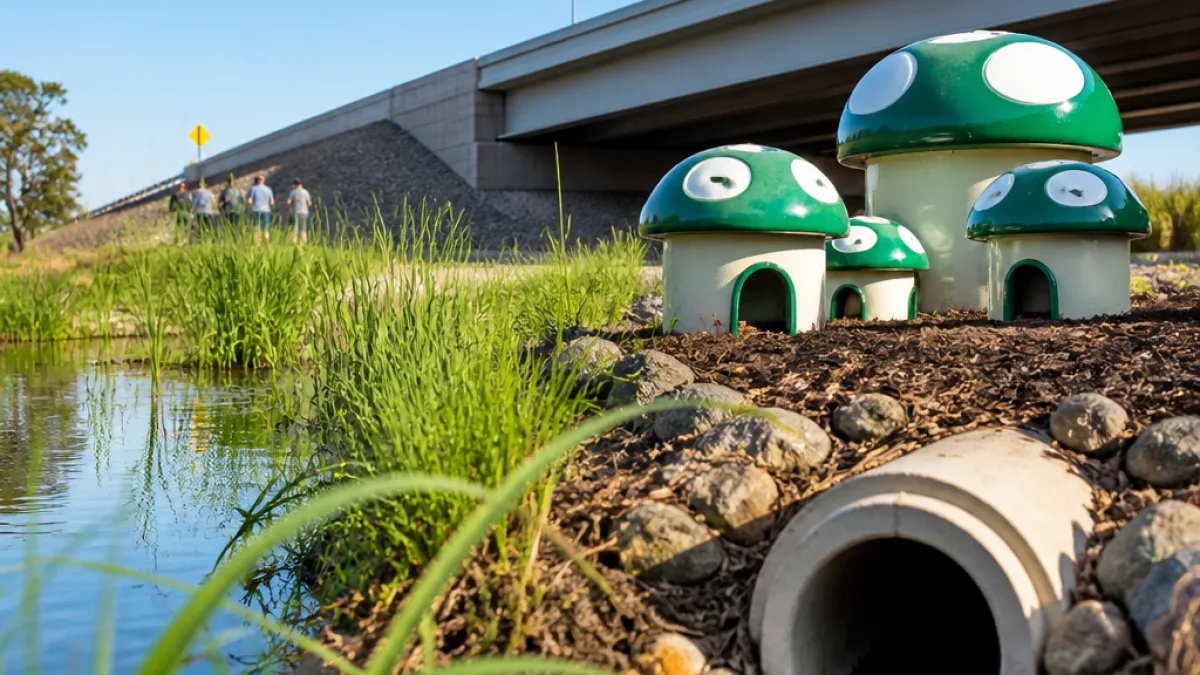
DAVIS, Calif. — In a post office parking lot near Interstate 80, three small green-and-white structures sit close to the ground, each roughly the size of a large shipping box. They are easy to miss unless visitors know where to look. For many in Davis, however, the miniature buildings represent one of the city’s most enduring and unusual stories.
The structures are part of Toad Hollow, a tiny settlement built beside an early wildlife crossing intended to help local amphibians move safely beneath a roadway. The project was conceived as a response to concerns that a new overpass could endanger toads living and breeding near a nearby drainage pond.
A public works project takes an unexpected turn
The controversy dates to 1995, when Davis was preparing to build an overpass along a corridor near Interstate 80. What might have been a routine transportation project became a community dispute after at least one resident warned the City Council that the planned construction could harm the area’s toads.
The proposed answer was a tunnel. Instead of crossing the road surface, the amphibians would have a protected route from one side of the overpass to the other, reducing the risk of being killed by traffic. The concept was presented as a solution already used in other countries, although the Davis project would quickly become far better known for its symbolism than for its results.
“It’s done elsewhere,”
Duane Copley, a city civil engineer at the time, said during the debate, according to the account of the project. Julie Partansky, then a council member who later became mayor, supported the idea after hearing about comparable tunnels in England, the Netherlands and Australia.
The tunnel’s purpose remains part of the debate
The source record does not settle whether the tiny residents were supposed to be toads or frogs. That uncertainty has become part of the attraction. The buildings themselves appear to have been designed as a miniature amphibian neighborhood, including a hotel and a local pub, giving the site a playful civic identity far beyond the practical question of how animals would cross a road.
More than 30 years later, the crossing is generally remembered as an unsuccessful attempt to protect all of Davis’ amphibians. The tunnel did not save every toad, or every frog, but the project did not disappear from public memory. Instead, its shortcomings helped turn it into a local landmark and a national punch line.
| Detail | What the record shows |
|---|---|
| Location | Near Interstate 80, beside a Davis post office parking lot |
| Project period | Debated and developed around 1995 |
| Historical account | Documented in a 1998 book about Davis’ history |
| Site features | Three miniature buildings, including a hotel and pub |
A small site with an oversized reputation
Toad Hollow’s appeal comes partly from the contrast between its scale and its reputation. The buildings are described as rundown and hand-painted, but the setting has become a recognizable example of Davis’ willingness to attach civic meaning to an unconventional idea. The site’s most visible legacy is not a major engineering achievement. It is a reminder of the moment when an ordinary road project collided with concerns about wildlife and community identity.
The story was also preserved in “Growing Pains: Thirty Years in the History of Davis,” a 1998 book by journalist Mike Fitch. That account records how the tunnel proposal moved from a resident’s concern into a formal public discussion involving elected officials and city staff.
Recent images show that the crossing and its miniature companion buildings remain in place. A view recorded on Oct. 19, 2026, captures the tunnel near the post office, while an earlier image from Oct. 20, 1999, documents the site’s presence more than two decades ago. The comparison underscores the project’s longevity, even as its original purpose has faded from everyday public works conversations.
Why Davis still remembers it
For visitors, finding the attraction requires more than following a conventional tourist route. The path leads through the post office parking area and toward the ground near a mailbox, where the small structures appear beside the crossing. That setting reinforces the story’s unusual character: a project with an environmental rationale that became a piece of roadside folklore.
- The crossing was proposed to help amphibians avoid traffic near a new overpass.
- The project grew out of a 1995 discussion about the effect of construction on local wildlife.
- Toad Hollow now functions as a symbol of Davis’ quirky culture, despite the tunnel’s limited success.
The site’s survival gives the community a way to revisit an old civic argument without reducing it entirely to ridicule. The tunnel reflects a genuine concern about animals and development, while the miniature village reflects the humor that followed when the solution became a public curiosity.
In the end, Davis’ amphibian crossing is remembered less as a model of wildlife engineering than as a piece of local character. The animals may not have received the protection residents hoped for, but the town gained a story that continues to draw attention, invite smiles and keep a small corner of the city’s history visible beside the highway.