
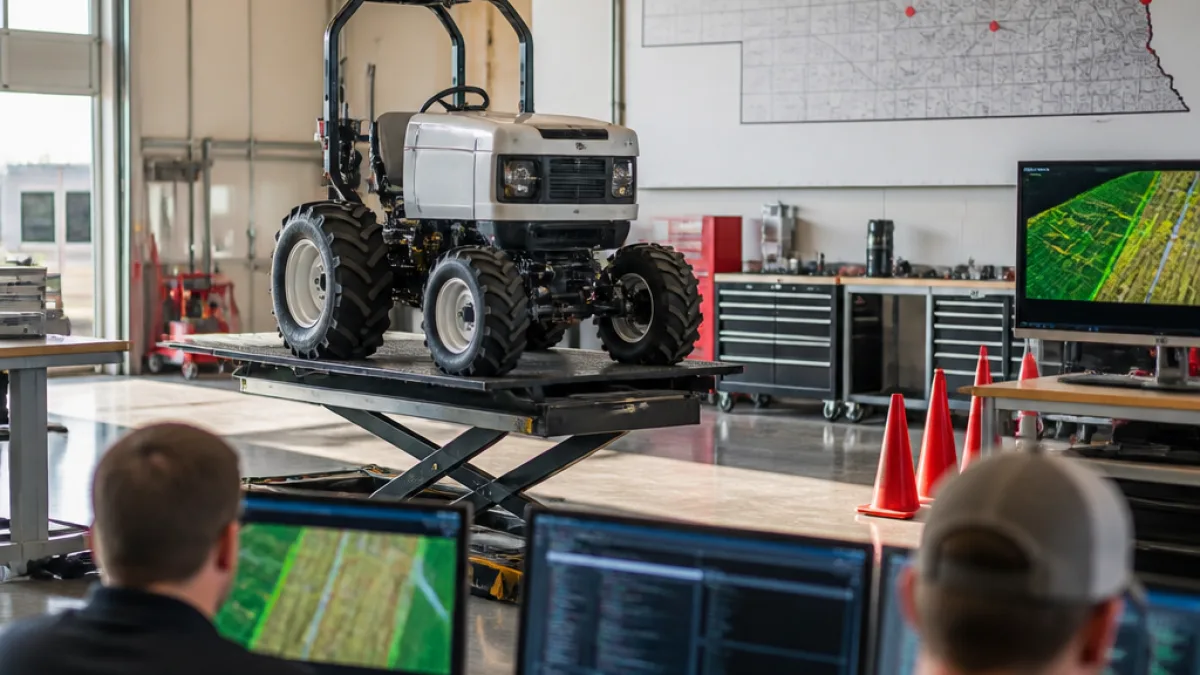
The Canadian company that once operated as JCA Technologies has matured into PTx Trimble and this spring marked a significant expansion into southeast Nebraska with the grand opening of an engineering center in Seward.
The move represents the latest chapter in a relationship that began nearly a decade ago when the Lincoln Partnership for Economic Development introduced the company to researchers and resources at the University of Nebraska–Lincoln. Since that initial contact, university partnerships, talent from Husker programs and local innovation assets have all played a role in attracting and growing the company’s Midwest presence.
Why Nebraska?
Darcy Cook, PTx’s senior director of autonomous solutions, said Nebraska’s strength in engineering and the steady pipeline of graduates influenced the decision to locate in the state.
“The reason we’re in Nebraska is the development of talent and expertise,” Darcy Cook said. “The engineering presence there is very strong. It’s a very good place to build this ecosystem.”
Company engineers and researchers said the fit was reinforced by on-campus expertise in agricultural engineering, robotics and autonomous systems, areas that closely align with PTx Trimble’s product development for tractors, grain carts and other farm machinery.
University ties shape workforce and research
The Seward facility is staffed largely by University of Nebraska–Lincoln alumni and researchers. One such alumnus, Josh Murman, works as an autonomous systems engineer and is pictured with an OutRun Intelligence retrofit kit used to convert conventional tractors and grain carts into autonomous machines. The presence of these Husker-trained engineers signals a close connection between campus programs and private-sector work.
Professors and university staff cited multiple campus resources that helped cultivate the partnership, including the research lab of Santosh Pitla, professor of biological systems engineering. Nebraska Innovation Campus, the university’s Industry Relations office and Career Services also provided connections to facilities, startup space and student talent.
Applied research meets industry needs
Pitla said the collaboration demonstrates the importance of applied research that addresses real-world industry challenges and delivers opportunities for students to work on practical problems.
“When research, education and industry partnerships come together, students gain the opportunity to work on real-world challenges and even
Though the quote in the source material cuts off, the surrounding reporting emphasizes that such partnerships create career pathways for graduates and accelerate technology transfer from campus labs to commercial products.
Local economic and industry implications
The Seward engineering center is another example of how university-industry engagement can anchor technology firms in Nebraska. For the company, the location provides a skilled labor pool and proximity to agricultural operations that can serve as testbeds for autonomous farming systems.
- Talent pipeline: Husker graduates and researchers staff the Seward facility.
- Technology focus: Autonomous systems for tractors, tillage equipment and grain carts.
- Support network: Lincoln Partnership for Economic Development, Nebraska Innovation Campus and university Industry Relations connected the company to campus resources.
| Event | Detail |
|---|---|
| Initial contact | Nearly a decade ago, through Lincoln Partnership for Economic Development |
| University partners | UNL research labs, Nebraska Innovation Campus, Industry Relations, Career Services |
| Facility opening | Spring (grand opening in Seward) |
As the firm continues to develop autonomous farming technologies, Nebraska’s role as a collaborator and source of talent could influence where future engineering and product development work is sited. The Seward center underscores a broader trend of agricultural technology innovation converging with university research and regional economic development efforts.
Local officials and university personnel involved in the partnership said they view the expansion as an example of how targeted engagement between higher education and industry can produce jobs and foster applied research that benefits the state’s agricultural economy.
Further details about staffing levels, investment amounts or product timelines were not provided in the source material.
















