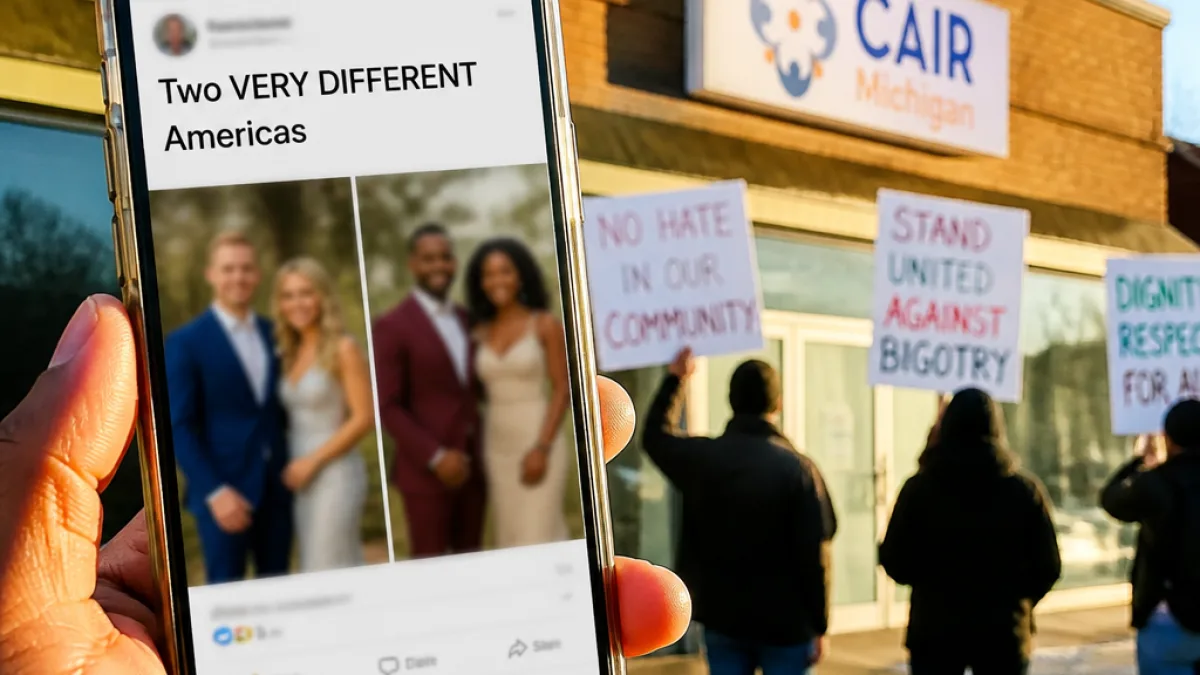
DETROIT — Civil rights advocates and academics are criticizing a Truth Social post by former President Donald Trump that juxtaposes photos of Trump and the first lady with Michigan Democratic U.S. Senate candidate Abdul El‑Sayed and his wife, saying the post relies on language and imagery intended to signal El‑Sayed as foreign or outside mainstream America.
CAIR flags use of full name as deliberate tactic
The post, which carried the headline "Two VERY DIFFERENT America’s," displayed side‑by‑side images of the couples. It also used El‑Sayed’s full name — Abdulrahman Mohamed El‑Sayed — rather than the shortened version he typically uses in public.
Dawud Walid, executive director of the Michigan chapter of the Council on American‑Islamic Relations (CAIR), said the inclusion of the candidate’s full name is an intentional rhetorical move that plays on perceptions of who belongs.
“He is intentionally saying his full name, Abdulrahman Mohamed El‑Sayed, to say, ‘Look, this guy is outside what we would consider to be a normative America,’” Walid said. “It’s a political tactic, and we’ve seen it before.”
El‑Sayed pushes back on air
El‑Sayed, appearing on CNN after the post surfaced, responded by reframing the comparison as a contrast between competing visions for the country. He questioned whether Americans were better off under the current administration and emphasized his and his wife's relationship in a dig at the Trumps.
“So yes, we got two different visions of America. Donald Trump’s vision is the one you are living in right now. Can you afford your gas? Can you afford your groceries?” El‑Sayed said. “And actually, Sarah and I like each other. I don’t know about the first lady and president, but from what I have heard, it’s a bit of a rocky road.”
Experts: messaging taps long‑standing patterns
Nazita Lajevardi, an associate professor of political science at the University of Michigan, said scholars have documented how political messaging frames certain candidates as insiders or outsiders, particularly when religion or ethnicity is at play.
“President Trump is trying to make an Islamophobic point about how Abdul El‑Sayed and his wife are outsiders in this country,” Lajevardi said. “But in reality, to anyone who is looking at those photos, Abdul El‑Sayed and his wife look like a happy, relaxed couple.”
Lajevardi added that the effects of such public messaging reach beyond the targeted public figures: it shapes perceptions and can also influence political engagement among the groups being portrayed.
Local context and potential impacts
Michigan remains a pivotal battleground in national and statewide elections. Attacks that emphasize religion, ethnicity or foreignness can alter campaign dynamics by energizing bases, depressing turnout among targeted communities, or shifting media attention toward identity politics instead of policy debates.
Advocacy groups say the repetition of this type of rhetoric can have real‑world consequences for American Muslims and other minority communities, including increased fear and heightened political mobilization.
- Source of criticism: CAIR‑Michigan
- Academic view: University of Michigan researcher Nazita Lajevardi
- Candidate response: Abdul El‑Sayed on CNN
Reactions and next steps
Local media outlets attempted to contact the El‑Sayed campaign for further comment but had not received a response in the immediate aftermath of the post. CAIR’s public critique signals the group’s intent to publicly document and challenge what it views as Islamophobic tactics in political communication.
| Actor | Statement or action |
|---|---|
| Donald Trump | Posted photo comparison on Truth Social with headline “Two VERY DIFFERENT America’s.” |
| Abdul El‑Sayed | Responded on CNN, contrasted visions of America and criticized current economic conditions. |
| CAIR‑Michigan | Condemned use of El‑Sayed’s full name and framed it as a tactic to cast him as an outsider. |
| Nazita Lajevardi (U‑M) | Called the post a continuation of messaging that defines who counts as American and noted effects on political mobilization. |
This episode highlights how social media posts by national figures can reverberate through Michigan politics, drawing rapid responses from advocacy organizations, academics and the campaigns themselves. As the 2026 election cycle continues, observers say similar exchanges are likely to recur and could influence both public debate and voter behavior.
Reporting note: Local outlets reached out to the El‑Sayed campaign for additional comment but had not received a response at the time of publication.