
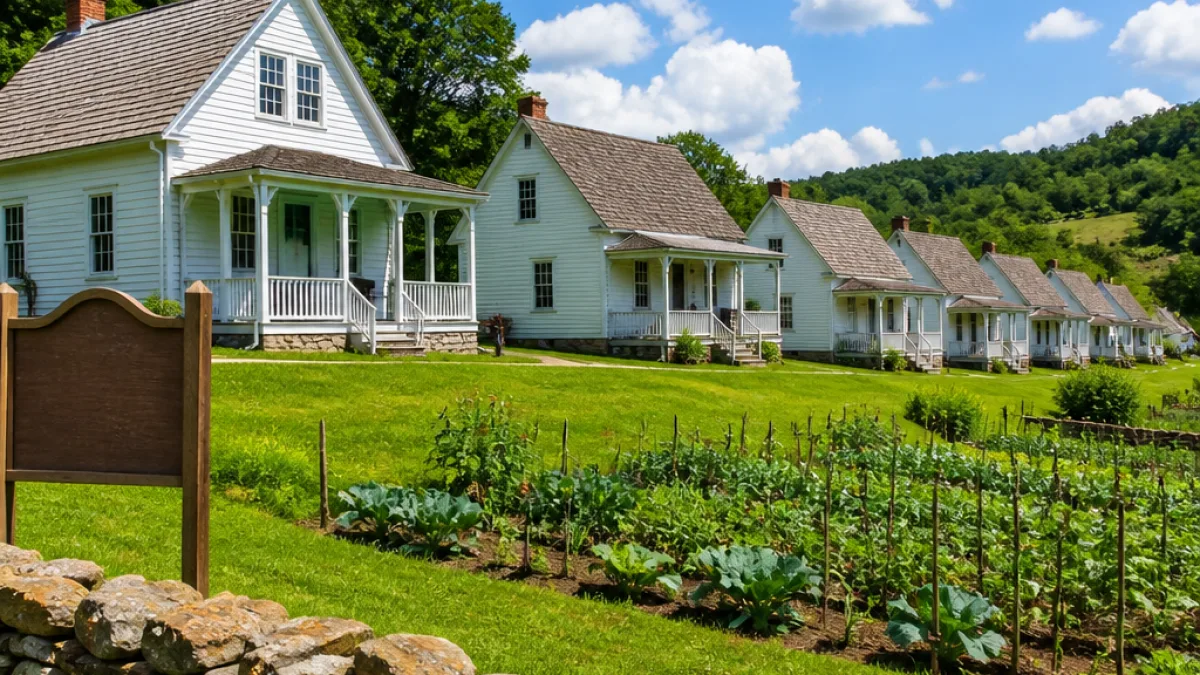
ARTHURDALE, W.Va. — Arthurdale, a planned homestead community established during the Great Depression to aid struggling coal-mining families, has been awarded one of the National Trust for Historic Preservation’s most prestigious recognitions. The community’s steward organization, Arthurdale Heritage, received the 2026 Trustees’ Emeritus Award for Historic Site Stewardship at the National Trust’s Preservation Summit in Washington, D.C.
Federal experiment remembered
The accolade highlights Arthurdale’s national significance as the first of roughly 100 homestead communities the federal government created in the 1930s. Conceived as part of a sweeping effort to address widespread poverty and unemployment, the project near Morgantown was intended to provide low-income families with durable homes, land and new economic opportunities at a time when many in the region relied on precarious coal-mining wages.
Arthurdale’s origins were closely tied to the Roosevelt administration’s broader New Deal reforms. The settlement attracted attention not only for its scale but also for the high-profile support it received from First Lady Eleanor Roosevelt, who championed the project after touring the impoverished Scotts Run area and advocating for a hands-on federal response.
What was built in Arthurdale
The federal program that shaped Arthurdale went beyond houses. Contemporary accounts and historic records detail an array of community amenities intended to help residents establish self-sustaining homesteads and diversify local employment.
- 165 residences constructed for selected families
- Multiple educational institutions — including six schools
- Commercial and industrial facilities: a furniture factory and a metalworking shop
- Agricultural infrastructure: chicken and dairy farms, plus individual homestead plots with barns and outbuildings
- Community and cultural spaces such as a store, community hall, hand-loom shop, pottery kiln and an inn
The homes in Arthurdale were notably pragmatic in design. Architects created what have been described as kit-style houses that emphasized livability and economy, and many of those original dwellings still define the community’s built environment within the national historic district.
Design, self-sufficiency and selection
Individual homesteads were planned to promote partial self-sufficiency. Typical allotments included three to four acres of tilled land, plus food-preservation structures and small livestock facilities. Records from mid-20th-century accounts indicate each homestead commonly featured root cellars, barns, chicken houses, corn cribs, pig pens, electric pumps and fruit trees.
Residents were chosen through an outside relief organization that screened applicants from the mining neighborhoods of northern West Virginia. The intent was to relocate families who faced the worst effects of Depression-era economic collapse into a community where housing, work and land could form the basis for more stable livelihoods.
Preservation and local stewardship
The Trustees’ Emeritus Award recognizes long-term stewardship and preservation efforts that keep historic sites active and meaningful. For Arthurdale, the honor acknowledges the sustained work of preservationists and local volunteers who have maintained the community’s buildings and interpreted its history for residents and visitors.
Arthurdale Heritage’s stewardship helps preserve a physical record of New Deal policies and the social experiments of the 1930s. The award also raises the profile of the community on the national preservation stage, which can boost heritage tourism and educational programming tied to the site.
Continuing relevance
While more than 90 years have passed since the first homesteads were built, Arthurdale remains a touchstone for conversations about how government interventions can influence community development and rural livelihoods. The recognition from the National Trust underscores Arthurdale’s role as both a historical artifact and a living community whose built environment reflects federal policy, local adaptation and community resilience.
| Item | Detail |
|---|---|
| Homes built | 165 |
| Schools | 6 |
| Awards | National Trust Trustees’ Emeritus Award for Historic Site Stewardship (2026) |
The National Trust recognition places Arthurdale alongside a select group of sites honored for their careful preservation and community engagement. For residents and historians in West Virginia, the award offers renewed attention to a distinct chapter of the state’s past and to the ongoing work of preserving that history.


















