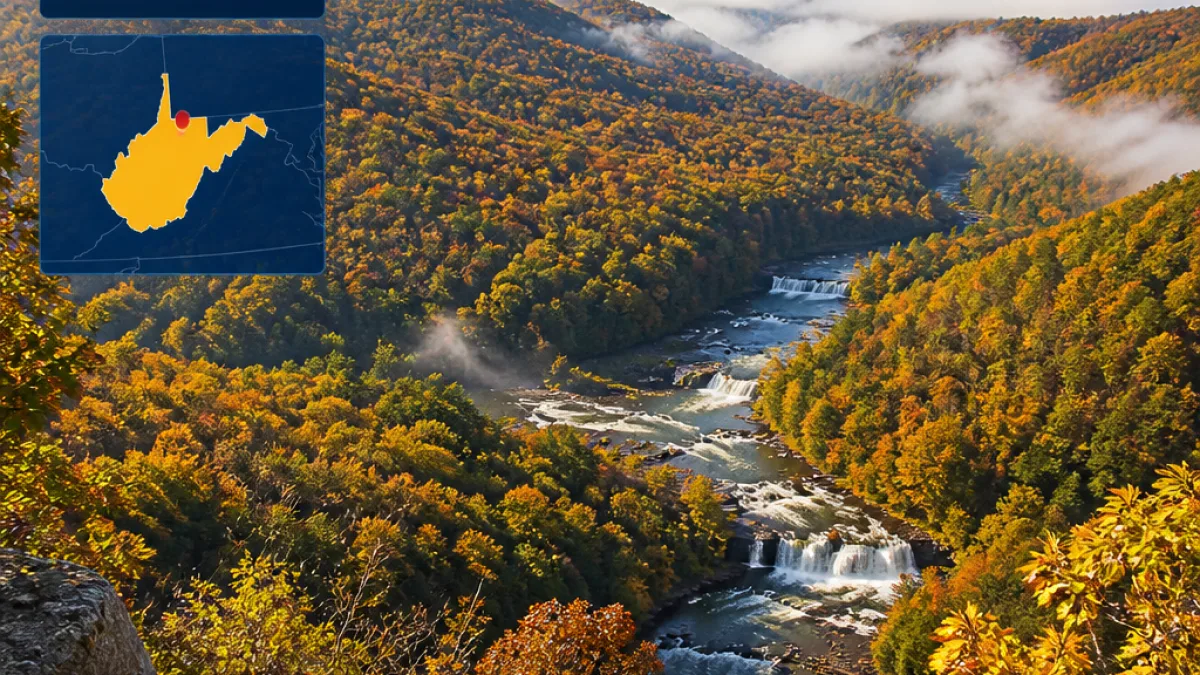
CHARLESTON, W.Va. — West Virginia has been ranked the second-most naturally beautiful state in the United States in an analysis that compared the physical features of all 50 states, a report that has renewed attention to the Mountain State’s outdoor attractions.
How the ranking was calculated
The study, produced by Holafly — a company that provides mobile data services to travelers — assessed states using six specific measures: forest cover, miles of rivers and waterways, the number of waterfalls, highest elevation, National Park Service sites and the presence of active or dormant volcanoes. Travel + Leisure later featured the Holafly analysis.
West Virginia earned an overall natural beauty score of 78.23 out of 100, placing it behind New Hampshire, which scored 90.83, and ahead of Virginia, which received 74.50.
What pushed West Virginia near the top
Rather than dominating a single category, West Virginia ranked well across nearly every metric used in the analysis. Among the figures cited:
- Forest cover: 78 percent
- Miles of rivers and waterways: 6,647 miles
- Number of waterfalls: 174
- Highest elevation: Spruce Knob at 4,863 feet
That balanced performance contrasted with other states that led particular categories. For example, Washington was credited with more than 3,000 waterfalls in the Holafly data set, while Hawaii’s terrain and volcanic features gave it advantages in elevation and geology.
Local landmarks and what they mean for tourism
The ranking highlights well-known West Virginia attractions, including highland summits and notable waterfalls that draw visitors throughout the year. Blackwater Falls in Tucker County is among the state’s best-known cascades, and Spruce Knob — the state’s high point — remains a destination for hikers and sightseers seeking panoramic views.
State tourism officials and local businesses often point to outdoor recreation as a major economic driver in West Virginia. While the Holafly study does not measure visitor spending or lodging trends directly, the prominence of rivers, forests and trails supports an active outdoor tourism industry that includes whitewater rafting, hunting, fishing, and mountain biking.
How the ranking fits with West Virginia’s geography
Geographers and conservationists note that West Virginia’s position within the central Appalachian chain gives it a concentration of ridges, streams and forested landscapes that is unusual relative to its size. That combination of features helps explain why the state performed consistently across the Holafly criteria.
| Metric | West Virginia |
|---|---|
| Forest cover | 78% |
| Miles of waterways | 6,647 |
| Number of waterfalls | 174 |
| Highest point | Spruce Knob, 4,863 ft |
Experts say those physical attributes create a dense mosaic of recreation opportunities compared with many other states. The state’s forests and waterways also support biodiversity and local industries such as forestry and recreation-based services.
What readers should know
The Holafly ranking is one measure among many that evaluate scenic value and outdoor assets. While it places West Virginia high on a list that included states typically associated with tourism — such as Hawaii, Washington and North Carolina — rankings depend on the metrics chosen and the sources of data.
For residents and visitors alike, the practical takeaway is clear: West Virginia’s mix of forests, rivers, waterfalls and mountains contributes to both lifestyle and local economies. Those who plan to explore the state’s outdoors should consult local land managers and tourism resources for safety, seasonal access and conservation guidelines before heading into public lands and waterways.
The Holafly analysis sparked renewed attention to the state’s landscapes when Travel + Leisure ran a feature, and the Mountain State’s placement near the top of the list is likely to be used in promotional material by communities and attractions seeking to attract more visitors.
As West Virginia continues to market its scenic assets, officials and conservation groups face the ongoing challenge of balancing increased visitation with protecting the natural places that made the ranking possible.