
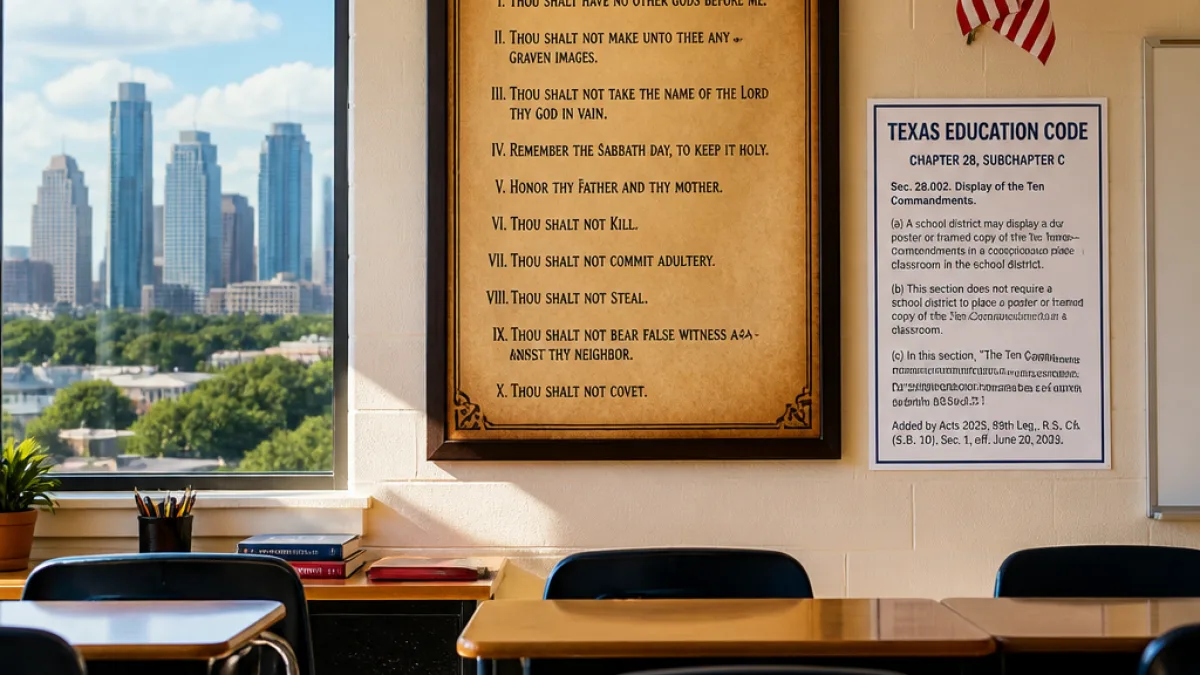
The American Civil Liberties Union asked the U.S. Supreme Court on Monday to take up its challenge to a Texas law that requires public elementary and secondary school classrooms to post a conspicuous display of the Ten Commandments. The petition, filed on behalf of parents from several faith traditions, contends the statute infringes on the First Amendment’s prohibition against government establishment of religion.
Legal clash reaches highest court
State lawmakers passed the law last year, specifying the size and other display requirements for the Ten Commandments in classrooms. The ACLU argues the law compels the government to impose a particular religious text in public schools, an action it says is at odds with the Establishment Clause.
The legal path to the Supreme Court has been uneven. A three-judge panel of the U.S. Court of Appeals for the 5th Circuit sided with Texas, ruling the law may stand. By contrast, an Arkansas judge recently struck down a similar statute as unconstitutional. In its petition, the ACLU said the 5th Circuit’s decision conflicts with prior Supreme Court precedents and has deepened disagreement among lower courts about how to apply Establishment Clause doctrine.
“As a rabbi and parent, forcing a Christian version of the Ten Commandments on children in every classroom is particularly upsetting,”
The ACLU’s petition includes statements from parents challenging the law. One plaintiff, Joshua Fixler, identified in the filing as a rabbi and a parent from Houston, described the requirement as especially troubling to families of non-Christian faiths.
What happens next
The Supreme Court receives thousands of petitions each term and accepts only a small fraction for review. The justices typically consider such requests at a closed-door conference after the Court’s next term begins in the fall. The petition from the ACLU has not yet appeared on the court’s public docket; the Hill obtained a copy of the filing directly from the civil liberties group.
If the Court agrees to hear the case, it could clarify how far states may go in permitting or requiring religious displays in public schools — a question with potential consequences beyond Texas. The issue follows other recent high-profile decisions by the Court involving religion in public education and public life, including rulings on school instruction materials and public prayers.
Local and broader implications
The dispute is likely to have practical effects inside Texas classrooms if the case proceeds. School districts, administrators and teachers may face uncertainty over compliance and enforcement while litigation continues. Parents and community groups on both sides of the issue have signaled strong interest; lawmakers in several Republican-led states have recently enacted similar measures requiring Ten Commandments displays.
Legal observers say the case could also test the Court’s current approach to Establishment Clause questions, given the conservative majority’s recent rulings favoring expanded religious expression in public settings.
Timeline of key developments
| When | Action |
|---|---|
| Last year | Texas Legislature enacted law requiring Ten Commandments displays in classrooms |
| Recent months | Arkansas judge struck down a similar law |
| 5th Circuit decision | Appeals court upheld Texas law |
| Monday | ACLU filed petition asking Supreme Court to hear the case |
What stakeholders are saying
- ACLU: Argues the law violates the Establishment Clause and conflicts with Supreme Court precedent.
- Parents Plaintiffs: Represent families of different faiths who object to a state-mandated religious display in public classrooms.
- State supporters: Backers in Texas and other states say the displays reflect historical and moral values (position summarized from legislative context).
As the case moves forward — or is declined — the outcome will shape how states balance historical displays and religious neutrality in public education. The ACLU’s filing puts a spotlight on the competing legal interpretations that the Supreme Court may be asked to resolve in the coming term.
— Reported from Austin.

















