
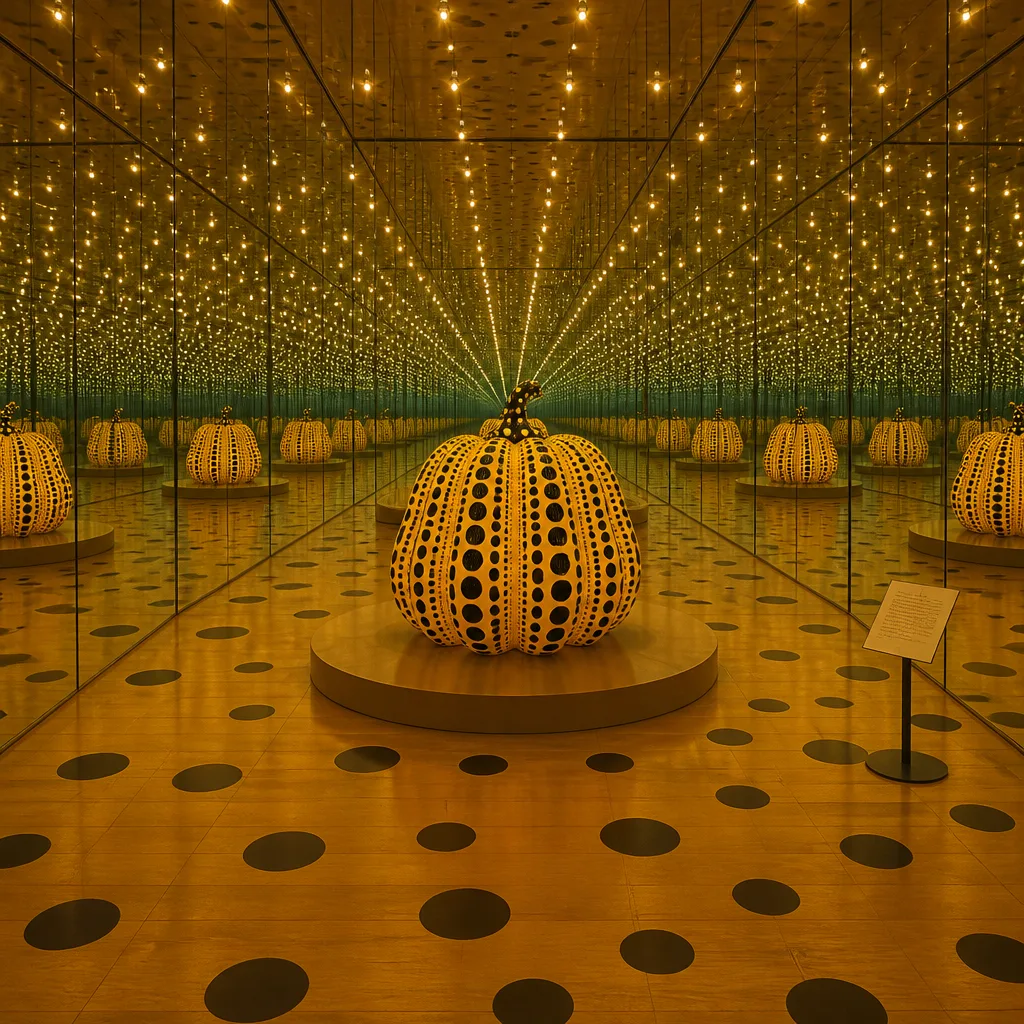
Yayoi Kusama, the Japanese artist whose polka dots, pumpkins and immersive Infinity Mirror Rooms made her one of the world’s best-known contemporary figures, has died. A statement on the artist’s official website said she passed away at a hospital in Tokyo on 14 August at the age of 97.
From wartime Japan to global fame
Kusama’s rise to international prominence was striking given a difficult early life and long periods of obscurity. Born in 1929, she spent much of her childhood in a household described as dysfunctional and abusive, and during World War II she worked in a military factory sewing parachutes. From an early age she experienced vivid hallucinations that flooded her world with repeated forms — the polka dots that would later dominate her work.
After brief study of the modernist nihonga painting style in Kyoto, Kusama left Japan in her late twenties. Encouraged by a correspondence with the American artist Georgia O’Keeffe, she moved to the United States in the late 1950s, first arriving in Seattle before relocating to New York. There, amid the emergence of pop art and countercultural movements, she developed a bold, experimental practice that encompassed painting, sculpture, installation, performance, film and literature.
Art that immersed and unsettled
Her Infinity Mirror Rooms — large-scale installations that used repeated reflections, light and colour to create the sensation of endless space — attracted millions of gallery visitors. Her earlier Infinity Nets paintings, with obsessive fields of repeated marks, and her playful pumpkin sculptures and polka-dot canvases became signature motifs. The commercial success of her work was reflected in strong auction returns, with some pieces selling for millions.
“It is with profound sorrow that (we announce) the passing of Yayoi Kusama at a hospital in Tokyo on August 14,” the statement on her official website said.
Provocation, performance and perseverance
Kusama’s practice was never confined to conventional categories. In the 1960s she staged “happenings” that aligned with countercultural performance art while challenging social mores. Her output also included surreal film work and written pieces. Throughout her life she candidly struggled with mental illness; the hallucinations she described informed the repeating patterns and obsessive surfaces that became her hallmark.
Her later years brought unprecedented recognition. Museums around the world staged major retrospectives and long queues formed for immersive installations that offered audiences a participatory experience. According to the statement from her team, Kusama “continued to paint until her final days, never setting aside her brush, and continued exploration of forever love and eternal soul,” underlining a lifelong dedication to making art.
What she leaves behind
Kusama’s influence is visible across contemporary culture: from high art institutions to public fascination with immersive, Instagram-friendly installations. Her career trajectory — from a young woman painting in Kyoto to a global artistic phenomenon in New York and beyond — highlighted both the persistence of an individual creative vision and the shifting institutions that elevated her work.
- Born: 1929 (Japan)
- Died: 14 August 2026 in Tokyo, aged 97
- Best known for: Infinity Mirror Rooms, polka-dot motifs, pumpkin sculptures, Infinity Nets
- Career highlights: moved to the US late 1950s; active across painting, sculpture, installation, performance, film and writing
| Art form | Notable characteristic |
|---|---|
| Installation | Immersive mirrored rooms creating endless reflections |
| Painting | Obsessive repeated marks, ‘Infinity Nets’ and polka-dot fields |
| Sculpture | Playful pumpkin works and three-dimensional polka-dot forms |
Though the details of forthcoming tributes and exhibitions will emerge in the coming days and weeks, Kusama’s work already occupies a secure place in the story of postwar and contemporary art. Her practice — driven by a combination of vivid internal vision and rigorous repetition — challenged audiences and offered new ways to experience space, colour and form. In life and work she remained, to millions, an unmistakable and immediately recognisable presence.
The full official statement on her passing was posted on the artist’s website on Thursday.














