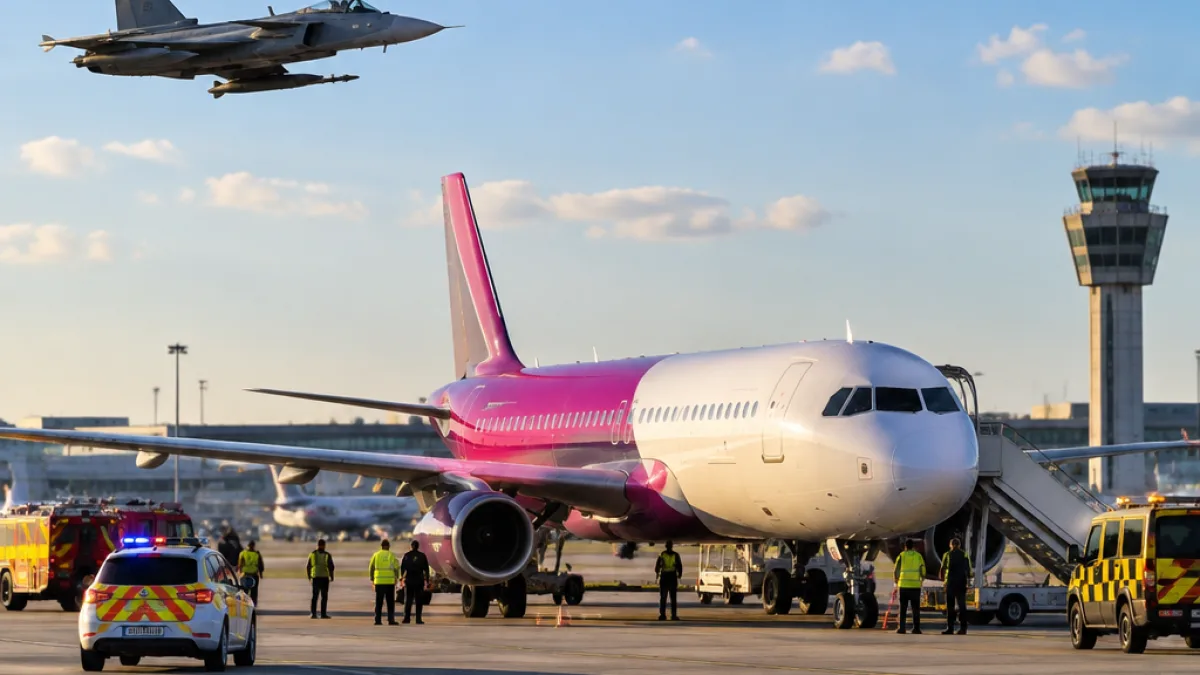
A Wizz Air aircraft travelling from London Luton to Sofia was diverted to Budapest on Monday after a bomb threat was reported during the flight, prompting the deployment of a Hungarian Gripen fighter jet.
The Airbus A321 was redirected while it was flying over Bosnia and Herzegovina, according to flight-tracking information cited in reports. It had been expected to reach Sofia at about 1.25pm local time, but was instead directed towards Hungary and landed at Budapest Liszt Ferenc International Airport.
Hungary’s defence minister, Romulusz Ruszin-Szendi, confirmed that the military aircraft had been sent to escort the passenger plane. His account said the alert forced the Wizz Air service to abandon its planned route and seek permission to land in Budapest.
“The plane received a bomb threat, which forced it to abort its flight, and the landing was secured by a Gripen fighter jet.”
The Gripen’s role was to accompany the aircraft as it approached the Hungarian capital. The intervention brought a military air-defence response to an incident that began on a commercial route from London, although the available information does not indicate that the aircraft was in danger of crashing or that anyone on board was injured.
Aircraft and passengers checked after landing
After landing, the plane was moved to a designated area of the airport. Wizz Air said Hungarian authorities then carried out security checks involving both the aircraft and the passengers. Police also introduced additional measures following the arrival, according to the Hungarian authorities.
The airline said the flight had been diverted in line with its security procedures and that it was co-operating with officials investigating the threat. The aircraft landed safely, but the source information does not say whether the threat was judged to be credible, who made it, or whether anyone was arrested.
“The aircraft diverted and landed safely at Budapest Liszt Ferenc international airport in accordance with the relevant security protocols and procedures, before taxiing to a designated stand, where the relevant authorities carried out the necessary security checks on the aircraft and passengers.”
For passengers at Luton and those planning to fly to Sofia, the incident is a reminder that an aircraft can be taken off its scheduled route even when the reported threat is received after departure. The flight’s original journey was between the United Kingdom and Bulgaria, but the response involved authorities in several countries as the plane crossed European airspace.
What is known about the diversion
| Detail | Information available |
|---|---|
| Origin | London Luton |
| Planned destination | Sofia |
| Actual landing point | Budapest Liszt Ferenc International Airport |
| Reason for diversion | Bomb threat received during the flight |
| Military response | A Hungarian Gripen fighter jet escorted the aircraft |
The Hungarian defence minister described the incident as a test of the country’s air-defence readiness and said its forces had been able to respond immediately. That statement confirms the military dimension of the operation, but does not provide further detail about the nature of the alert or the source of the threat.
Wizz Air said the safety of passengers and crew remained its highest priority. Its statement did not give a revised timetable for the service, explain when the aircraft might continue to Sofia, or set out what arrangements were being made for travellers affected by the diversion.
Investigation remains with the authorities
The next stage is expected to focus on the security inspection and the circumstances in which the warning was received. At the time of reporting, no further information had been provided about the outcome of the checks, the identity of the person responsible for the threat, or whether the flight would resume its journey.
Passengers or relatives seeking practical updates should rely on information issued by Wizz Air, Budapest airport and the relevant authorities rather than flight-tracking data alone. Flight trackers can show a change of route and landing point, but they do not establish why a diversion took place or whether an aircraft has been cleared to continue.
The incident began with a flight leaving London, but the operational response was completed in Hungary, where officials secured the aircraft and began the checks. Until those authorities publish further findings, the confirmed facts remain that the Luton-to-Sofia service was diverted following a bomb threat, landed safely in Budapest and was placed under additional security measures.