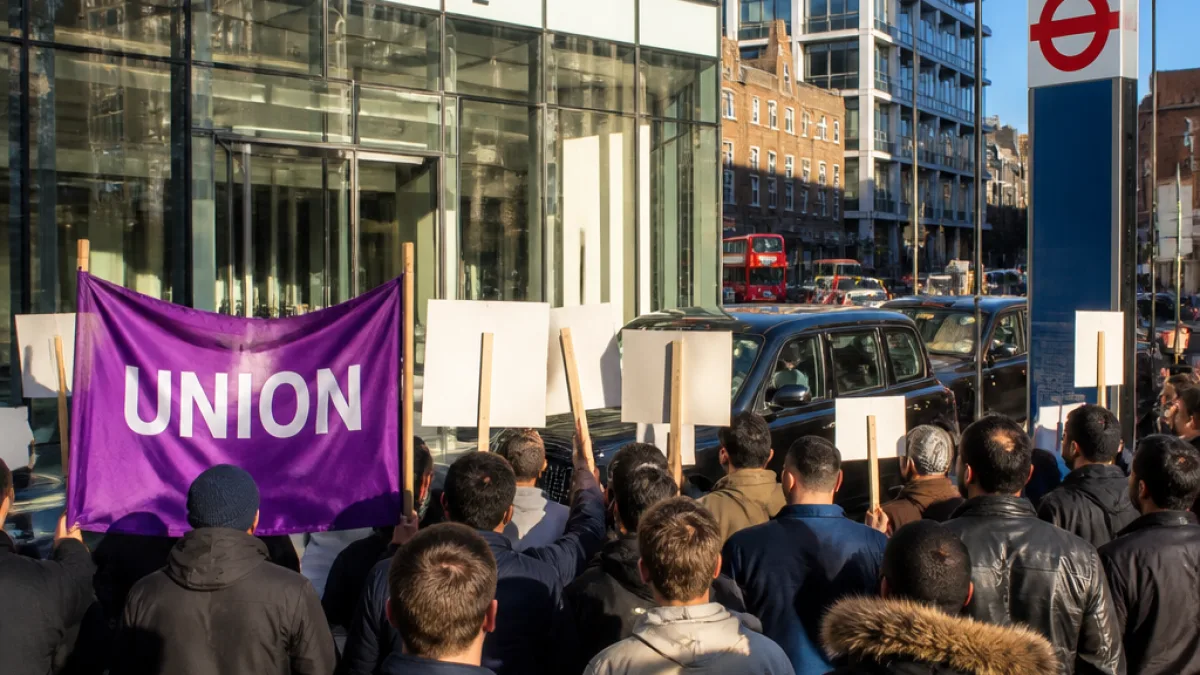
About 15 demonstrators — taxi and private-hire drivers joined by union representatives and campaigners — gathered outside the King's Cross offices of autonomous vehicle developer Wayve to demand an immediate halt to trials of driverless taxis on London’s roads.
Drivers say trials threaten livelihoods and safety
The protest comes as companies including Wayve and Waymo test autonomous vehicle technology in the capital with human safety operators on board. Demonstrators told WE NEWS they were alarmed by what they describe as a lack of information for those who work on London’s streets.
Abdurzak Hadi, a private-hire driver and member of the App Drivers and Couriers Union (ADCU), said he feared being put into direct competition with vehicles that could, in theory, operate round the clock. He told the crowd he was uncertain about Transport for London’s position and wanted licences for driverless cars to be suspended until clearer rules are available.
"I'm worried that I'll be forced to compete with a machine that can work 24 hours."
Campaigners from Fare Free London and GMB union representatives said their concerns extend beyond job losses to road safety and congestion. Priyanka Khurana of Fare Free London warned that adding autonomous cabs would increase the number of cars on the city’s roads, undermining efforts to expand public transport and cut traffic.
"By adding more cars, you're first of all taking away the jobs of the taxi drivers,"
James Rossi, a GMB representative and London bus driver, said unions were not seeking to oppose technological progress but wanted “assurances” that workers affected by automation would be protected and supported, including through retraining funded by the companies that introduce the technology.
"We're not here to stop artificial intelligence. What we want is assurances."
Industry response and regulatory context
Wayve told WE NEWS it was proceeding cautiously, taking a phased approach to developing autonomous services and working with Uber and Transport for London to ensure any future roll-out would be responsible. The company’s trials currently include a safety operator inside the vehicle.
Waymo is also testing driverless technology on London streets. These tests follow a period of rapid development in automated vehicle systems globally and renewed interest from technology firms in urban ride services.
Separately, a recent London Assembly Transport Committee report warned driverless taxis could worsen congestion and pose risks to employment in the private-hire and taxi sectors. The committee urged TfL to seek greater clarity on how the technology would be introduced and its likely impacts.
What protesters are asking for
Protesters set out a short list of demands for regulators and companies involved in trials:
- Immediate suspension of licences for driverless vehicles until comprehensive guidance is issued by TfL;
- Clear communication with drivers about trials taking place on London roads;
- Safeguards to protect jobs and employer-funded retraining schemes for staff displaced by automation;
- Full assessment of congestion impacts before any expansion of autonomous taxi services.
On the streets around King’s Cross, drivers said they felt excluded from conversations shaping the future of the city’s transport network. "No message was sent to the wider drivers to inform them of the situation," one protester said, calling for transparency from both developers and regulators.
Snapshot: positions at a glance
| Actor | Stated position |
|---|---|
| Wayve | Phased development, working with Uber and TfL; safety operators present during trials |
| Taxi & private-hire unions (ADCU, GMB) | Want licences suspended until clearer rules and worker protections are in place |
| Fare Free London | Opposes expansion of autonomous cabs due to congestion and job loss concerns |
| London Assembly Transport Committee | Warned driverless taxis could worsen congestion and threaten jobs |
For Londoners concerned about road safety, congestion and the future of work in the capital, the demonstration underlines growing tensions as firms test advanced technologies in public spaces. Transport for London has responsibility for licensing and oversight of vehicles operating in the city and will face pressure to clarify its approach as trials continue.
At King's Cross, motorists and pedestrians noticed the small but vocal presence of drivers defending their livelihoods. One passer-by told WE NEWS the debate should not be reduced to tech-versus-jobs: "We need a proper plan that keeps people working and our streets safe."
The protest was peaceful and short-lived, but organisers say it signals the start of an increased campaign to secure stronger protections for the capital’s drivers as autonomous technology advances.