
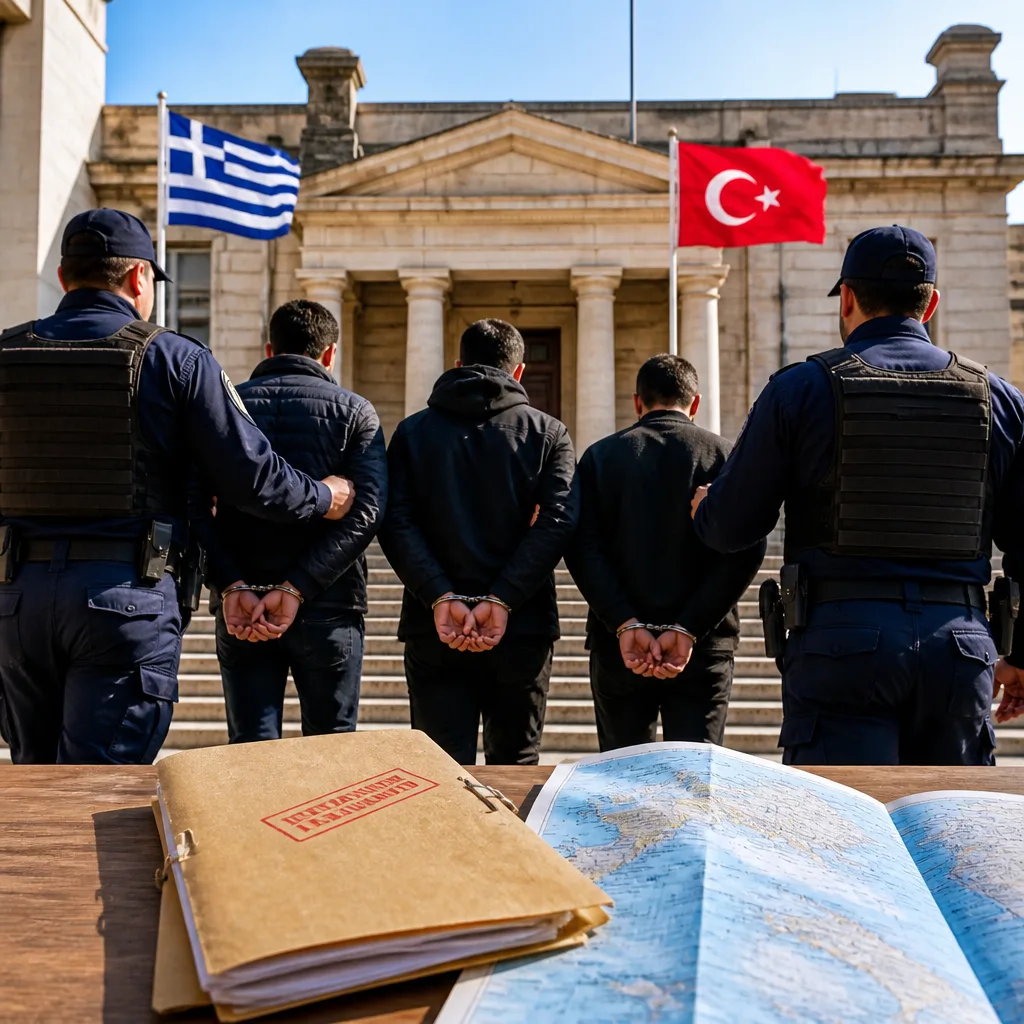
Türkiye has requested that Greece extradite three men sought on serious criminal allegations, including the suspected head of the Bayğaralar organised‑crime network, following bilateral talks between justice ministers in Athens.
Athens says courts cleared extraditions, two transfers halted by ECtHR
Justice Minister Akın Gürlek raised the cases of Ramazan Bayğara, Nedim Sorguç and Ali Yeşildağ during an exchange with his Greek counterpart, Yorgos Floridis. According to Greek officials, national judicial authorities have approved the extradition requests and the Greek government has given its assent.
"Greek judicial authorities had approved the extradition of all three suspects and the Greek government had endorsed the decisions."
However, Floridis said the transfers of Bayğara and Sorguç are currently suspended because of interim measures imposed by the European Court of Human Rights (ECtHR). The ECtHR can issue such measures to prevent a transfer where it finds there may be a real risk to an individual's rights while it considers an application.
Allegations and procedural developments
Turkish authorities identify Ramazan Bayğara as the alleged leader of the Bayğaralar group and have sought his arrest internationally under an Interpol Red Notice. He was detained in Greece and formally requested for extradition to face charges that include the establishment of a criminal organisation and intentional homicide, according to Turkish judicial requests.
Nedim Sorguç is accused by Türkiye of membership in a criminal organisation and drug trafficking. His planned removal to Türkiye had been due to take place on 20 August, but was interrupted by an application to the ECtHR that resulted in interim measures. Ali Yeşildağ is wanted on allegations of intentional homicide and an armed robbery involving multiple perpetrators.
| Suspect | Alleged offences | Current status |
|---|---|---|
| Ramazan Bayğara | Establishing criminal organisation; intentional homicide | Detained in Greece; extradition request approved; transfer paused by ECtHR measure |
| Nedim Sorguç | Membership of criminal organisation; drug trafficking | Extradition approved; transfer halted following ECtHR application |
| Ali Yeşildağ | Intentional homicide; armed robbery with multiple perpetrators | Extradition request pending; Greek authorities approved transfer |
Broader co‑operation and concerns over transnational crime
Gürlek used the meeting to argue that transnational organised crime has become a pressing area for co‑operation between the two neighbours, saying criminal groups increasingly operate across borders and exploit technology and social media to recruit and to facilitate offences ranging from drug trafficking and money laundering to robbery and homicide.
He also noted administrative steps taken in Türkiye to expedite and co‑ordinate investigations into organised‑crime networks, including a circular issued to chief public prosecutors at 75 heavy penal court centres across the country’s 81 provinces. The move is designed to speed up casework and strengthen co‑operation with foreign authorities.
- Extradition requests formally made to Greece for three suspects wanted by Türkiye.
- Two transfers (Bayğara and Sorguç) are on hold because of interim ECtHR measures.
- Bilateral co‑operation emphasised amid concerns over cross‑border organised‑crime networks and online recruitment.
The developments underscore the complex intersection of national criminal justice systems, international human‑rights oversight and the practicalities of extradition. Where the ECtHR issues interim measures, member states normally defer transfers until the court has had an opportunity to consider the substance of the application. That process can prolong cases and requires co‑ordination between domestic courts, executive authorities and Strasbourg.
As the legal procedures continue, Greek authorities will need to balance domestic court rulings and government decisions with compliance with European human‑rights obligations. Any eventual handover would be subject to the lifting of the ECtHR measures and the completion of the required administrative formalities in both countries.
There was no immediate public comment from the suspects’ legal representatives in Greece in relation to the requests. Both governments indicated a desire to deepen judicial co‑operation to combat organised crime that operates across borders.














