
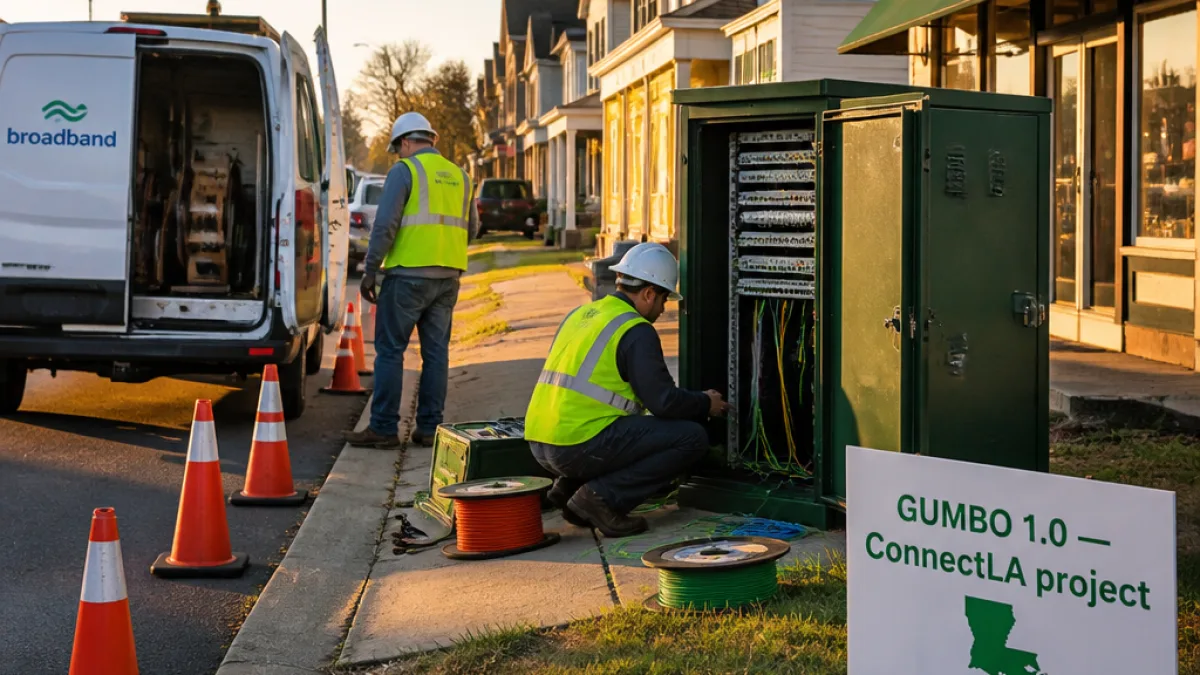
State-backed project delivers new connections across Livingston Parish
More than 200 households and around 30 businesses in Livingston Parish have gained access to reliable broadband following a recent expansion delivered by Spectrum, officials have said. The work was funded through Louisiana’s Granting Underserved Municipalities Broadband Opportunities programme, known as GUMBO 1.0, and coordinated by ConnectLA.
Authorities say the project is part of a broader effort to address the digital divide across the state. In announcing the milestone, Governor Jeff Landry described the work as historic for Louisiana and said improved infrastructure will create new economic opportunities for families.
"We are making history in Louisiana," the governor said. "As better infrastructure continues to be placed across our state, we are providing new opportunities for families to continue to prosper in today's economy. I'm grateful to President Trump and our Louisiana congressional delegation for helping make this progress possible."
The expansion is a commercial and public-sector collaboration: Spectrum delivered the installations while funding came from the GUMBO 1.0 initiative under the auspices of ConnectLA. Officials did not publish a detailed timetable for the rollout or the precise neighbourhoods reached, but confirmed the scheme directly benefits more than 200 households and roughly 30 businesses in Livingston Parish.
What this means locally
For residents and enterprises in and around Livingston Parish, new or more reliable broadband connections can have multiple immediate effects. They commonly include:
- Improved access to remote education and online resources for students;
- Enhanced opportunities for home-working and small-business operations that rely on stable internet; and
- Greater reach for local firms seeking online customers or services.
While the delivery partner and funders have framed the expansion as a targeted move to reduce inequity in digital access, the announced figures are modest in scale compared with larger national programmes. Nevertheless, for the households and enterprises affected, the change is tangible: households moving from unreliable or absent service to consistent broadband can see immediate improvements in daily life and economic prospects.
Wider context and unanswered questions
The announcement situates the Livingston Parish work within a national conversation about the role of public funding and private providers in extending broadband to underserved communities. The governor’s statement referenced support from federal political figures, signalling co-ordination across levels of government.
Civic leaders and residents will now look for further details about coverage maps, service speeds, pricing and customer support. The initial press release did not specify the exact speeds available on the newly connected lines, nor did it outline whether further phases of expansion are planned for other unserved or underserved neighbourhoods within the parish.
There is also interest in how small businesses will be supported to capitalise on the new connectivity, for example through training, digital marketing assistance or local business networks. Local councils and community groups commonly play a role in helping households and firms make best use of upgraded infrastructure; however, no co-ordinated local support package was detailed in the announcement.
| Metric | Reported figure |
|---|---|
| Households connected | 200+ |
| Businesses connected | ~30 |
| Programme funding source | GUMBO 1.0 (ConnectLA) |
For Livingston Parish residents, the practical test of success will be whether the new connections deliver affordable, reliable speeds and if local people and enterprises can translate connectivity into improved opportunities. Officials involved in the project have set out the headline numbers; the next stage for the community will be scrutiny of service quality and the broader economic and social outcomes that follow.
As networks expand nationwide, small-scale projects such as this one are being watched for lessons about partnership models, deployment speed and the extent to which state-backed schemes can reach the communities that have historically lagged behind urban centres.










