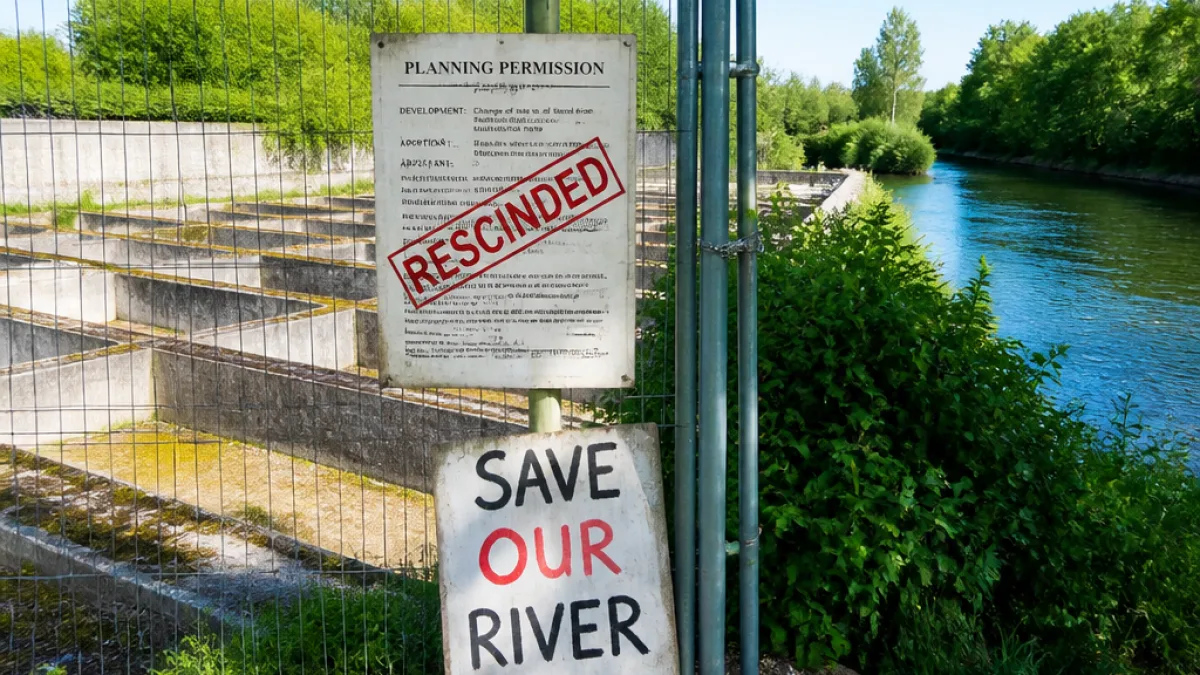
Wiltshire Council has moved to rescind planning permission for an inland salmon farm at the former trout ponds in Downtown, near Salisbury, after a campaign group filed a legal challenge arguing the authority did not carry out an environmental impact assessment (EIA).
What has happened
The council approved Avon Valley Salmon’s plans in May to turn the site’s concrete tanks into a closed-system salmon farm. In June, Communities Against Factory Farming (CAFF) lodged a judicial review claim at the High Court, asserting the council failed to consider the need for an EIA and did not properly take animal welfare into account.
Following the challenge, Wiltshire Council wrote to CAFF saying it would rescind the planning permission, a move the company said would delay the project but not end it. The applicant, Avon Valley Salmon, has indicated it will work with the council and regulators while the matter is resolved.
Concerns from campaigners and company response
CAFF’s claim raises a series of environmental questions. The group has highlighted the site’s proximity to the River Avon Special Area of Conservation and expressed worry about where sludge from fish waste would be spread if removed from the site.
“There isn't really a safe way of finding out where it's going. Is it going to be spread on fields that don't really need it? There's just a lot of unanswered questions.”
The quote from Maya Pardo of CAFF summarises the group’s concern that the council had not demonstrated the project’s full environmental impact through an EIA, and that animal welfare considerations had not been properly weighed.
Avon Valley Salmon’s owner, Julian Connor, told reporters that the council had not previously required an EIA but now has. He described the rescinding of permission as “disappointing” but said the firm did not see it as stopping the project, estimating a delay of around six months.
The company has argued the scheme would operate a closed system of concrete tanks with specialist filters and extensive wastewater treatment and claimed its discharge water would not pollute the local river. It also said a canopy or building over the tanks would reduce contamination risks from birds and the need for antibiotics.
Local implications
For Salisbury residents, the dispute touches on several local priorities: water quality in the River Avon catchment, the handling and destination of farm waste, and the transparency of planning processes for developments near sensitive environmental sites.
The area has already been subject to heightened scrutiny because the Avon valley is designated a Special Area of Conservation; developments within the catchment require careful assessment to ensure protected habitats and species are not harmed.
- Environmental scrutiny: An EIA would set out likely significant effects on the local environment and identify mitigation measures.
- Animal welfare: CAFF argues welfare considerations were not adequately explored in the original decision.
- Timing and local economy: The company anticipates a delay of roughly six months, which affects investment and local employment prospects tied to the project.
What happens next
The judicial review process will determine whether Wiltshire Council’s original decision complied with legal requirements on environmental assessment and related duties. If the court finds in favour of CAFF, the decision could be set aside. The council’s decision to rescind permission may be a procedural step while it reconsiders the application in light of the legal advice.
| Key dates / facts | Detail |
|---|---|
| Planning approval | Granted by Wiltshire Council in May |
| Judicial review filed | Claim lodged by CAFF in June |
| Council action | Written to CAFF to rescind planning permission |
| Company response | Owner says project delayed ~six months; company claims closed system prevents river pollution |
The unfolding legal and planning exchanges will be closely watched by residents and local environmental groups in Salisbury and the wider Avon valley. The case raises wider questions about how local authorities balance economic development with statutory obligations to protect designated conservation areas and to assess the environmental consequences of intensive farming operations.
Reporting will continue as the judicial review progresses and as Wiltshire Council clarifies the next steps in its handling of the application.