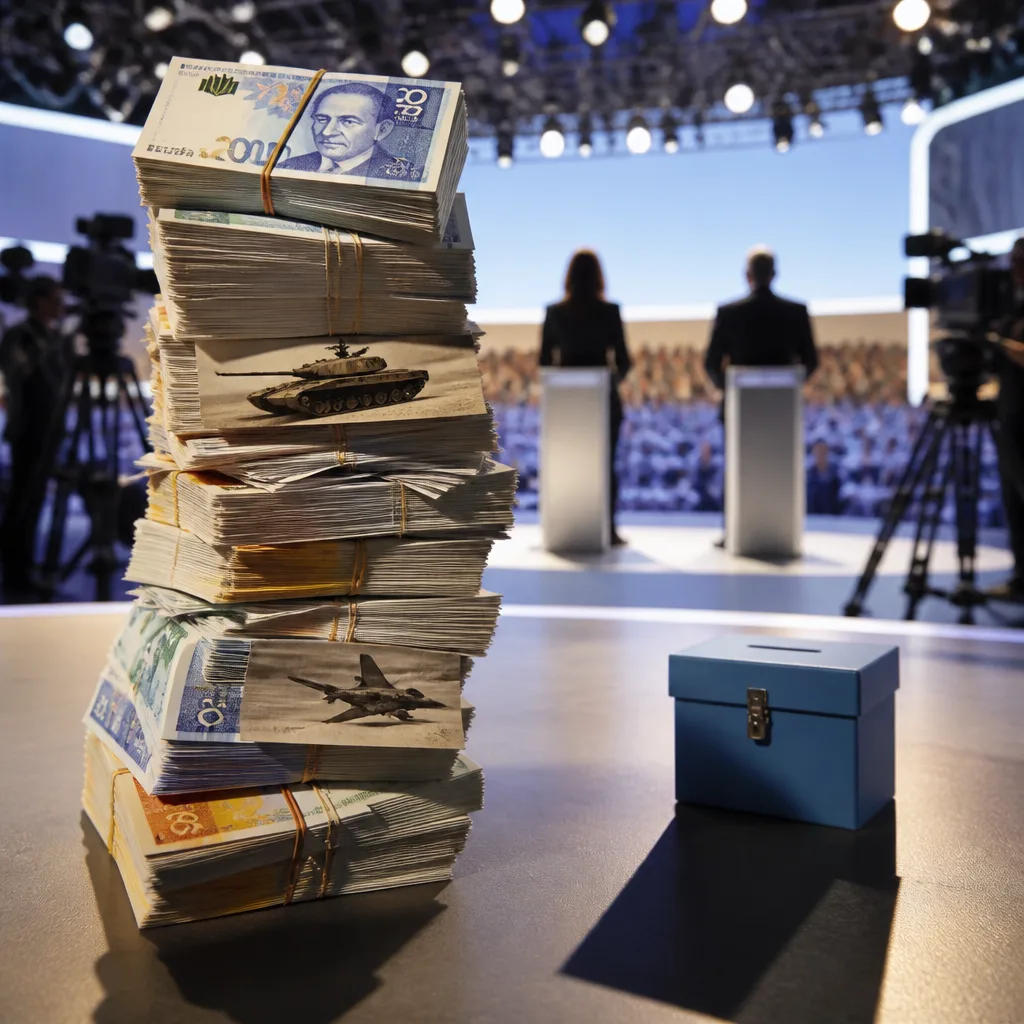
Israel’s parliamentary campaign is being fought overwhelmingly on security themes, with parties promising strength against regional foes. Behind the rhetoric, however, the state’s public finances have absorbed an extraordinary burden from sustained military operations — a strain that is receiving scant attention from the front-runners in the run-up to October’s ballot.
War spending reshapes the budget
Official estimates show the scale of the fiscal shift. The Bank of Israel calculated that between 2023 and 2026 some 350 billion shekels was spent on conflicts in Gaza, Lebanon, Syria and other theatres, a figure that does not include spending on the war with Iran that began in late February. In April the Finance Ministry reported an additional 35 billion shekels linked to that most recent campaign.
Defence outlays account for the bulk of those sums. The Bank of Israel reported defence expenditure of 249 billion shekels, and defence’s share of gross domestic product has expanded rapidly — rising from about 5.2% in 2023 to more than 8% in 2024, according to central bank figures.
Debt and revenue: a tightening squeeze
The fiscal consequences are measurable. The Finance Ministry now places public debt at roughly 1.4 trillion shekels, up from about 1.07 trillion prior to October 2023, a jump driven largely by the cost of successive military operations. Tax receipts, however, have continued to flow: the state reported record tax collection of 509.3 billion shekels, though the resilience of revenues has not offset the charge of higher borrowing.
Analysts warn that the combination of heavy defence spending and rising debt will complicate policy choices for any incoming government. Higher borrowing raises the cost of servicing debt, and sustained military expenditure crowds out other public priorities such as health, education and infrastructure.
“Unfortunately, there just isn’t any electoral benefit in talking about the economy,”
said Yossi Mekelberg, an associate fellow at Chatham House, summing up a widely observed dynamic among Israeli politicians.
Why the debate avoids fiscal detail
There are several reasons the economics of war has been marginalised in campaign discourse. For politicians, security messaging is politically lucrative; it appeals to candidates’ bases and to a broad electorate worried by regional instability. Discussing complex fiscal trade-offs, by contrast, is less likely to move votes and can invite unpopular spending or tax choices.
Moreover, the immediacy of threats and the visibility of military operations create a political environment in which long-term economic consequences are easily overshadowed. That pattern helps explain why contesting parties are devoting limited airtime to debt trajectories and medium-term fiscal planning.
- Short-term pressure: Ongoing conflicts require urgent budgets that are politically difficult to cut.
- Electoral incentives: Security messages are more salient for voters than abstract debt discussions.
- Fiscal crowding out: Defence spending has risen faster than other budget items, narrowing policy choices.
| Metric | Value |
|---|---|
| War-related spending (2023–2026) | 350 billion shekels |
| Additional April expenditure (war on Iran) | 35 billion shekels |
| Defence spending | 249 billion shekels |
| Defence share of GDP | 5.2% (2023) → >8% (2024) |
| Public debt (post-October 2023) | 1.4 trillion shekels |
| Public debt (pre-October 2023) | 1.07 trillion shekels |
| Tax collection (latest reported) | 509.3 billion shekels |
The fiscal reality presents voters with a clear trade-off. Sustained high defence spending can provide short-term security benefits. It also risks longer-term economic strain, higher debt service costs and reduced fiscal space for social programmes.
As campaigning intensifies, the central question for policymakers will be whether the political class can be induced to debate those trade-offs openly. For now, analysts say, the issue remains notable more for its absence from televised forums and rallies than for the policy alternatives offered by parties on the stump.