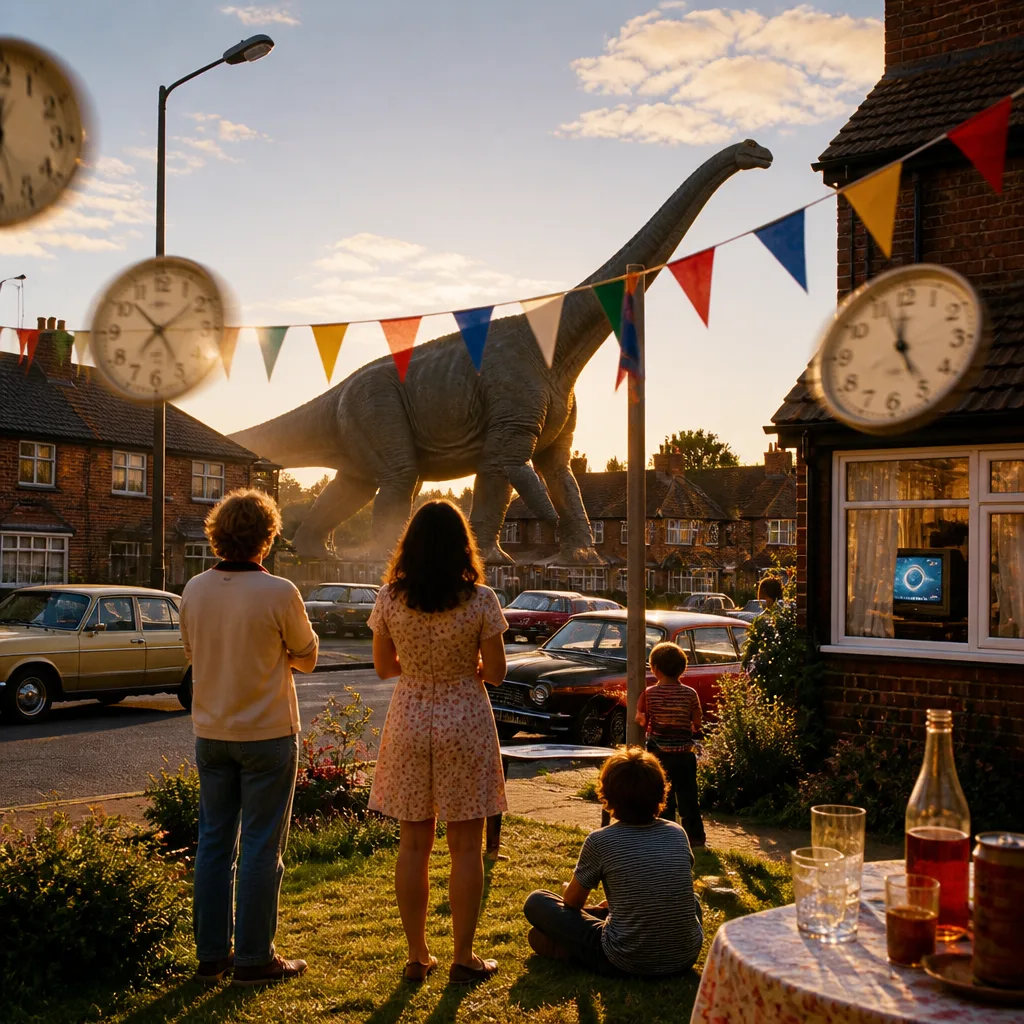
The End of Oak Street, the new film written and directed by David Robert Mitchell, catapults suburban domesticity into a nightmarish scramble when dinosaurs suddenly stalk a sleepy neighbourhood — and then the timeline itself unravels.
Plot mechanics: family life meets temporal anomaly
Set initially in 1982, the film opens amid ordinary, recognisable rhythms — block parties, parental rows and adolescence’s bruised feelings — only to introduce a scientific hint that everything will not remain ordinary. A news segment in the early scenes mentions NASA examining strange temporal phenomena, a thread that many viewers may miss as the story foregrounds the Platt family’s domestic tensions.
Denise Platt, portrayed by Anne Hathaway, becomes the first to notice temporal oddities in her neighbourhood after visiting the widow Mrs Huddleston. A plant in Mrs Huddleston’s garden has inexplicably sprouted at an unnatural rate; library research yields little explanation, but local characters such as the librarian Mrs Valcourt begin to suggest that something unusual is at work.
“How does the time travel in The End of Oak Street work?”
From suburban horror to bewildering finale
The film’s middle and later sections shift register dramatically: dinosaurs invade the streets, tear through lawns and turn neighbours into grisly set dressing. These slasher-style moments and graphic kills have divided reaction, but it is the ending that has provoked the most discussion. The narrative’s deployment of time-travel elements reframes earlier scenes, asking the audience to reassess what they have witnessed and how causality operates in Mitchell’s story.
Critics and audiences alike have been left debating whether the finale is meant to be taken as a literal rearrangement of events, a metaphor for grief and family breakdown, or a deliberately ambiguous coda that leaves interpretation open. Whatever the intention, the result is the same: the film refuses to tidy its mysteries into a conventional resolution.
Key components to watch for
- Temporal hints: an early broadcast about NASA research into anomalies and inexplicably fast-growing flora.
- Character reactions: Denise’s curiosity drives the investigation, while supporting figures like librarian Mrs Valcourt and widow Mrs Huddleston provide clues rather than answers.
- Genre blending: suburban drama, slasher horror and speculative time-travel elements collide, culminating in a polarising final act.
| Act | Notable events |
|---|---|
| First (1982) | NASA news item; domestic set-up; Denise notices strange plant growth |
| Middle | Dinosaurs appear; escalating violence and suburban carnage |
| Ending | Time-travel revelation reframes prior events and invites debate |
Fans of Mitchell’s earlier work will spot his appetite for mixing tones and unsettling narrative shifts; here, he borrows the scale and wonder of Spielbergian spectacle, then strips it down to something more intimate and grotesque. The presence of performers such as Hathaway and Ewan McGregor — alongside younger cast members — gives the domestic drama immediate emotional stakes, even as the film periodically detaches into shock-driven set pieces.
For viewers left scratching their heads, the safest reading is to treat the time-travel element as a structural device: it punctures the film’s realist surface and forces an examination of cause, consequence and memory. Whether audiences accept the final beat as satisfying will depend on how comfortable they are with ambiguity and tonal whiplash; for some, the ending is a bold flourish, for others an unsatisfactory obfuscation.
Mitchell’s film will likely keep viewers talking — and re-watching — as they try to stitch the chronology back together. That, perhaps, is precisely its intent: a summer story of neighbourly squabbles and adolescent longing that, when rewound and warped, exposes the fragile architectures upon which everyday lives are built.