
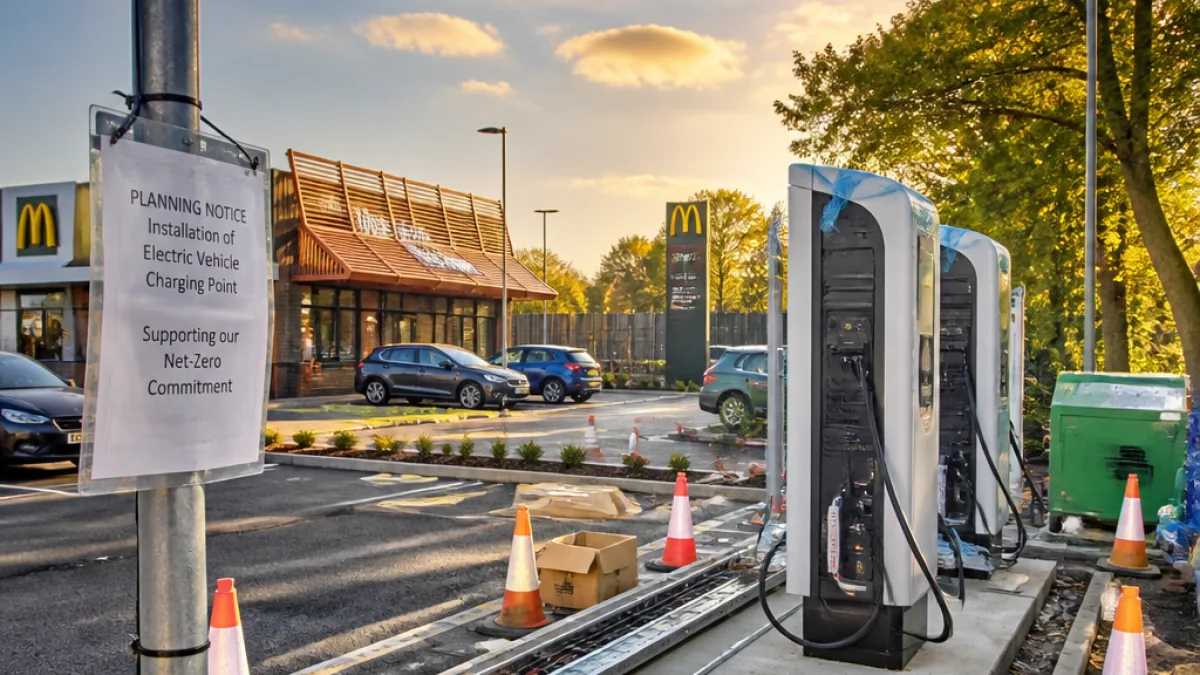
Plans have been submitted to install two rapid electric vehicle (EV) charging stations within the customer car park of the McDonald’s on James Watt Way in Greenock, documents lodged with the planning authority show.
What is proposed
The application, made by InstaVolt Ltd, would place two fast-charging units in the existing car park, which currently holds 22 vehicle parking spaces. The documents do not specify whether the number of parking bays will change following the installation.
"install two rapid electric vehicle charging stations at the McDonald's on James Watt Way"
The submission says the work would not disturb any trees nor increase local flood risk. It also states that the installation is consistent with Scottish planning policy, particularly in relation to targets for achieving net-zero greenhouse gas emissions by 2045.
Local context and likely impacts
Installing rapid chargers at a high‑footfall roadside location could make charging more convenient for drivers passing through or visiting the town centre fringe. For Greenock residents considering switching to electric, additional public charging points are a key practical factor.
However, the application leaves some local questions unanswered. The existing car park capacity of 22 spaces is confirmed in the paperwork, but there is no clear statement on whether bays will be removed, repainted or reallocated to create the charger locations. That detail will be of interest to customers, local commuters and residents who use the car park.
- Applicant: InstaVolt Ltd
- Site: McDonald’s, James Watt Way, Greenock
- Current car park capacity: 22 spaces
- Proposed new equipment: Two rapid EV chargers
- Stated environmental impacts: No trees affected; no increased flood risk
Policy alignment and the wider picture
The applicant points to Scottish planning objectives and the national target for reaching net-zero emissions by 2045. Public rapid chargers at commercial sites form part of the wider network planners and policymakers expect to grow as more motorists move away from petrol and diesel vehicles.
For Greenock, which has a mix of residential areas, industrial estates and key road links, adding chargers at an accessible roadside commercial outlet could support local EV adoption and provide a refuelling option for drivers on longer journeys. For operators such as McDonald’s, offering charging facilities can also be part of broader corporate sustainability strategies.
What happens next
The planning application will be assessed by the local authority against relevant material considerations, including parking provision, highway safety, environmental impacts and conformity with local development plans. Local residents and other stakeholders will have the opportunity to view the proposals and submit comments during the statutory consultation period.
Pending determination, the proposal is the latest example of private-sector investment in EV infrastructure in the area. How the scheme is implemented — notably whether it will reduce overall parking capacity or reserve bays for charging users — will determine its practical effects on daily life for people who use the James Watt Way car park.
| Detail | Information from application |
|---|---|
| Applicant | InstaVolt Ltd |
| Location | McDonald’s, James Watt Way, Greenock |
| Chargers proposed | 2 rapid EV charging stations |
| Current parking spaces | 22 |
| Environmental impact noted | No trees disturbed; no increase in flood risk |
Residents looking for more information should consult the planning portal or the local authority’s weekly list of applications to see when the proposal is validated and open for comment.














