
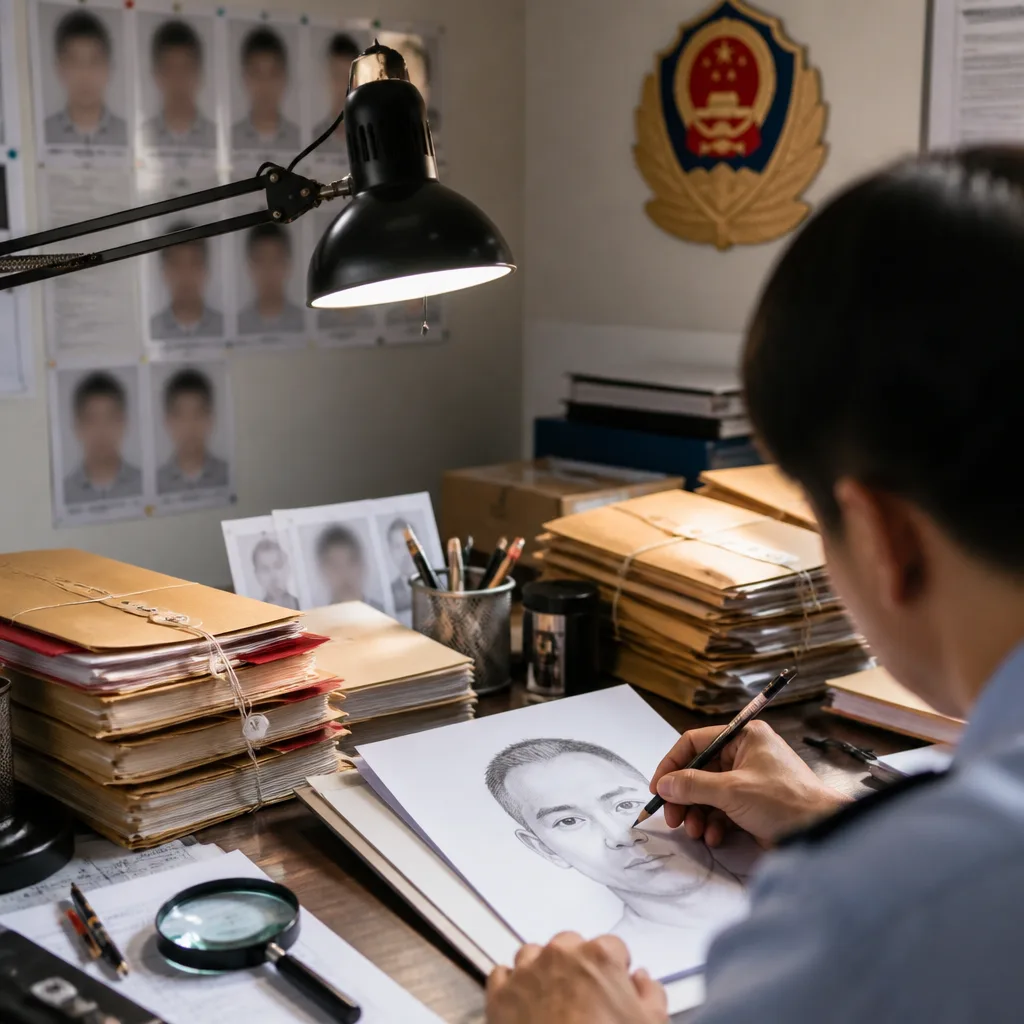
A forensic sketch artist in north-east China has told how combining artistic training with an understanding of criminal investigation has helped police identify suspects in more than 130 cases over a career spanning 26 years.
From art college to police technical unit
The artist, Cui Quan, 57, works in the criminal investigation division of the public security bureau in Yanji city, in the Yanbian Korean autonomous prefecture of Jilin province. He graduated from the College of Arts at Yanbian University in 1993 and initially served as a police officer at a grassroots station in Yanji before applying his drawing skills to police work.
According to the account, Cui presented his college sketch portfolio to relevant departments within the bureau and in 2000 was dispatched to the technical department, where he began to explore and utilise forensic sketching in investigations.
Technique, training and early challenges
Cui described the early years of his practice as a period of steep learning. When he first produced sketches based on eyewitness descriptions of features such as the nose, eyes and face shape, many witnesses reported that the images either did not resemble the suspects or only partly did.
"Initially, when I created sketches of suspects based on victims' descriptions of features like the nose, eyes, and face shape, most eyewitnesses said my sketches didn't — or only somewhat — resemble the suspects,"
He said this experience taught him that forensic sketching is more than draughtsmanship. "It requires rich experience, scientific inference, and a deep understanding of the verbal descriptions provided by witnesses to create an image that closely matches the real appearance," he said, adding that he spent the first five years learning from others and broadening his knowledge.
- Professional background: College of Arts graduate turned police officer.
- Shift to forensics: Dispatched to the bureau's technical department in 2000 to pursue sketching work.
- Case outcomes: Sketches credited with assisting in over 130 cases during 26 years.
- Skill development: Studied complementary disciplines, including criminal psychology, to improve effectiveness.
Career milestones
The narrative also notes a spur to Cui's interest: a 1999 television news programme that featured Zhang Xin, a national expert in police sketching who had reportedly helped solve a major case through portraiture. That programme inspired Cui to pursue his talent within policing.
| Year | Event |
|---|---|
| 1993 | Graduated from College of Arts, Yanbian University |
| 1999 | Television feature on Zhang Xin that inspired Cui |
| 2000 | Dispatched to technical department to work on forensic sketching |
| 2000–2026 (26 years) | Provided sketches that assisted in over 130 cases |
The account emphasises that producing useful forensic portraits demands not only artistic proficiency but also investigative judgement: interpreting sometimes imprecise eyewitness descriptions and applying scientific inference to generate likenesses that aid enquiries.
While the precise nature of the cases in which Cui's sketches played a role is not detailed in the material provided, the claim of more than 130 beneficiary cases underlines the continued role that specialist sketch artists occupy within some policing systems, particularly where photographic or video evidence may be absent.
The story also illustrates how specialist skills may evolve within police forces when individuals with relevant civilian qualifications apply them to investigative work and then augment them with domain-specific study such as criminal psychology.
No further operational details, investigative outcomes or corroborating statistics were provided in the source material.














