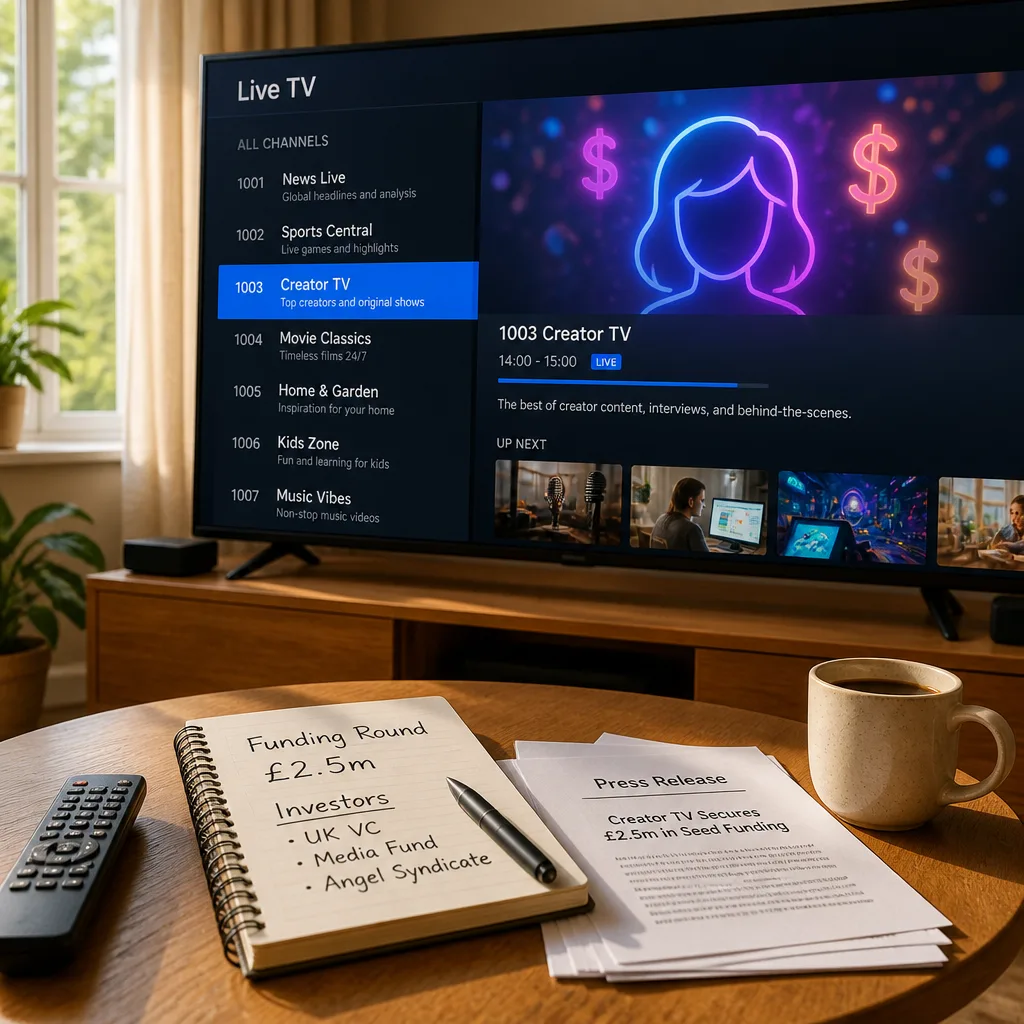
Fairground Entertainment has launched what it says is the first free ad‑supported streaming television (FAST) channel composed entirely of artificial intelligence‑generated video, signalling a bold experiment in how television can be produced and scheduled.
The channel, called Creator TV, went live this month and appears on The Roku Channel’s live guide among more than five connected TV and FAST platforms, according to trade reporting. Fairground announced the service in late July and has secured $4 million in funding led by Viant Technology.
Who’s behind it and what’s on offer?
The operation is run by Colin Petrie‑Norris, the former chief executive of Xumo, one of the early FAST platforms. Fairground says the schedule is assembled in the manner of traditional television, with programming slotted into primetime blocks and thematic specials timed to calendar events such as Halloween.
Creator TV sources material from more than 100 AI creators worldwide. Programmes are described as spanning science fiction, drama, animation, true crime and comedy, and the channel includes AI‑generated adaptations of public‑domain works such as Dracula and Robin Hood. Broadcast content is rated TV‑14.
- Backers: $4m raised, led by Viant Technology
- Distribution: live on The Roku Channel guide and multiple FAST/CTV platforms
- Creative contributors include Kelly Boesch, Phantom X Studio (Kavan the Kid), Ryan Phillips, Wonder Studios and Massive Studios
“premium”
Fairground markets the output as “premium”, positioning it against the familiar criticism that synthetic media still struggles to match human creators on craft and nuance.
Critical reaction and commercial logic
Early reviews have been unkind. Technology and culture sites described visual and narrative shortcomings — from awkward dialogue and unnatural pauses to strange physical movement — with one reviewer likening a medieval scene’s physics to a lunar landscape. Critics characterise the round‑the‑clock output as uneven, even grotesque in places.
Yet those qualitative judgements may be secondary to the business calculus. As a FAST channel, Creator TV is supported by advertising and distributed on platforms that programme large volumes of free content. The cost efficiencies of synthetic production and the ability to scale programming rapidly present a clear commercial attraction: lower production costs plus continuous inventory for ads can yield viable revenue even if the viewing experience is imperfect.
That divergence — heavy scepticism among reviewers but a plausible economics story for operators and investors — will determine whether Creator TV is a curiosity or the first of many channels exploiting synthetic supply chains for audiovisual material.
Questions that will matter going forward
Several issues will be watched closely by the industry and regulators alike:
- Quality and audience retention: will viewers tolerate the idiosyncrasies of AI‑generated visuals and acting long enough to create meaningful ad revenue?
- Attribution and rights: how will platforms and advertisers assess provenance, copyright and liability when content is machine‑made or trained on existing works?
- Ethics and disclosure: will services be transparent about synthetic origins, and how will that affect viewer trust?
Creator TV’s model — continuous, algorithmically assembled content plus AI‑generated commercials — is a proof of concept that forces these questions into the mainstream. Its backers, platform partners and the named contributors will be scrutinised as the channel accumulates viewing data and advertiser interest.
| Element | Detail |
|---|---|
| Channel | Creator TV |
| Funding | $4 million (led by Viant Technology) |
| Lead executive | Colin Petrie‑Norris (former Xumo CEO) |
| Content contributors | Kelly Boesch; Phantom X Studio; Ryan Phillips; Wonder Studios; Massive Studios |
| Distribution | The Roku Channel live guide; several other FAST/CTV platforms |
Whether Creator TV will be remembered as a harbinger of a low‑cost, high‑volume entertainment economy or as a short‑lived novelty will depend on metrics beyond critical opinion: viewer engagement, advertiser uptake and how quickly AI production improves. For now, the experiment is live — and the industry will be watching to see whether synthetic schedules can pay their own way.