
Proposed surcharge would sharply increase bills for second properties
Plans to introduce a council tax surcharge on second homes in Edinburgh have prompted fresh debate after columnists and commentators set out the likely scale of the charge and its potential effects on the local housing market. Critics argue the measure would produce very large increases in annual bills for owners of second properties and could have unintended consequences for property values in the city.
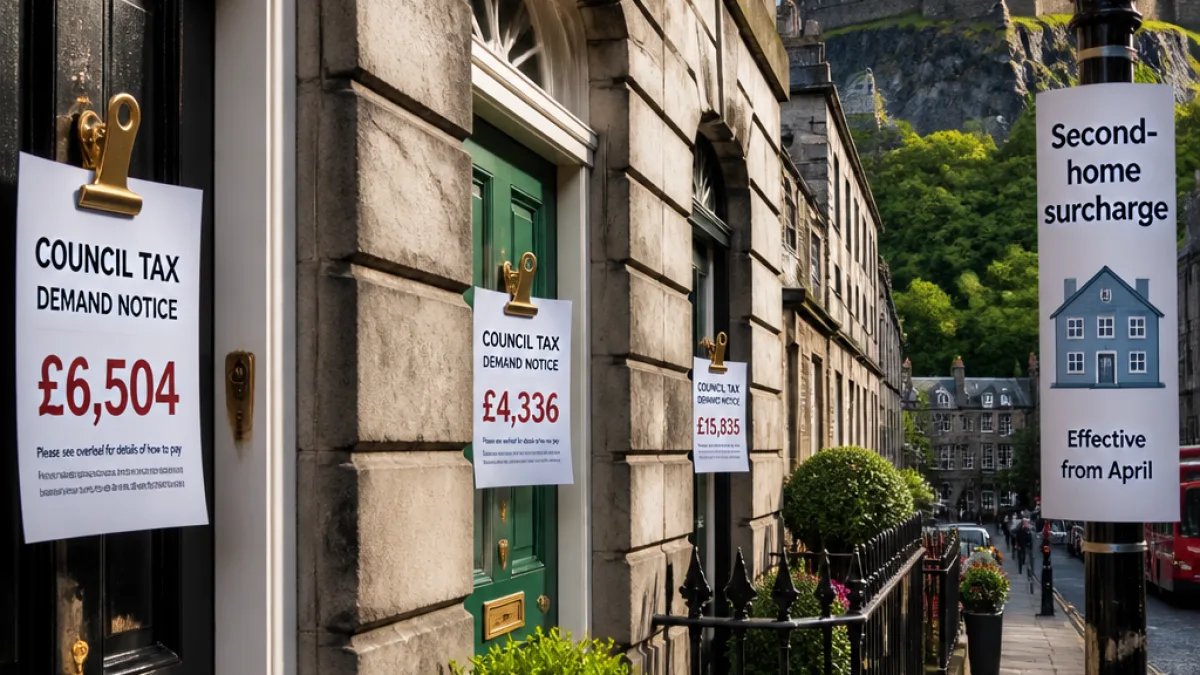
Analysis published this week highlights how a surcharge could raise council tax bills for Edinburgh’s 1,440 second homes, multiplying current charges by roughly four in the examples given. The figures shown include examples across council tax bands and demonstrate the scale of the proposed changes.
| Council tax band | Current charge cited | Charge with surcharge cited |
|---|---|---|
| Band A | £1,084 | £4,336 |
| Band D | £1,626 | £6,504 |
| Band H | £3,983 | £15,835 |
Those figures were published in a column which warned that, if the surcharge were applied as described, the annual bill for the lowest value property in band A would exceed the current charge on the most expensive band H properties. The column cautioned that the surcharge would be an ongoing annual charge rather than a one‑off levy such as stamp duty or capital gains tax.
"The second‑home surcharge takes the council tax for the lowest value property in band A to a hefty £4,336 – which is higher than the current charge on the most expensive properties in band H."
Concerns about market knock‑on effects and fairness
Commentators argue the policy could slow down sales of higher value properties and depress prices, which in turn might affect the values of other properties across Edinburgh. That argument rests on the expectation that buyers presented with much higher recurring costs may be less willing to purchase, or might seek lower offers to compensate for the increased annual liability.
Those critical of the surcharge also describe it as a departure from the original rationale of council tax — framed historically as a contribution towards local services such as education, social work, refuse collection and road maintenance — arguing that a second property does not proportionately multiply use of those services.
The column notes that council services are funded from a mix of sources, including business rates and central government grants, and points out that council tax has been subject to regular increases. In Edinburgh, the council tax for the current year was increased by 4 per cent by the local administration, the piece adds.
Political context and local debate
According to those attending council meetings referenced in the analysis, support for such taxes within local politics varies. The column suggests Labour is not necessarily the strongest advocate of the surcharge, while naming the Liberal Democrats, SNP and Greens as the keenest proponents. That political landscape signals potential cross‑party discussion if formal proposals progress at council level.
- Targeted group: 1,440 second homes in Edinburgh highlighted in the analysis.
- Illustrative annual bills: Band A could rise to £4,336; Band D to £6,504; Band H to £15,835.
- Local budget context: council tax in Edinburgh was increased by 4% this year.
For Edinburgh residents the debate is likely to centre on balancing the objectives of housing policy and fairness in contribution to public services against the possible economic impact on the city’s property market. Any move to introduce a formal surcharge would require detailed proposals from the council and scrutiny of their projected effects on households and on the local economy.
As the discussion unfolds, householders, landlords and prospective buyers in Edinburgh will be watching council deliberations closely to understand whether the proposed changes will be advanced and, if so, how they might be mitigated or targeted to avoid disproportionate effects.













