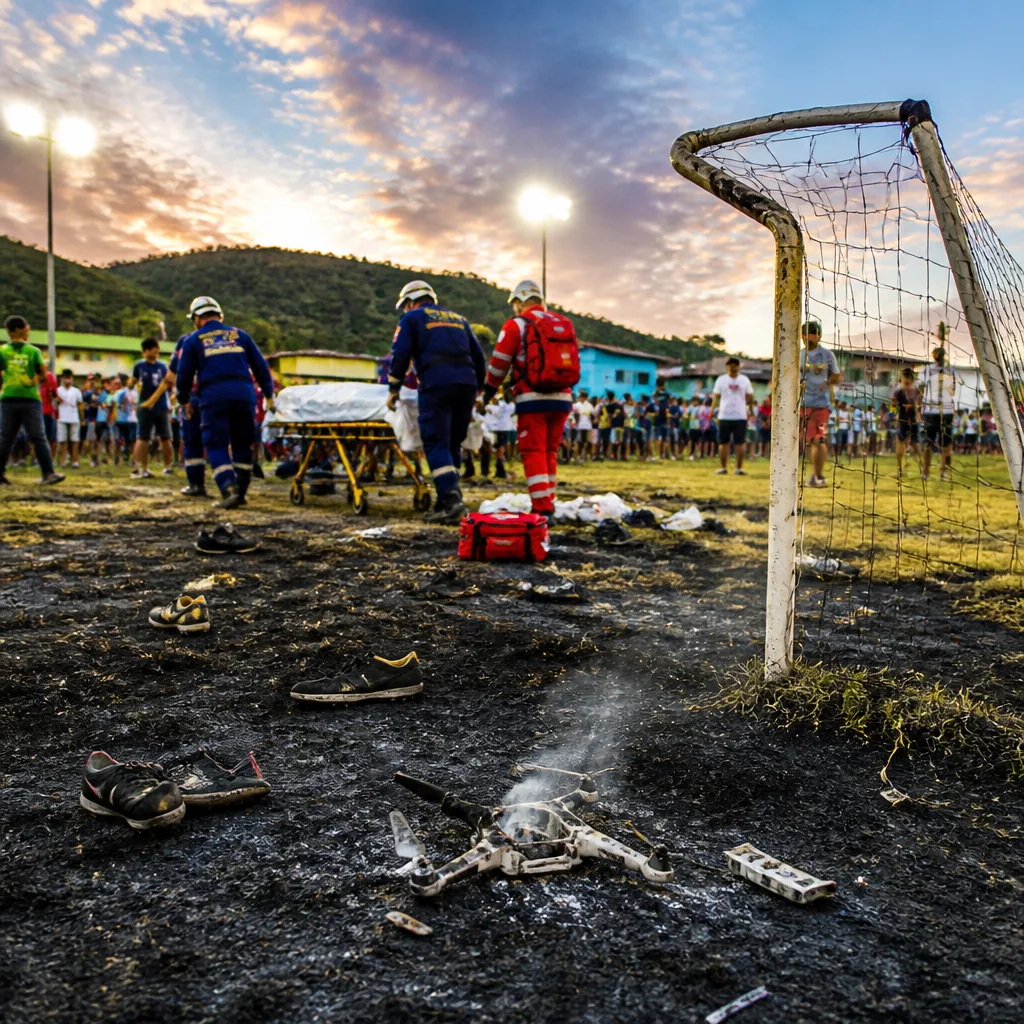
A drone carrying an explosive struck a community football pitch in El Plateado, Colombia, in the evening in July 2024, killing a 10‑year‑old boy and injuring a number of other children and adults, regional officials said. The attack, captured on social media, has been linked by Colombia’s military to a dissident FARC coalition known as the Jacobo Arenas Western Bloc (EMC).
Child killed, a dozen wounded
Video posted online showed the immediate aftermath of the blast: emergency responders tending to the wounded and a boy being carried on a gurney. The victim identified by local media was Dilan Camilo Erazo Yela, a 10‑year‑old described by his family and teacher as quiet and keen on cycling.
“He was a boy who had dreams, and one of them was to be a great cyclist,” Dilan’s uncle, Rubiel Yela, told Colombia’s Caracol Radio.
Regional authorities reported that the explosion wounded 12 people in total. Among the injured were an 11‑year‑old boy with a chest wound and a two‑year‑old girl later diagnosed with post‑traumatic stress disorder.
| Casualty | Details |
|---|---|
| Killed | One child — 10‑year‑old Dilan Camilo Erazo Yela |
| Injured | 12 people, including an 11‑year‑old (chest wound) and a 2‑year‑old (PTSD) |
Armed group blamed and wider implications
Colombian military spokespeople attributed the operation to the EMC, a grouping of dissident commanders who rejected the 2016 peace agreement between the government and the Revolutionary Armed Forces of Colombia (FARC). The EMC comprises former FARC fighters and has been implicated by authorities in a range of violent incidents since its formation.
The strike underlines a growing pattern of improvised aerial tactics in Latin America, where small unmanned systems are being repurposed as delivery platforms for explosives. The use of drones in populated areas adds complexity to both criminal investigations and military responses, complicating efforts to secure evidence and attribute responsibility.
- Immediate human toll: one child killed, a dozen wounded, families and a community traumatised.
- Attribution: Colombian military blames the Jacobo Arenas Western Bloc (EMC), a dissident FARC coalition.
- Legal and operational challenges: drones hinder accountability and increase the risk to civilians in public spaces.
Community impact and forensic challenges
Survivors of the blast and local authorities face both short‑term and long‑term harms. Beyond obvious physical injuries, authorities recorded psychological trauma in very young victims. Forensic investigators must contend with the difficulties of securing a chaotic scene and tracing delivery systems that may be small, mobile and quickly moved across rural terrain.
Cases of this type raise questions about the intersection of criminal law, counter‑insurgency operations and human rights protections. Where non‑state armed groups use aerial delivery methods against civilian targets, prosecutors and rights monitors must establish not only who launched an attack but whether it was directed at combatants or aimed indiscriminately at public spaces.
The incident in El Plateado is one of several in recent years that illustrate the shifting tactics of irregular armed organisations in Colombia. It also highlights the pressing need for improved detection and mitigation measures to protect civilians in rural and semi‑rural communities where security forces may be thinly stretched.
Authorities in Colombia continue to investigate the July 2024 attack and the military’s attribution to the EMC. The death of a child playing on a local pitch has renewed calls from community leaders and rights groups for stronger measures to prevent the weaponisation of drones and to secure accountability for attacks that strike at civilian life and daily routines.