
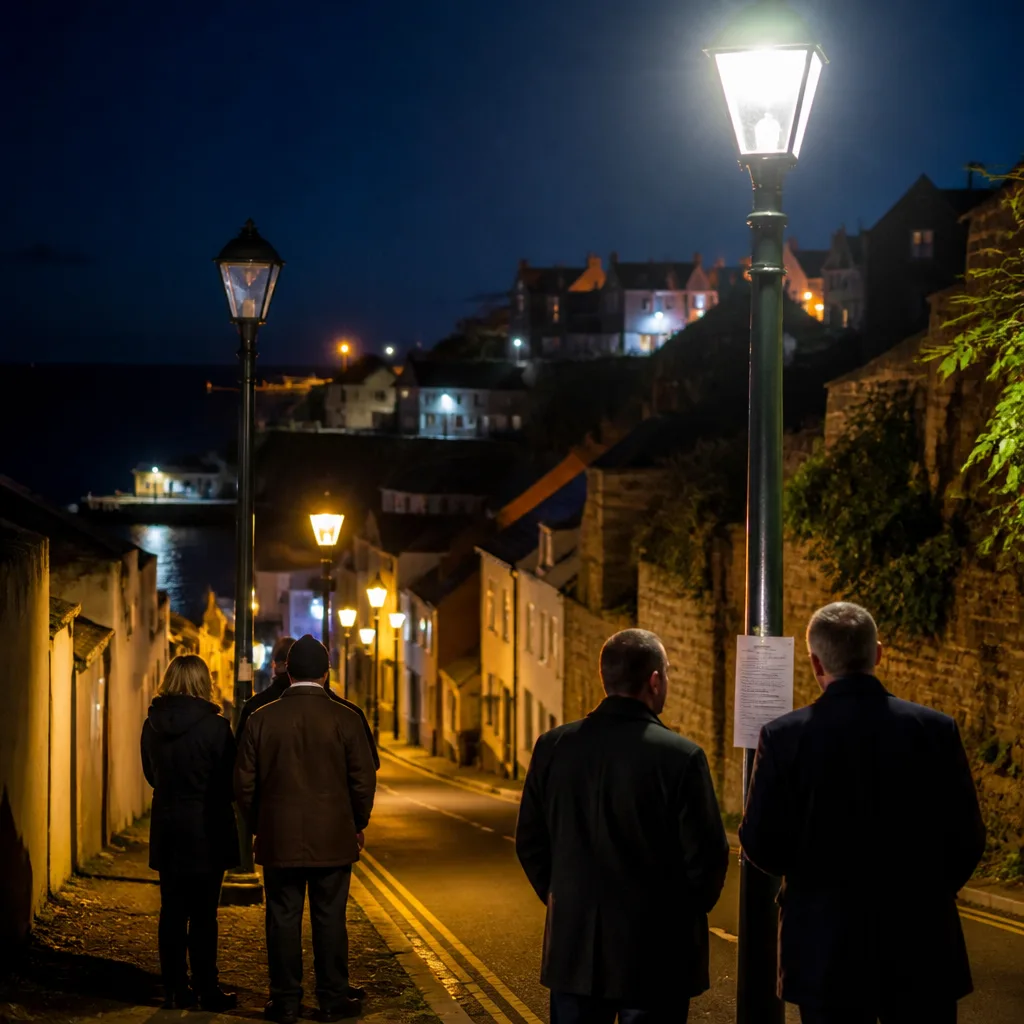
Town councillors in St Austell have voted to object to the latest phase of Cornwall Council’s streetlight switching-off and dimming scheme, warning that extended hours of darkness are likely to produce an increase in crime and anti-social behaviour.
Objection follows lack of local consultation
Members were told the final phase of the countywide programme will affect lighting across parts of the town. Some lights will be switched off between midnight and 05:00 from Sunday to Thursday and dimmed on Friday and Saturday between midnight and 05:00. Other columns will be turned off every night in that same overnight period. Councillors were assured that the lights in the town centre will remain unaffected.
| Area | Planned action | Hours |
|---|---|---|
| Most residential areas | Switched off | 00:00–05:00, Sunday–Thursday |
| Some residential areas | Switched off | 00:00–05:00, seven nights |
| Selected roads | Dimmed | 00:00–05:00, Friday–Saturday |
Councillors said the rollout had been implemented without formal consultation with town and parish councils or the public, and they expressed disappointment at a perceived lack of transparency.
Concerns for public safety and vulnerable residents
During a meeting, councillors highlighted the potential for increased thefts and burglaries and said the additional darkness raised particular worries for vulnerable groups, including women and children. The town council voted by 10 to 2 to record an official objection.
- The council objected “due to the well-known ASB (anti-social behaviour) and crime issues in this area and the strong likelihood that ASB and crime will increase as a result of the additional periods of darkness”.
- Councillors unanimously resolved to ask the town clerk to write to Cornwall Council to complain about the lack of consultation and to seek an apology.
- Town centre street lighting will not be affected by the changes, according to the information presented to councillors.
Cornwall Council has previously said the programme is intended to reduce energy consumption and save money, and that it will also cut light pollution. An interactive map published by the county authority shows most of the lights affected in St Austell are in residential areas; busier roads largely remain outside the scheme.
Implications for policing and crime prevention
The dispute in St Austell underscores a wider tension between local authorities’ attempts to reduce costs and environmental impacts and community concerns about safety. Reduced street lighting can hamper natural surveillance, potentially affecting how residents perceive safety and how easily crimes can be prevented or detected.
Town councillors have used their formal channels to register their objections and to demand a clearer, more transparent consultation process. The council’s move to seek an apology signals both the strength of local feeling and a determination to press for reconsideration or mitigation measures where public safety might be compromised.
Any change that alters visibility overnight will be watched closely by community groups, policing bodies and neighbouring councils. Where similar schemes have been adopted elsewhere, authorities have sometimes introduced targeted measures — such as retaining lighting near vulnerable housing, transport hubs or high-crime streets — to reduce unintended consequences.
For now, St Austell’s town council has set out its position and requested further engagement from Cornwall Council while residents and local organisations wait to see whether the county will respond to the objections or adjust its plans.














