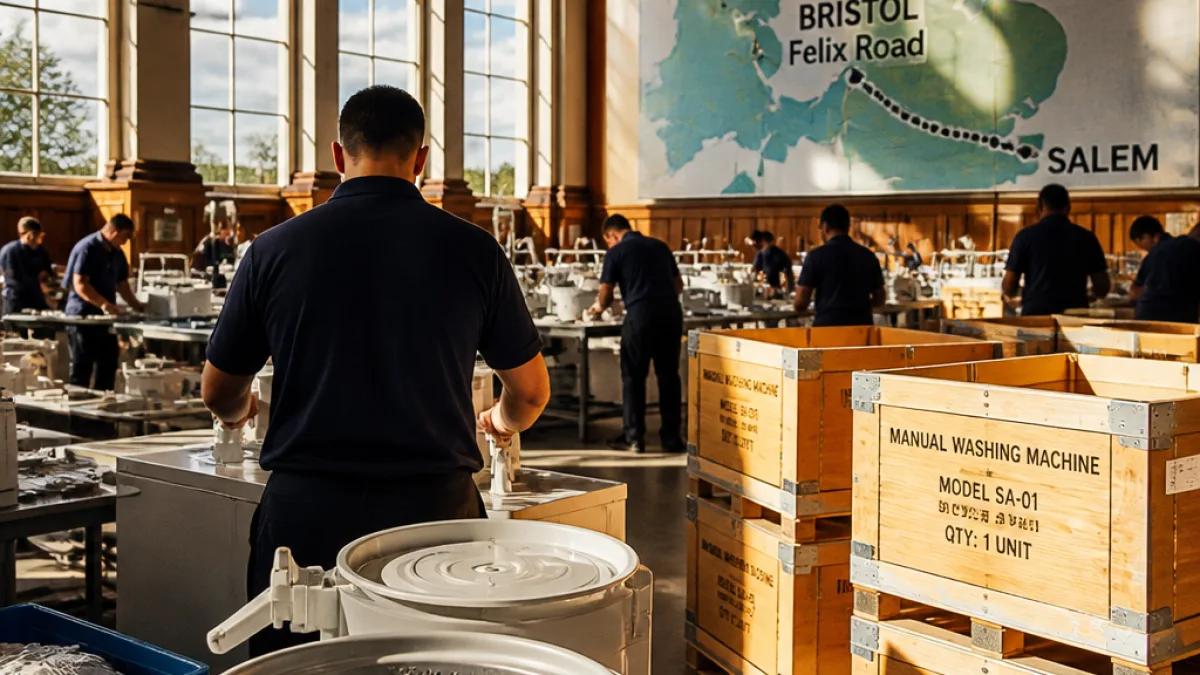
The Bristol social‑engineering venture behind a manual washing machine designed for communities with limited water and electricity has taken a significant step by opening a manufacturing and support hub in Salem, Tamil Nadu, in south India. The move marks what the team described as a "full‑circle" moment for the organisation, which is headquartered on Felix Road in Easton.
From Easton to Salem — scaling a low‑tech solution
The Washing Machine Project was founded in 2018 by Navjot Sawhney after he witnessed the burden of handwashing during a chance encounter in India. The organisation produces a compact, flat‑pack manual washing machine — the first prototype was named after the woman who inspired the design — intended for use where clean water and electricity are scarce.
According to the organisation, the machines require no electricity and use around 50% less water than traditional handwashing methods. The design has been used in a wide range of settings internationally, including Gaza, Greece, the Democratic Republic of Congo and Uganda.
Local roots, global reach
The Felix Road base in Easton remains the charity’s headquarters and design centre. The team says the project has already reached about 105,000 people worldwide and was named by Time magazine among the publication’s "The Best Inventions of 2025".
The new hub in Salem is intended to move the venture from prototype and small‑scale distribution to higher‑volume manufacture and local support. The organisation has set a target of producing 10,000 machines a year at the Indian facility, and estimates that if the plan proceeds as intended it could impact up to 1 million people in India.
- Headquarters: Felix Road, Easton, Bristol
- Founded: 2018
- People reached so far: approximately 105,000
- Target production at Salem hub: 10,000 machines/year
- Estimated potential impact in India: up to 1 million people
"A full‑circle moment" — the team described returning to where the idea began as they opened the manufacturing and support hub in Tamil Nadu.
Practical design for challenging settings
The project’s machines are promoted as being easy to repair and flat‑packable for transport — attributes that help with distribution to remote or resource‑constrained locations. The organisation says the machines have been deployed in conflict zones and other areas where water and power are intermittent or costly, and that the design can reduce the time spent on laundry tasks by women and girls in particular.
For Bristol, the expansion illustrates how a small local team can develop a product in the city’s engineering ecosystem and scale it internationally while maintaining links to its Easton base. The move to manufacture in Tamil Nadu also aligns production nearer to large potential user bases in India, while creating capacity for higher volumes and local support networks.
| Metric | Figure |
|---|---|
| People reached to date | 105,000 |
| Production target (Salem hub) | 10,000 machines/year |
| Estimated water saving | 50% less water |
| Potential impact in India | 1,000,000 people (target) |
Local campaigners and social enterprises in Bristol have in recent years emphasised the value of engineering solutions that are affordable, repairable and locally supported. This development provides a case study in how a city‑based team can combine community‑oriented design with international manufacturing partnerships to scale impact.
As the Salem hub becomes operational, the organisation will face practical tests around logistics, quality assurance and after‑sales support — areas that will determine whether the target production rates and the projected reach in India can be realised. For now, the opening will be welcomed in Bristol as evidence that a small, locally founded project can win global recognition and expand its capacity to serve communities in need.