
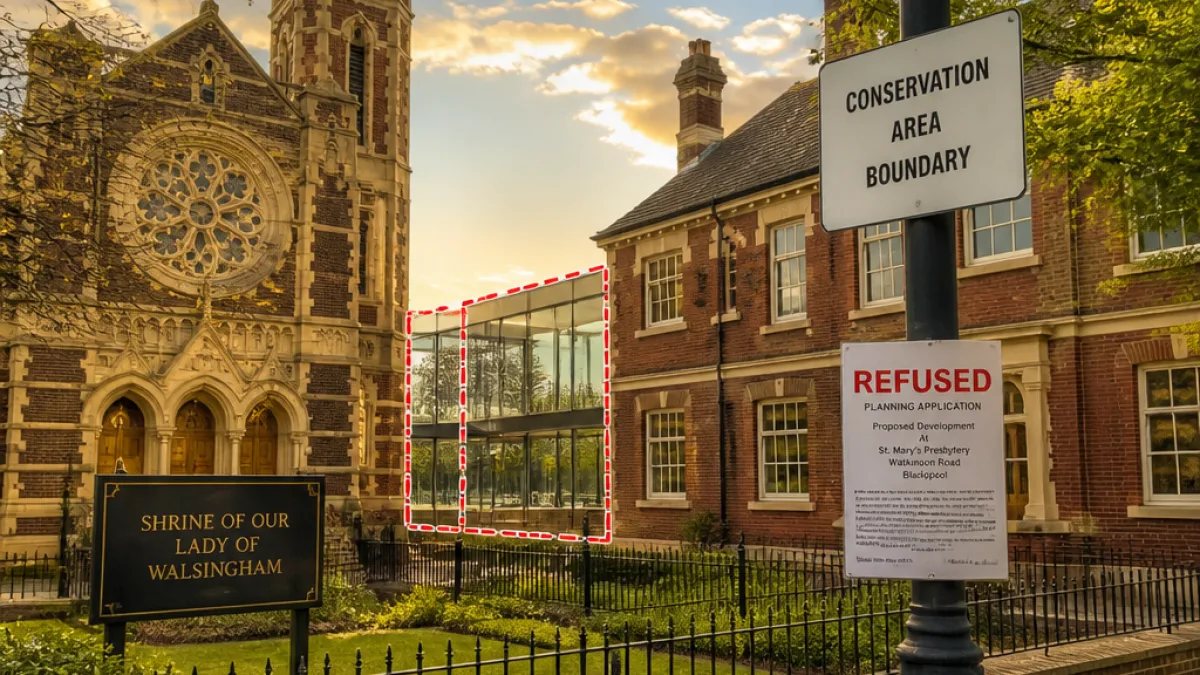
Blackpool Council planning officers have recommended refusal of a scheme that would have joined the Shrine church to the neighbouring Cygnet Newton House, a 21‑bed specialist rehabilitation service for adult men with complex mental health needs.
Officer cites lack of local need and heritage harm
The applicant, Cygnet – which owns and operates Newton House – had been in the process of purchasing the Shrine church from the Historic Chapels Trust, which is closing its operations. In reports prepared for the planning case officer, the proposals were criticised on two principal grounds.
- The officer said the applicant had “failed to demonstrate” there was a “locally generated demand” for additional beds and that the plans were “not supported by the relevant commissioning managers.”
- The proposed physical extensions to link the church and the existing facility were judged to be “incongruous additions to the site” and likely to be “significantly harmful to the character, quality and significance of the non‑designated heritage asset and the Stanley Park conservation area.”
“The applicant had failed to demonstrate there was a locally generated demand… extensions proposed would be incongruous additions… significantly harmful to the character, quality and significance of the non‑designated heritage asset and the Stanley Park conservation area.”
What the decision means locally
The officer recommendation raises two immediate issues for Blackpool residents. First, it leaves uncertain the future use of the Shrine church building now being sold by the Historic Chapels Trust. Second, it puts on hold plans by a private mental health provider to expand an existing local service.
The council’s concerns about a lack of evidence for local commissioning support mean the proposal does not currently align with the way health and social care services are planned and funded. Commissioners – the bodies responsible for assessing local need and purchasing services – did not back the application, according to the planning report.
Heritage and conservation arguments
Planners placed considerable weight on the building’s setting. Although described as a non‑designated heritage asset, the Shrine sits within the Stanley Park conservation area, an area where changes to historic buildings are carefully controlled to protect character and appearance.
| Issue | Officer finding |
|---|---|
| Local demand for beds | Not demonstrated; no support from commissioning managers |
| Design and site impact | Extensions judged incongruous; significant harm to heritage and conservation area |
| Ownership | Historic Chapels Trust disposing of the building; Cygnet in process of purchase |
Next steps and wider context
The planning officer’s advice is a key stage but not the final word. Applications typically go before elected councillors on the planning committee, who will decide whether to accept the officer recommendation or grant consent. Any decision could be subject to future appeals by the applicant if refused.
For residents, the case highlights the tensions that often arise when healthcare provision and heritage conservation intersect. Providers say repurposing and expanding existing buildings can offer efficient ways to deliver services close to communities. Conservationists and planners counter that sensitive historic settings require careful protection from changes that would erode local character.
At this stage, the council report makes clear the application did not persuade officers that the benefits outweighed the harms. That leaves the Shrine church’s future uncertain and the Cygnet proposal stalled pending the council’s formal decision process.
WE NEWS will follow the planning committee timetable and report any decision and its potential consequences for local services and the conservation area.















